

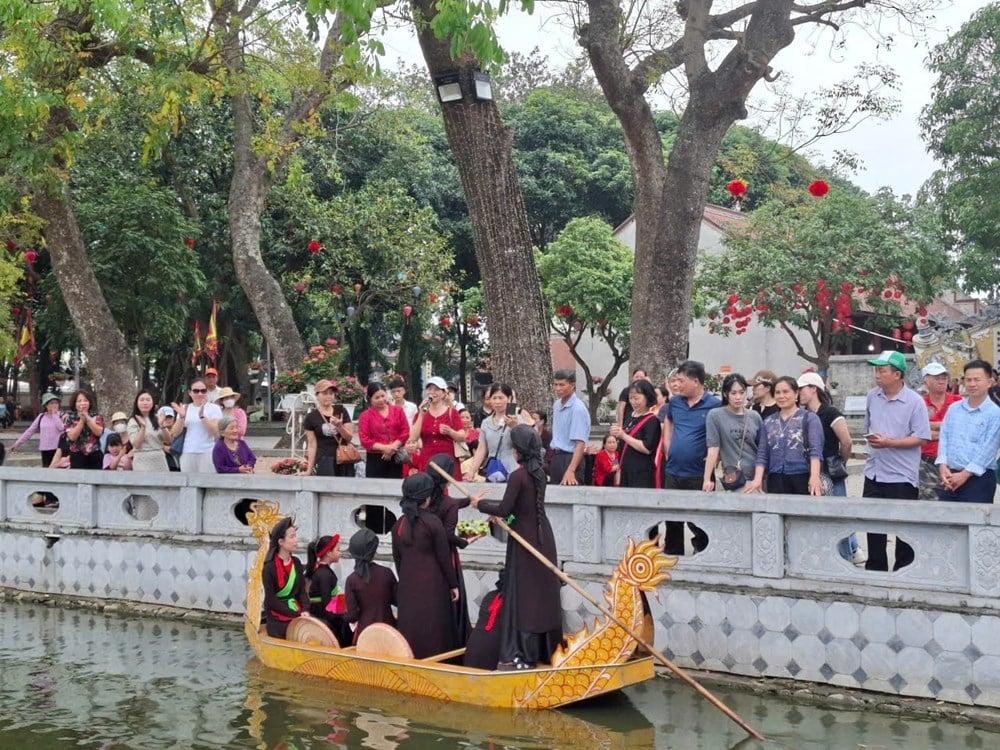
Tourists enjoy and interact with Quan Ho folk singers at the Do Temple. Photo: N. Huu
High potential for development
Located on the southern bank of the Duong River, in Song Ho ward, Thuan Thanh town, Bac Ninh province (about 16 km from Bac Ninh city) and very close to Hanoi, Dong Ho painting village, with a history of over 400 years, has long been one of the famous tourist destinations, attracting visitors not only because of its proximity and time, but also because of its rural atmosphere, from the paintings to the simple daily life of the local people.
To get to Dong Ho painting village, visitors can follow National Highway 38, cross Ho Bridge, turn right onto Thien Duc Road, and follow the embankment for about 2 km; or from Hanoi , visitors can take bus route 204.
Here, visitors can immerse themselves in the traditional culture of the craft village, along with customs, festivals, and familiar images of old rural life such as chickens, pigs, the mouse wedding, coconut harvesting, etc.
In particular, visitors are guided by artisans through the painting process to better understand the unique techniques of printing and creating colors from natural plants. In addition, visitors can immerse themselves in the atmosphere of the ancient Tranh Temple and the Dong Ho Folk Painting Conservation Center, a massive structure with a landscape and architecture deeply rooted in tradition.
Here, visitors can tour the exhibition hall, learn about the history and development of Dong Ho painting, immerse themselves in Quan Ho folk songs performed by artisans, and take beautiful photos with many unique and impressive architectural angles and check-in spots.
When it comes to experiencing traditional craft villages, visitors cannot miss the Phu Lang pottery village, established in the 14th century, located on the banks of the Cau River in Que Vo town. It was recognized as a National Intangible Cultural Heritage in 2016. Currently, the Vietnam Historical Museum still preserves and displays some Phu Lang pottery products dating from approximately the 17th to 19th centuries.
Phù Lãng pottery is distinguished by its natural, durable, and unique glaze colors, its rustic and simple yet robust shapes, embodying the pristine beauty of the earth and a strong sculptural character. A prominent feature in Phù Lãng pottery decoration is the use of relief sculpting in the form of double carving, which the people of Phù Lãng call "double carving," with themes such as: the Four Sacred Animals, mythical creatures (Nghê), cranes, tiger faces, the character for longevity, scroll patterns, lotus petals, and waves...
The Phù Lãng pottery village once faced the risk of disappearing, but now, with over 200 kilns constantly burning, the craft has been revived. For pottery makers, being able to make a living from their craft is precious, so despite the hard work, their love for the profession remains unchanged.
Besides being a place that keeps the flame of traditional crafts alive, Phu Lang pottery village is also an attractive tourist destination for those who love to explore traditional culture and lifestyles.
When visiting Phu Lang pottery village, tourists have the opportunity to learn about the pottery-making process from kneading the clay, shaping, applying patterns to firing the pottery - a process that requires a lot of effort and dedication from the craftsmen.
Beyond simply observing, visitors can also directly participate in creating products in their own unique style. This is a truly unique experience, helping visitors gain a deeper understanding of the skill and talent of the artisans.
Beyond the pottery-making experience, Phu Lang pottery village also offers visitors peaceful rural landscapes. The small alleyways, imbued with poetic and distinctly Vietnamese charm, the beautifully arranged kilns, and the stunning finished Phu Lang pottery products displayed with vibrant, rustic yet sophisticated patterns and motifs—all combine to create a space steeped in the traditional art of Bac Ninh - Kinh Bac region.
According to statistics, Bac Ninh currently has 1,589 historical sites (including 5 special national-level sites, 206 national-level sites, and 466 provincial-level sites); and 19 artifacts or groups of artifacts recognized as National Treasures.
Bac Ninh also has 4 UNESCO-listed heritage sites: Bac Ninh Quan Ho folk songs, Ca Tru singing, Huu Chap tug-of-war ritual and game, and the Tam Phu Mother Goddess worship belief of the Vietnamese people; and 8 intangible cultural heritage sites included in the National List of Intangible Cultural Heritage.
In addition, there are 599 traditional festivals maintained and organized annually by local communities; 120 craft villages, including 62 traditional craft villages; and a rich variety of folk performing arts such as Tuong, Cheo, Trong Quan, water puppetry, and folk games are preserved and maintained.
To further enhance its potential and strengths, Bac Ninh is currently prioritizing investment in tourism services, leveraging the province's tourism resources to create a system of high-quality, unique tourism products that meet the needs of tourists; developing "green" tourism products, prioritizing cultural tourism, community tourism, river tourism, ecotourism, and rural agricultural tourism.
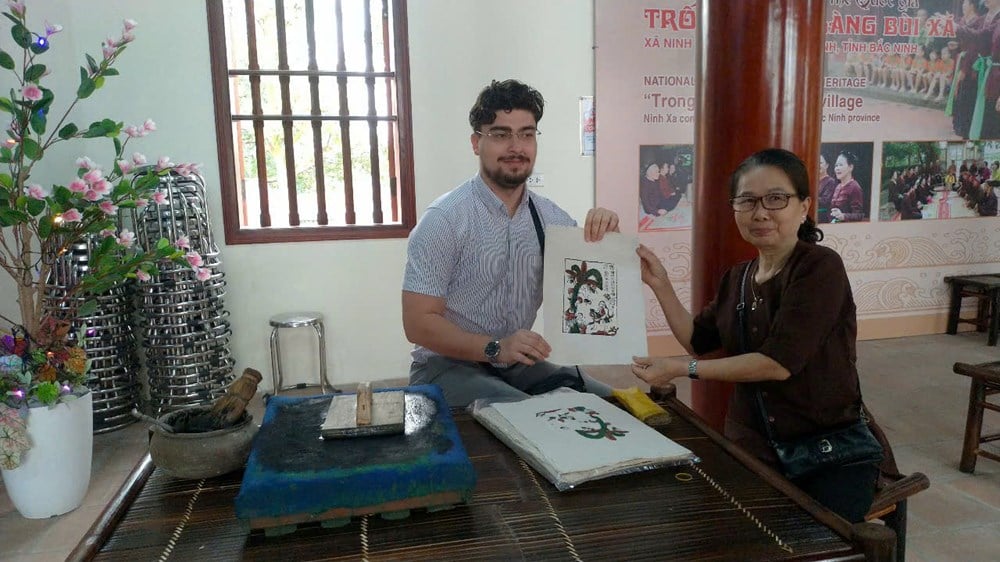
Experience making Dong Ho folk paintings at the Dong Ho Folk Painting Conservation Center. Photo: B. LONG
A diverse range of tourism products including experiential, cultural, spiritual, and resort tourism.
Currently, many tourists prefer agricultural and rural tourism models because of their affordable cost, the opportunity to relax and immerse themselves in a fresh, peaceful environment, and enjoy delicious, safe fresh fruits right from the orchards, as well as buy them as gifts for friends and relatives.
In Bac Ninh, notable attractions include the Quan Ho Folk Song Tourism Area in Hoa Long Ward, Bac Ninh City, offering resort and eco-tourism experiences, as well as opportunities to explore cultural values, especially Bac Ninh Quan Ho folk songs, connected with the Ba Chua Kho Temple Cultural and Festival Tourism Area (Bac Ninh City), and the Nhu Nguyet Battlefield Historical Tourism Area...
Besides experiencing Dong Ho painting and Phu Lang pottery making, tourists can also visit many famous craft villages such as Dong Ky and Phu Khe wood carving villages, Da Hoi iron forging villages, Dinh Bang sticky rice cake villages, Dai Bai bronze casting villages, and Xuan Hoi rattan weaving villages; or participate in agricultural and ecological tourism tours such as Green Farm (Tien Du), Thu Thuy (Tu Son City)...
According to Mr. Nguyen Trung Khue, Deputy Director of the Department of Culture, Sports and Tourism of Bac Ninh province, the combination of traditional and modern elements, and the blend of spirituality and experiential tourism is creating a new attraction for Bac Ninh tourism, attracting domestic and international tourists. In 2024 and the first months of 2025, the growth rate of tourist arrivals in Bac Ninh is projected to increase to 40% per year.
According to the plan for 2030, one of the four priority tourism product lines for Bac Ninh is experiential tourism activities focusing on authentic cultural heritage spaces, traditional craft villages, and original Quan Ho villages: ancient houses, folk games, learning Quan Ho folk singing, and vocational training. The province also aims to develop a high-tech agricultural tourism model – where tourists experience farming combined with entertainment and relaxation.
"To diversify products, the province has researched and restored the culinary cultural space of Quan Ho villages, initially forming culinary service packages in Quan Ho villages or areas with community tourism activities, and organizing pilot programs in Diem area, Bac Ninh City."
Continue developing OCOP products associated with tourism activities; research and plan the development of night-time food streets in Bac Ninh City and Tu Son City; guide travel companies in building and developing model tours, routes, and tourist destinations; provide guidance on the art and skills of preparing dishes with strong traditional cultural characteristics, creating novelty for tourists, especially international visitors.
At the same time, the province is implementing a pilot project to develop OCOP tourism products for the period 2023-2025 with a total budget of over 60 billion VND, focusing on agricultural tourism, traditional craft villages, and cultural heritage. The province also aims to develop green, sustainable tourism that reflects the unique cultural identity of Bac Ninh - Kinh Bac," said the Deputy Director of the Department of Culture, Sports and Tourism of Bac Ninh province.
Besides visiting traditional craft villages, exploring historical and cultural relics, and attending festivals, many models of agricultural farm investment combined with tourism, photo opportunities, and purchasing agricultural products have emerged in various districts.
Typical examples include Delco Farm, a high-tech agricultural farm in Thuan Thanh town; the model of growing perilla in greenhouses in Luong Tai district; Ngam Mac Safe Vegetable Cooperative in Gia Binh district; and Liem Anh Farm, a center for experimental production of high-tech applied agriculture, in Tien Du district...
According to Mr. Nguyen Trung Khue, based on the unique cultural foundation and rich heritage system of the Kinh Bac region, the province is also promoting experiential tourism and historical and cultural exploration through visiting historical sites such as Do Temple, Dau Pagoda, Phat Tich Pagoda, But Thap Pagoda, Kinh Duong Vuong Mausoleum, and participating in traditional festivals such as the Lim Festival, Dau Pagoda Festival, Do Temple Festival, etc.
The provincial tourism sector has been and continues to advise on the development and replication of tourism models linked to agriculture and rural areas; organize promotional activities for rural tourism destinations and products within and outside the province; develop community tourism associated with the construction of new rural areas; integrate the promotion of community tourism destinations with tourism programs and events in particular, and cultural, artistic, and sports activities in general; guide and encourage organizations and individuals to exploit and develop rural tourism; guide localities in implementing plans to preserve, restore, and exploit traditional cultural values to serve the development of rural and community tourism...
According to Culture Newspaper
Source: https://bvhttdl.gov.vn/bac-ninh-thuc-day-phat-trien-du-lich-nong-thon-2025060215462818.htm











![[Photo] Election atmosphere at polling station No. 7, Xuan Dinh ward, Hanoi city](https://vphoto.vietnam.vn/thumb/402x226/vietnam/resource/IMAGE/2026/03/15/1773543204075_img5935-1773539854991135573309-154-0-1707-2484-crop-17735409472061858573395.jpeg)
![[Photo] Prime Minister Pham Minh Chinh receives the Chinese Ambassador to Vietnam](https://vphoto.vietnam.vn/thumb/1200x675/vietnam/resource/IMAGE/2026/04/05/1775397481797_ndo_br_dsc-5512-jpg.webp)




















































Comment (0)