

The rhythmic sound of bamboo poles striking the water, the lively shouts and calls to each other, create a picture of rustic life, rich in the spirit of the riverside countryside.
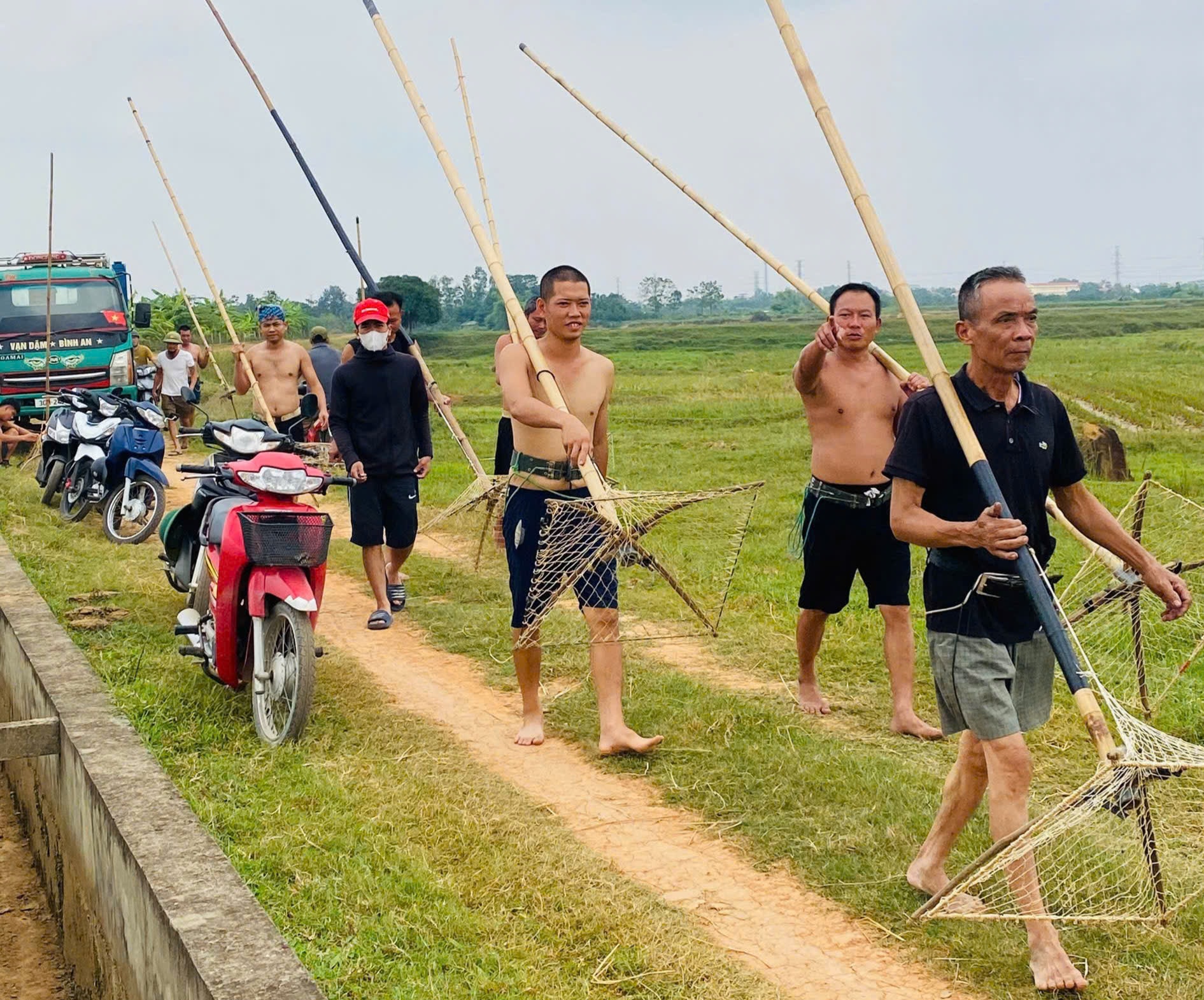
According to legend, the custom of using poles to catch fish in Tich Giang has existed since ancient times, associated with the ancient Tuong Phieu communal house - a place of worship for Saint Tan Vien, the leading deity of the "Four Immortals" in Vietnamese folk beliefs. Locals say that it was Saint Tan Vien who taught the people how to weave fishing nets, make poles, and construct cranes to catch fish on the Tich River.
To commemorate the benevolence of the Saint, the villagers built a temple to worship him and preserve this traditional craft as a unique cultural feature. During each temple festival, the villagers choose the largest fish caught during the fishing season to offer to Saint Tản, expressing their gratitude.
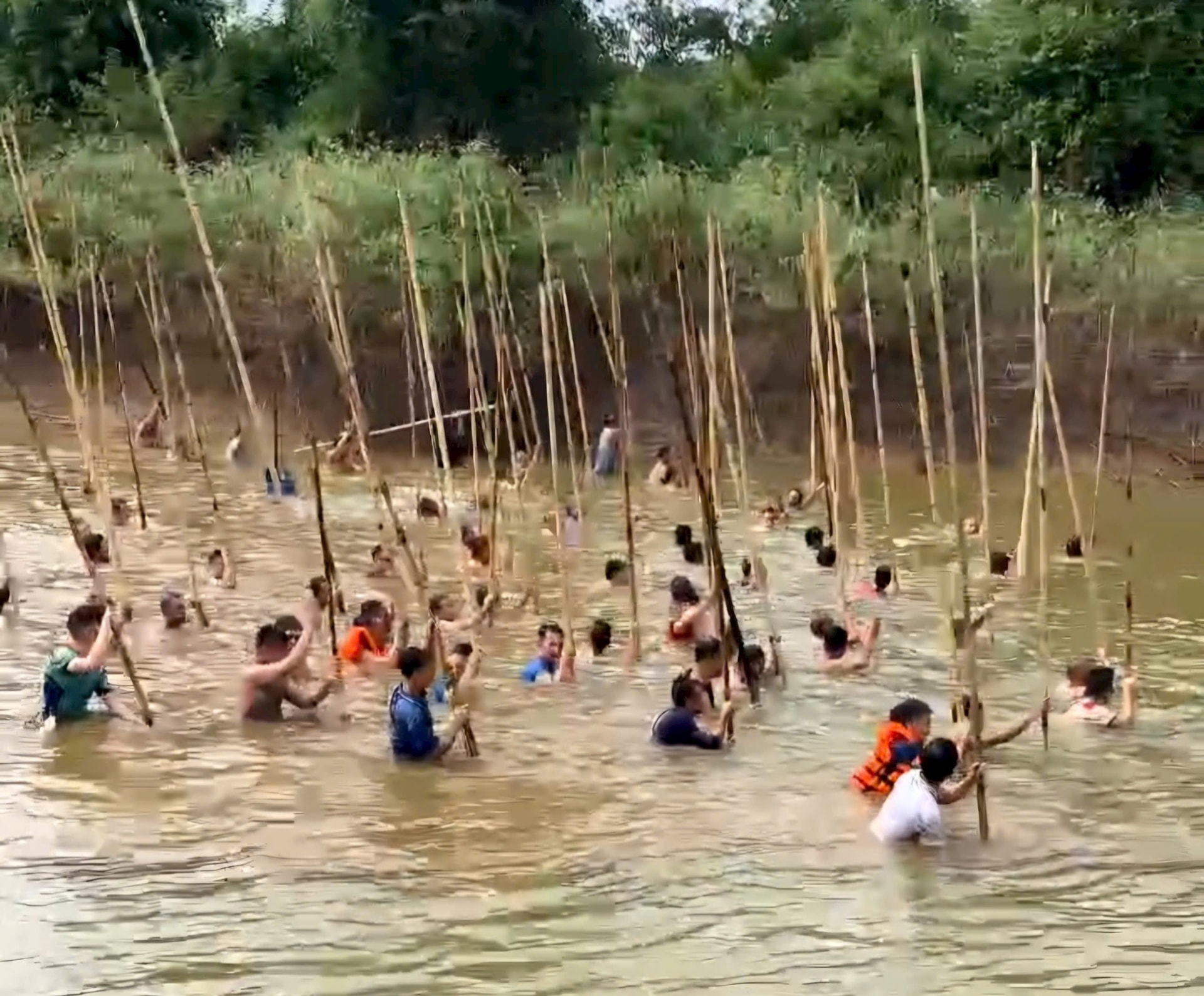
Mr. Nguyen Tien Cuong, a resident of Tuong Phieu village, shared: “From around August to October in the lunar calendar, when the heavy rains stop, less water flows from Ba Vi mountain, the river dries up, and the fish gather in the deeper sections… that’s the ideal time to go fishing with poles.” The fishing tools of the Tich Gang people are very simple: a conical bamboo frame, with nets on all four sides, and the top connected to a long bamboo handle extending beyond the water surface.
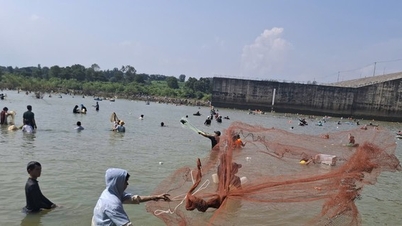
When they go down to the river, the men stand in a line, holding bamboo poles and forcefully striking them against the water. Any fish that gets caught in the net will struggle to escape, and with experience, the man striking the pole will immediately recognize it, either lifting the pole to remove the fish from the net or diving down to catch it.

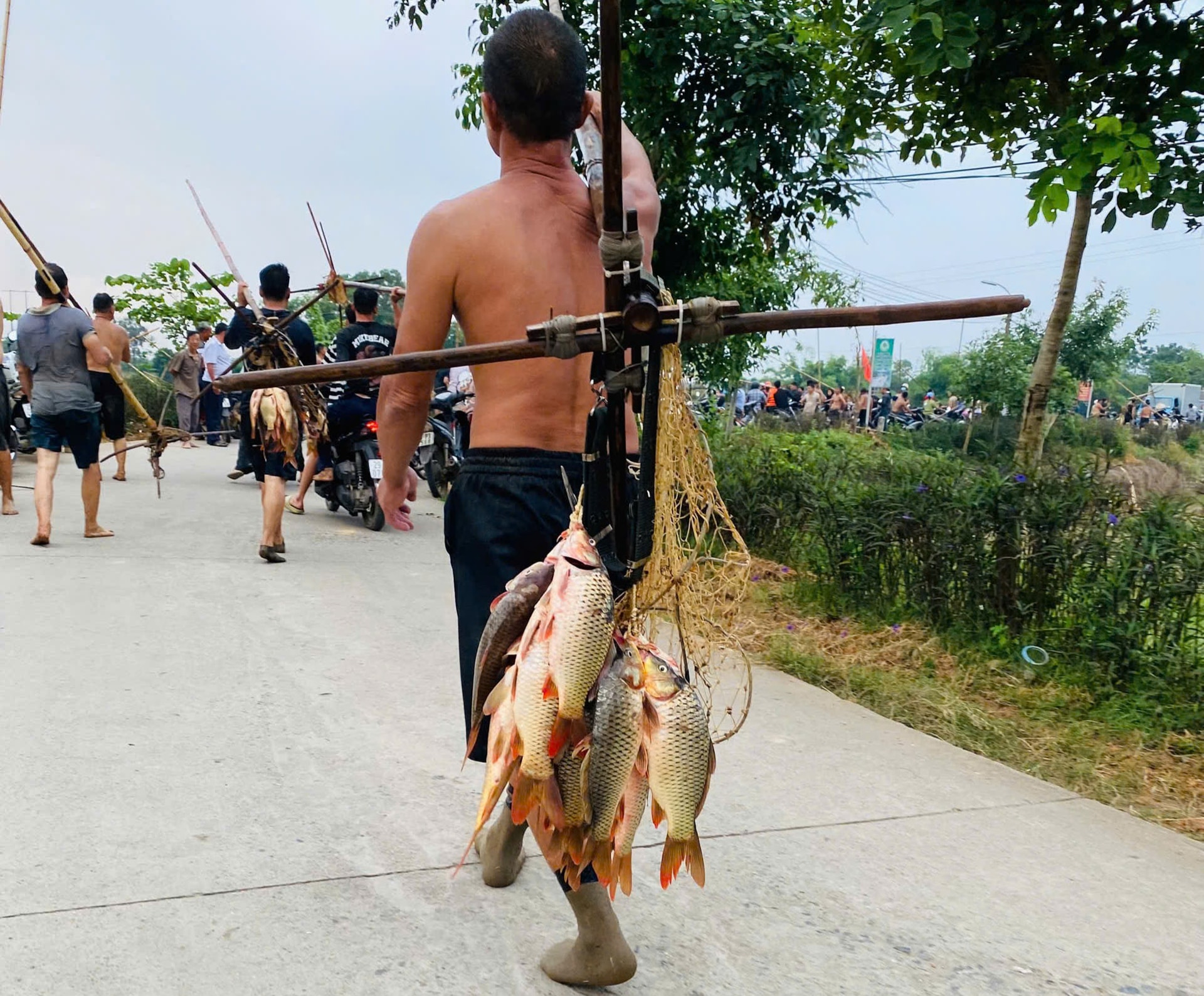
These days, on weekends, people in Tich Giang gather to fish in the river. Some days, the group grows to 60-80 people, setting up their nets. After a fishing session, almost everyone gets a string of fish to take home. Some people catch up to ten kilograms in a single session. "The fish in the Tich Giang River are mainly carp, because this species lives near the bottom and is easily caught in nets. Because it's wild fish, the meat is firm and very flavorful. We locals only bring them home to eat; few sell them," added Mr. Cuong.
Despite numerous changes over time, the traditional fishing method using poles is still preserved by the people of Tich Giang as a unique cultural feature. According to Nguyen Van Cong, Vice Chairman of the People's Committee of Phuc Tho commune, Tuong Phieu means "gentle breeze." This ancient village is famous for its communal house, which is classified as a National Monument with unique architecture, and the Tuong Phieu communal house festival is also recognized as a National Intangible Cultural Heritage. Besides preserving cultural heritage, the people of Tuong Phieu are also excelling in flower and ornamental plant cultivation, linked to ecotourism . Recently, the Hanoi Department of Tourism recognized "Tuong Phieu Flower Colors" as one of the city's outstanding new tourism products for 2025.

According to the leaders of Phuc Tho commune, the custom of using poles to catch fish on the Tich River is a unique cultural space, reflecting the strong bond between people and nature. It is these folk activities that have created a distinct identity for the land along the Tich River. “We hope to preserve and promote the value of the pole-fishing custom as part of rural experiential tourism. Through this, we not only help people increase their income, but also awaken pride and strengthen community bonds, especially among the younger generation, with their roots in their homeland,” shared Nguyen Van Cong, Vice Chairman of the People's Committee of Phuc Tho commune.
Source: https://hanoimoi.vn/dac-sac-tuc-dap-sao-bat-ca-o-tich-giang-721930.html
![[Image] National Assembly discusses the implementation of the socio-economic development plan.](https://vphoto.vietnam.vn/thumb/1200x675/vietnam/resource/IMAGE/2026/04/20/1776696707422_ndo_br_img-20260420-185419-jpg.webp)

![[Photo] General Secretary and President To Lam meets with National Assembly delegates from ethnic minorities.](https://vphoto.vietnam.vn/thumb/1200x675/vietnam/resource/IMAGE/2026/04/20/1776696701056_a1-bnd-8331-3342-jpg.webp)


![[Photo gallery] Flock to the foot of Tri An dam to 'hunt for nature's bounty' after the largest hydroelectric plant in Southern Vietnam closes its floodgates.](https://vphoto.vietnam.vn/thumb/402x226/vietnam/resource/IMAGE/2025/10/19/1760858793060_5_20251019135535.jpeg)
































































Comment (0)