

According to Luyen Quang Kien, paying attention to specific data and using persuasive arguments is the key to achieving a 9.0 score in the IELTS Writing test.
Kien, a 31-year-old English teacher from Hanoi , is the first person to achieve a 9.0 in all four IELTS skills – Listening, Speaking, Reading, and Writing – after taking the computer-based test on June 3rd.
According to Kien, Writing is the most difficult skill to score a perfect 9.0 in. Despite achieving a 9.0 overall score (average of the four skills, rounded to the nearest 0.25) five times, Kien has only scored 9.0 in the Writing section twice.
This test consists of two parts: Task 1 and Task 2, each worth a maximum of 9 points. The four grading criteria are task completion, vocabulary, grammar, and coherence, with the first criterion being the most important.

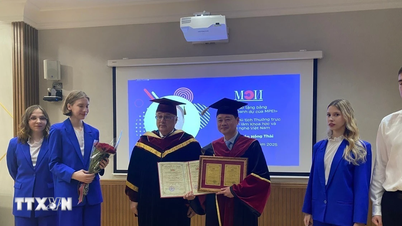
Kien is the first person in Vietnam to achieve a 9.0 in all four IELTS skills. (Photo: Provided by the subject)
Here's Kien's advice on how to tackle Task 1 and Task 2 of the IELTS Writing test:
Pay special attention to the details in Task 1.
Kien believes that candidates find it difficult to achieve a perfect score in the Writing skill because they score low in Task 1. This section presents charts in various forms, requiring candidates to analyze, compare, contrast, and process data over a specific period.
"If you rely solely on the formula, candidates will only get 6-7 points for the task completion criterion. To achieve a high score, you need to know how to compare key points and use vocabulary flexibly," Kien said.
He gave an example from Task 1 of the June 3rd exam, which was a line graph comparing the unemployment rate of the United Kingdom with the rest of Europe and Japan. Kien identified specific information in the graph such as the highest, lowest, peak, trough, areas that remained unchanged, and areas that crossed each other.
"Things like highest, lowest, and most significant changes are very important. Candidates should only compare places where there are significant changes," he said.
Mr. Kien noted that in Task 1, in addition to the introduction and conclusion, candidates need to state the reason for each paragraph in the body of the essay. He divided the body into three paragraphs, focusing on the United Kingdom, Europe, and Japan, because he clearly saw a trend. In the first two years, the unemployment rate in the United Kingdom was the highest, and then it dropped sharply, giving way to the rest of Europe. He also mentioned that Japan consistently had the lowest unemployment rates.
Persuasive argumentation in Task 2
Unlike Task 1, Task 2 is a social commentary essay, requiring candidates to present arguments to prove their point and discuss it persuasively. Kien once encountered an essay question asking whether the benefits outweigh the disadvantages of homeschooling children.
"I listed three benefits, but they all countered that this had more disadvantages," Kien recounted.
Many believe that homeschooling helps children avoid several problems at school, such as bullying, being influenced by bad friends, or early romantic relationships. Parents can also create a program that suits their child's interests and learning pace. Furthermore, families save on schooling costs.
However, according to Mr. Kien, children may avoid problems at school but lack the opportunity to develop social skills. Without exposure to school, children will find it difficult to solve problems effectively in life later on. Moreover, not all parents can create a suitable learning program for their children. Parents are not proficient in all areas to tutor their children, so they have to hire tutors or enroll their children in online courses.
"Schools provide all the necessary supplies and textbooks, but at home, parents have to spend money to buy them for their children's studies," Kien argued.
In conclusion, he stated that homeschooling is only suitable for highly capable parents who are knowledgeable about their children's education, have pedagogical training, and are financially stable.
"I agree that there are a few people who are better at raising children, but most should go to school," he said.
In argumentative essays, the counter-argument doesn't necessarily have to be more extensive, but it must always be stronger than the supporting arguments. If the opposing argument is stronger, the candidate must acknowledge its validity but argue that it is only true within certain limits. For example, in Kien's essay, the parents created a program suitable for their child, but this is only appropriate for professionals.
Overall, regarding the Writing test, Mr. Kien noted that the mistake most candidates make is thinking they must use difficult vocabulary and complex grammatical structures. IELTS is a test of language proficiency, so using accurate and refined language will earn candidates a high score. Mr. Kien's test consistently uses common and diverse vocabulary.
"Instead of focusing on sharp arguments first and then considering whether their vocabulary is flexible enough, candidates often do the opposite: choose vocabulary first, then ideas," Kien said.
Having ideas already in his head, he completed the two articles in a short time, with about 20 minutes left to review them several times before time ran out.
"To write quickly, candidates need to read and watch a lot to accumulate knowledge, so that they will have arguments ready in their heads for any essay topic," he said.
Dawn
Source link




![[Image] Vietnam's colorful journey of innovation](/_next/image?url=https%3A%2F%2Fvphoto.vietnam.vn%2Fthumb%2F1200x675%2Fvietnam%2Fresource%2FIMAGE%2F2025%2F12%2F14%2F1765703036409_image-1.jpeg&w=3840&q=75)

































































![[Image] Vietnam's colorful journey of innovation](https://vphoto.vietnam.vn/thumb/402x226/vietnam/resource/IMAGE/2025/12/14/1765703036409_image-1.jpeg)






























Comment (0)