

At a recent ceremony for the transfer of the semiconductor technology training program between Ho Chi Minh City International College and Da Ye University (Taiwan, China), Professor Ly Thanh Hoa, Director of the Institute of Technology - responsible for the semiconductor program at Da Ye University, affirmed that the demand for human resources in this field is very high, but there is a significant shortage of highly skilled engineers.
Taiwan is currently focusing on training human resources for the semiconductor industry in many other countries.
Colleges are partnering to provide semiconductor training.
According to the Semiconductor Industry Association (SIA), the United States will face a shortage of 67,000 semiconductor workers by 2030. Taiwan and South Korea estimate they need around 30,000 workers in this field each year.
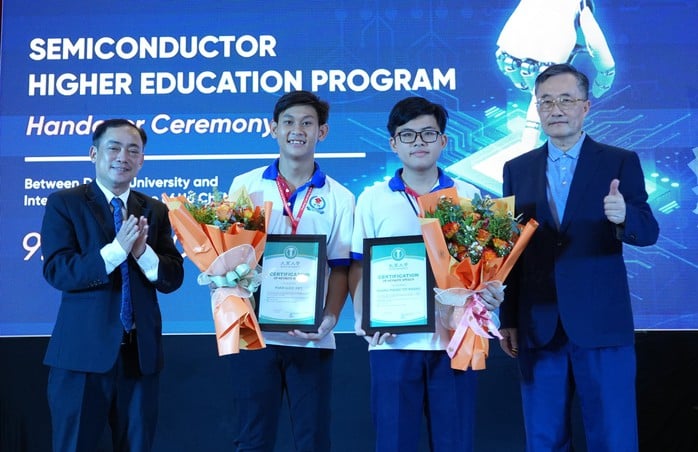
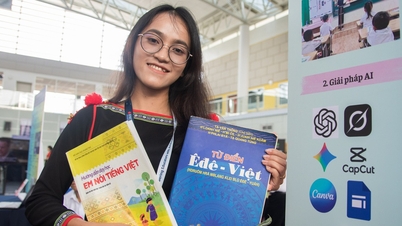
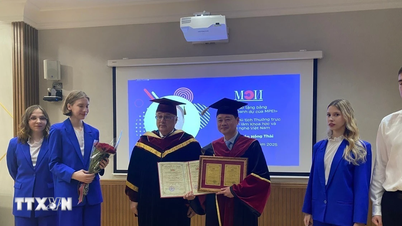
Ho Chi Minh City International College awarded certificates of merit to two outstanding students for participating in a scientific presentation at Da Yeh University (Taiwan, China).
In Vietnam, the program "Developing Human Resources for the Semiconductor Industry until 2030, with a vision to 2050" aims to train at least 50,000 personnel with university degrees or higher by 2030; at least 15,000 personnel in the design stage, and at least 35,000 personnel in the production, packaging, testing, and other stages.
According to Mr. Nguyen Dang Ly, Principal of Ho Chi Minh City International College, in the semiconductor industry, for every one designer, there are 2-5 people needed for the rest (manufacturing, packaging, and testing).
"Vietnam currently has about 35 universities offering integrated circuit design training, but no colleges are involved in training for manufacturing, packaging, and testing – stages that are experiencing a severe shortage of personnel. Therefore, our school is collaborating with Da Yeh University to transfer the semiconductor technology training program, guaranteeing 100% employment after graduation," said Ms. Ly.
Under this program, students will study the first two years in Vietnam, and then transfer to Taiwan for the next two years. Successful applicants will receive the INTENSE scholarship, which covers 100% of tuition fees.
Great potential right here in Vietnam.
Mr. Le Van Thinh, Head of the Management Board of Export Processing Zones and Industrial Parks of Ho Chi Minh City, said that after merging with Binh Duong and Ba Ria - Vung Tau provinces, Ho Chi Minh City has become the region with the largest technology parks and export processing zones in the country.
"Ho Chi Minh City has more than 100 industrial parks under planning, spread across an area of nearly 50,000 hectares. This has attracted thousands of businesses, including a large number of FDI and Taiwanese businesses, creating jobs for millions of workers," Mr. Thinh added.
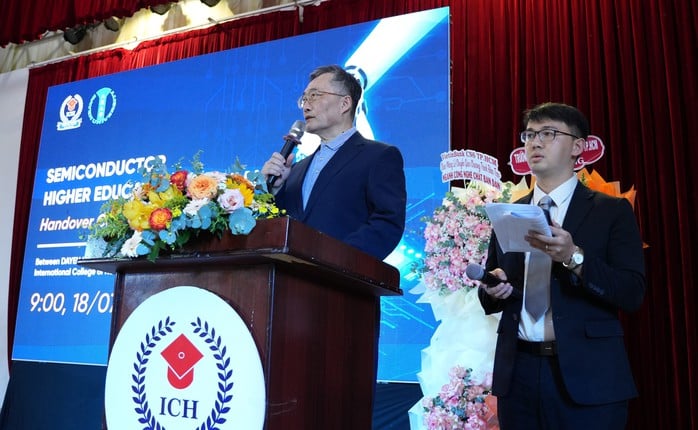
Professor Li Qinghua stated that Taiwan is currently focusing on training semiconductor industry personnel for many other countries.
According to Mr. Thinh, the high-tech industry, especially semiconductors, has been identified as one of Vietnam's key economic development sectors. The pioneering role of vocational schools in training high-quality human resources for this industry is a correct and strategic direction.
Professor Ly Thanh Hoa acknowledges the great need for human resources, but training still faces many difficulties and challenges. The biggest obstacle is the investment in equipment for training. According to Professor Ly Thanh Hoa, the machinery used for chip production costs from hundreds of thousands to millions of USD. Currently, major universities have only invested in simulation equipment or equipment for basic research. Vietnam needs to quickly build a model of linkage - ordering - tiered development; only then can it catch up with the development speed of this industry in the region.
Source: https://nld.com.vn/chuyen-giao-chuong-trinh-dao-tao-ban-dan-sinh-vien-cd-nhan-hoc-bong-100-196250719120908006.htm
![[Image] Vietnam's colorful journey of innovation](/_next/image?url=https%3A%2F%2Fvphoto.vietnam.vn%2Fthumb%2F1200x675%2Fvietnam%2Fresource%2FIMAGE%2F2025%2F12%2F14%2F1765703036409_image-1.jpeg&w=3840&q=75)























































![[Image] Vietnam's colorful journey of innovation](https://vphoto.vietnam.vn/thumb/402x226/vietnam/resource/IMAGE/2025/12/14/1765703036409_image-1.jpeg)






















Comment (0)