

Big players also raise interest rates.
In its interest rate schedule effective from December, BIDV Bank adjusted online savings deposit interest rates upwards across most terms. Specifically, the online deposit interest rate for 1-2 month terms is 2.6%/year; for 3-5 month terms it is 2.9%/year; and for 6-11 month terms it reaches 4%/year. The highest rate is 5%/year, applicable to deposits of 24 months or more. Compared to the previous interest rate schedule, these adjustments represent increases of 0.1 to 0.7 percentage points, depending on the term.
Prior to BIDV, VietinBank was the first state-owned commercial bank to increase interest rates in line with market trends. While interest rates for over-the-counter deposits remained unchanged, customers depositing savings online at VietinBank enjoyed higher returns, with an increase of approximately 0.4–0.6 percentage points. Currently, the highest online deposit interest rate at VietinBank is 5% per year for long-term deposits from 24 to 36 months.

Deposit interest rates have increased recently.
Since the beginning of December, the trend of increasing deposit interest rates has continued to spread amidst credit growth outpacing deposit growth. Many commercial joint-stock banks have adjusted deposit interest rates, including ACB, VPBank, Techcombank, VIB, BVBank,SHB , Saigonbank, NCB, Vikki Bank, etc.
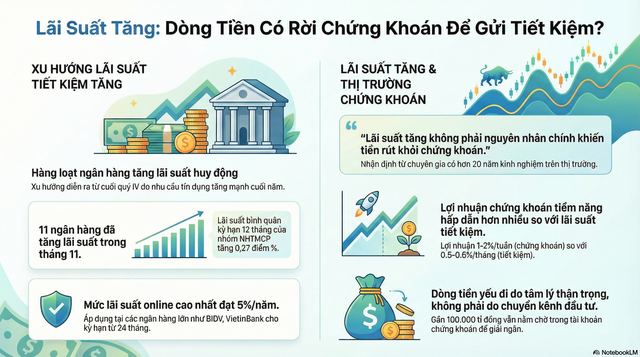
According to statistics from MBS Securities Company, 11 banks increased deposit interest rates in November alone. State-owned commercial banks also recorded adjustments, mainly in short-term maturities. Currently, the highest interest rate for deposits under 12 months on the market is approximately 5.4% per year, an increase of 0.2 percentage points compared to the beginning of the year.
Interest rates began to rise from the beginning of the fourth quarter, reflecting increased demand for capital mobilization to meet the typically sharp increase in credit demand towards the end of the year. By the end of November, the average 12-month interest rate of joint-stock commercial banks reached approximately 5.32% per annum, an increase of 0.27 percentage points compared to the beginning of the year, while state-owned commercial banks maintained a stable rate around 4.7% per annum.
Is idle money fleeing from the stock market?
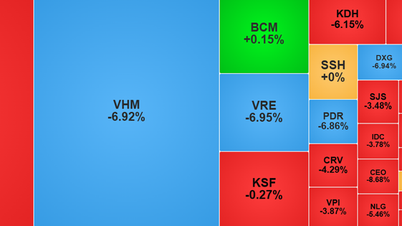
Deposit interest rates are rising, while the stock market remains sluggish with declining liquidity. In fact, the VN-Index plummeted by more than 50 points on the last trading day of the week, causing many investors to close their apps. Will money flow from the stock market to savings deposits when interest rates are rising and the stock market discourages investors?
Mr. Truong Hien Phuong, Senior Director of KIS Vietnam Securities Company, commented that with over 20 years of experience in the market, he believes that interest rates on savings deposits are almost not a factor that investors care about. Only during long holidays, especially the Tet holiday of about 8-10 days, do some investors temporarily reduce their margin lending to limit interest costs. Very few cases involve withdrawing money from securities and transferring it to savings deposits.
"Even though deposit interest rates have edged up, the highest rates on the market are around 6-7% per year, equivalent to about 0.5-0.6% per month. If trading is effective, stock investors can absolutely achieve a return of about 1% in just one session, or 1-2% in a week when the market is favorable."
"The increase in interest rates is not the main reason for the outflow of money from the stock market to bank deposits. The primary reason for the weakening of capital lies in cautious sentiment, as investors limit trading and wait for clearer opportunities," said Mr. Truong Hien Phuong.
According to many securities companies, during periods of negative market volatility, statistics show that the amount of money investors hold in securities accounts sometimes reaches nearly 100,000 billion VND. This reflects investors' willingness to keep money in their accounts, waiting for positive signals to disburse it immediately, instead of switching to other investment channels.
Source: https://nld.com.vn/lai-suat-tang-nhanh-tien-nhan-roi-se-chay-di-dau-19625121415450488.htm

































































































Comment (0)