

However, the connection and shared responsibility between rice brokers and farmers remain weak, leading to many negative consequences affecting farmers' production and profits.
"Rice brokers" manipulate prices.
According to Mr. Nam Nho (Phong Tan commune, Gia Rai town, Bac Lieu province): “Previously, I was quoted a price of 9,000 VND/kg for rice, but now, due to the storms and the rice crop collapsing, the rice brokers are asking me to sell it for 7,000 - 7,200 VND/kg. The rice is ripe but submerged in water; if I don't harvest, dry, and sell it quickly, it will sprout and I'll lose everything, so my family reluctantly agreed.”
In recent years, the emergence of rice brokers has somewhat helped farmers during harvest season. While previously farmers had to scramble to find traders, now they simply need to call a broker and everything is resolved smoothly.
However, along with the convenience, selling rice through middlemen brings many inconveniences for farmers. Rice middlemen are intermediaries between sellers and buyers, usually earning a commission from traders, and also manipulating prices with farmers to pocket the difference.
The profits earned from rice by farmers are therefore divided among many people. Many farmers are frustrated when rice brokers come up with all sorts of excuses, causing confusion among farmers, from wet rice, dirty rice, rice not yet ripe, to falling rice prices... all with the main goal of getting farmers to accept the price they offer.
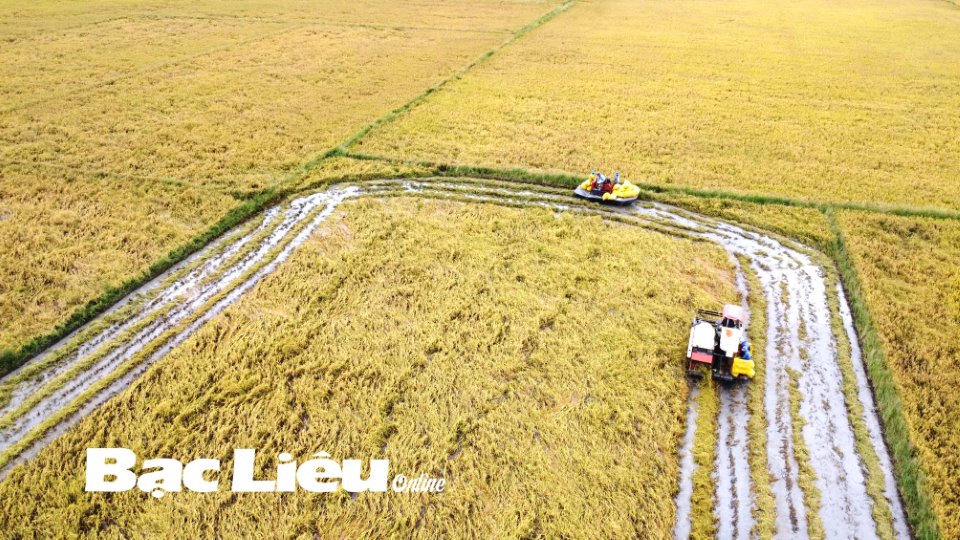
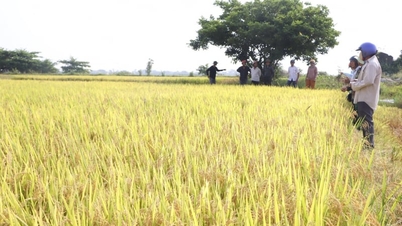
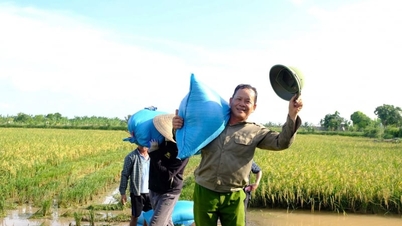
Large areas of summer-autumn rice crops in Gia Rai town, Bac Lieu province, have been flattened due to the impact of heavy rain, storms, and strong winds. Photo: CL
One undeniable fact leading to the emergence of rice brokers in this industry's production chain is the looseness and lack of linkages in production, as well as the farmers' habit of cultivating rice in fragmented, small plots of land with different varieties.
Therefore, businesses are unable to handle direct procurement and have to rely on intermediaries, which has led to an increasingly diverse force, encompassing various forms such as rice intermediaries, straw intermediaries, harvesting machine intermediaries, tiller intermediaries, and even intermediaries selling seasonal rice seeds…
Traders are forcing the issue.
Besides having to endure price manipulation by middlemen, farmers are also being exploited by traders. Using various excuses, traders employ tactics to force farmers to lower prices, such as: sharing transportation costs or claiming the rice is of poor quality.
In years when rice prices rise, traders have their boats ready at the dock, and they weigh the rice as soon as anyone finishes harvesting. Many households that are still harvesting are forced to weigh their rice because the traders are in a hurry. However, when rice prices fall, or when unfavorable weather conditions cause the rice to fall over, be flooded, or have black husks, the traders find ways to prolong the process, giving many reasons not to send boats to buy the rice.
The prolonged delay in purchasing rice causes many difficulties for farmers. Rice left unharvested for too long is susceptible to dampness, mold, and germination, reducing quality and making it difficult to sell. Furthermore, because farmers harvest their rice simultaneously, if they don't sell it soon, those who harvest later won't have a place to store their rice.
For the reasons mentioned above, farmers are forced to sell to traders at prices lower than initially agreed upon in order to quickly finish the harvest. Alternatively, even if deposits were paid for the rice at the beginning of the season, if market prices fluctuate by harvest time, traders may abandon the deposits or force farmers into a difficult situation by colluding with rice brokers to lower prices.
This isn't just a problem during the summer-autumn rice crop, when farmers face disadvantages; even during what are considered favorable seasons like the winter-spring crop, similar situations occur. While business and trade today are entirely based on market mechanisms, price manipulation and coercion have consequently reduced farmers' profits.
To ensure farmers don't suffer losses.
Bac Lieu is entering the final days of the 2024 summer-autumn rice harvest season, with a total area of nearly 58,000 hectares across the province.
The widespread heavy rains and thunderstorms in early September submerged many rice fields that were ripening and nearing harvest. In many fields, the rice plants lay flattened on the ground, and the rainy weather caused them to sprout, reducing their quality and yield.
In the context of soaring fertilizer prices and challenging farming conditions, the deceptive tactics of traders and rice brokers have contributed to increased production costs and reduced farmers' profits. To avoid the current situation of being dependent on brokers and traders, relevant authorities need to encourage and facilitate farmers' participation in the "Large-Scale Farming" model.
In addition, farmers also need to maintain credibility in the linkage process. In reality, there are many cases where farmers break their agreements and sell off their rice to outside traders when prices rise, even though they had previously signed contracts with rice brokers or traders.
To secure long-term business relationships, form strong linkages, and foster a sense of shared responsibility to mitigate risks and market impacts, farmers need to understand the market, establish production linkages for high-quality rice varieties with guaranteed purchase contracts from companies and businesses at the beginning of the season, and reduce intermediaries in production and consumption to increase productivity and profits.
Source: https://danviet.vn/co-lua-o-bac-lieu-co-vai-role-gi-trong-trong-lua-lam-sao-de-co-lua-thuong-lai-nong-dan-vui-ve-20240919200609847.htm








































![[Video] Sunset at Lap An Lagoon – Where the sun sets over the fishing nets](https://vphoto.vietnam.vn/thumb/1200x675/vietnam/resource/IMAGE/2026/05/31/1780192137701_beach-landscape-sea-water-nature-grass-745871-pxhere-com.jpeg)




























Comment (0)