

The traditional Hmong mouth organ (khen) is constructed from six perforated bamboo tubes that pass through a wooden body. Any gaps in the body of the mouth organ are usually patched with peach resin. To secure the bamboo tubes, artisans craft a binding device from rattan fibers, strengthening the structure and ensuring its aesthetic appeal. The materials used are sourced from nature; the only metal component is the reed, usually made of copper leaf. When played, the Hmong mouth organ produces the gentle sounds of all six bamboo tubes. It is often performed solo, in duets, or in ensembles with other traditional instruments such as bamboo flutes and two-stringed fiddles. Many legends and anecdotes about the origin and creation of this unique instrument are still passed down within the Hmong community.
The Hmong boy has been attached to the Hmong flute since childhood, even before he was born. When the flute's melody rises, it carries the wild sweetness of the mountains and forests, making birds flutter their wings, trees sway in the wind, and hearts soften, making everything beautiful to behold!
In the transitional weather between autumn and winter, I followed the fluctuating, sometimes loud, sometimes soft, sometimes deep, sometimes high-pitched sounds of the Hmong flute played by young men to Sung Cho village, Sung Phai commune ( Lai Chau city). Here, many Hmong people still cherish the sound of the flute. They play it with burning passion, easily moving and evoking strong emotions in anyone who hears it. The flute is as powerful as the lives of the Hmong people in this challenging land.
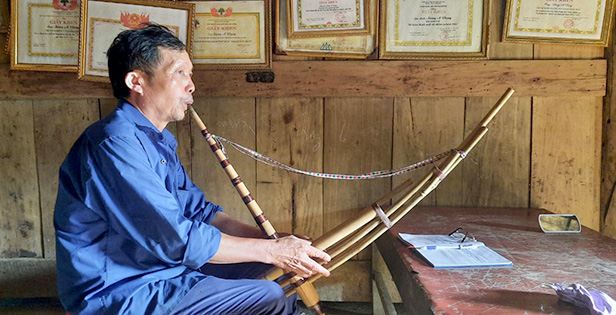
The Hmong people's reed pipe has helped them stand firm in the harsh mountain forests. With a glint in his eyes, Mr. Sung A Vang from Sung Cho village enthusiastically said: "Since I was little, I listened to my father and uncle playing the reed pipe every day. The sound of the reed pipe has seeped into my blood and flesh. Many days, even after listening to an entire song, the lingering melody still stirs my emotions, so I decided to learn to play the reed pipe."
Mr. Sung A Vang is the third generation in a family renowned for their connection to the khene (a type of bamboo flute). I've heard that even when his family lacked food and clothing, they never lacked the sound of the khene. Mr. Vang learned to play the khene in his youth. Being from a family of musicians and possessing a bit of diligence, even the most difficult khene melodies posed no challenge for him. Therefore, by adulthood, he had mastered 32 khene melodies. Even now, at over 60 years old, he has never once considered giving up the khene. Whenever he hears someone's khene playing, whether it's early morning or a quiet winter night, Mr. Vang will spontaneously sit alone by his door and play a few tunes, only feeling satisfied when he is completely immersed in the passionate melody.
That alone was enough for me to understand that for the Hmong people, simply being able to frolic and get intoxicated by the sound of the Hmong flute is sufficient. The sound of the flute is the voice of the heart, a bridge between the living and the spiritual world . The sound of the flute expresses joy when moving into a new home, the sound of welcoming spring or expressing love, the sound of bringing the bride to her husband's house, the sound of calling friends to celebrate spring and go to festivals. Mr. Vang's flute playing has a unique quality, so many people from within and outside the village admire it and travel to his house to ask him to teach them. Then they learn to play the flute with him.
Once upon a time, Mr. Vang's flute playing captivated many young women. His flute music won over the other suitors who came to the house of the girl he later chose to marry. Now, Mr. Vang participates in every spring festival, competition, or village holiday, his flute playing carrying the sounds of the mountains and forests to those far away.
Over time, life has changed considerably, but the Hmong people in Lai Chau have always preserved their traditional Hmong flute. The sound of the flute is the soul of the Hmong people; preserving the Hmong flute means preserving their ethnic identity. Today, the melodies from the Hmong flute have left their mark, awakening the hearts of countless tourists who have had the opportunity to visit Lai Chau - a beautiful land on the border of our country.
Source











































































Comment (0)