

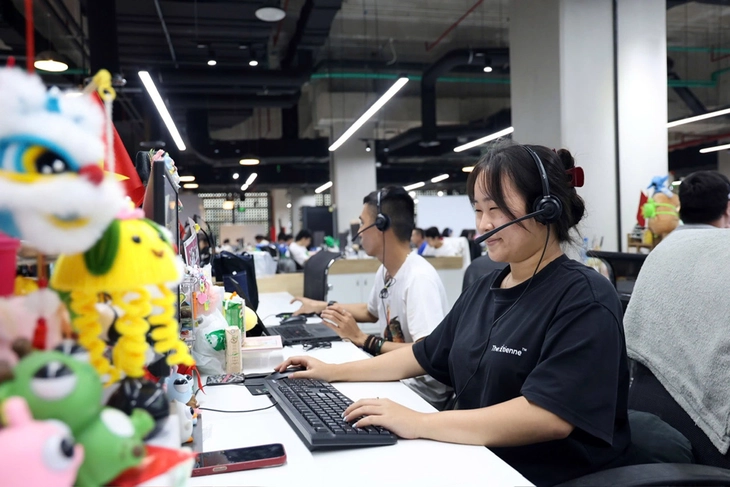
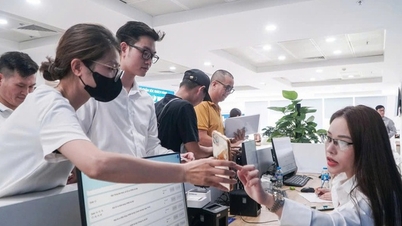
Employees working at the technology "unicorn" VNG - Photo: QUANG DINH
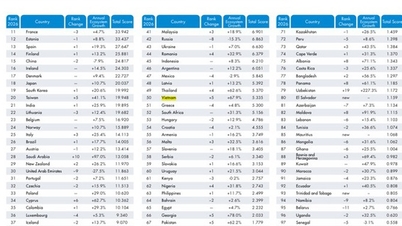
According to StartupBlink's ranking, Ho Chi Minh City is ranked 110th globally and is among the top five most dynamic startup cities in Southeast Asia.
Earlier, at the end of August 2025, the Ho Chi Minh City Innovation and Entrepreneurship Center officially commenced operations amidst a startup ecosystem in the city valued at approximately $7.4 billion, accounting for nearly 50% of the total number of startups nationwide.
It must be a reliable destination for startups.
"If there is one city in the region that is on the verge of something big, it is Ho Chi Minh City," affirmed Edward Lim, Country Director for Vietnam of BLOCK71 at NUS Enterprise.
According to Mr. Lim, with its young, tech-savvy population and its role as an " economic gravitational force" attracting the majority of FDI, Ho Chi Minh City has the potential to become a "living laboratory," where start-ups and large domestic and foreign businesses can collaborate to test new models in real market conditions.
"If we can combine the vision of becoming a financial center with a strategy to promote innovation, building bridges between capital, talent, and technology, Ho Chi Minh City can absolutely rise to become the innovation capital of Southeast Asia," Mr. Lim affirmed.
Meanwhile, speaking to Tuoi Tre newspaper, Mr. Dung Ho - Director of Strategy and External Relations of XNOR Group - said that Vietnamese law is still not flexible with internationally popular investment forms such as preferred shares, ESOP (employee stock ownership plan), or SAFE (preliminary agreement for future equity).
"Foreign investors often require these terms to protect their interests and manage risks. If a start-up operates solely under a Vietnamese legal entity, managing cash flow or withdrawing capital later becomes very complicated. In general, registering in Vietnam makes it difficult to receive foreign investment," said Mr. Dung Ho.
In fact, many Vietnamese startups have chosen Singapore – ranked 9th in Startup Genome's global startup ecosystem ranking with a valuation of approximately $144 billion – as their headquarters.
A prime example is Sky Mavis, which, despite being recognized as a "unicorn" of Singapore because it is headquartered there, is still considered a Vietnamese start-up as its founding team is primarily Vietnamese and it is run by a Vietnamese CEO.
Therefore, according to experts, in order to build a sustainable startup ecosystem like Singapore, Ho Chi Minh City needs to affirm its position as a reliable destination for foreign investment.
"This requires clearer legal reforms to meet investors' demands while enhancing the city's presence and prestige on the international stage," said an expert.
We need to build a "living ecosystem".
In this context, the plan to build IFC not only signifies infrastructure development but can also become a platform connecting ideas, capital, and credibility for the startup community.
Speaking to Tuổi Trẻ newspaper, Christopher Beselin, chairman of Endurance Capital, said that the IFC project will only truly be valuable if it is implemented as an open platform where investment capital, talent, and innovation can meet.
If properly guided, IFC can create a trustworthy environment, facilitating the flow of capital into Vietnamese startups. Investors will feel protected, and founders can focus on product development instead of spending excessive time on the fundraising process.
"If the IFC initiative can connect all these elements: policy, capital, domestic and foreign human resources, and infrastructure, Ho Chi Minh City could absolutely become a true regional hub for building and scaling up technology companies, not just a place to start ideas," said Mr. Beselin.
According to Mr. Beselin, Vietnamese startups themselves need to proactively improve governance standards, transparency in reporting, and increase accountability in operations. The sooner founders develop a mindset and working methods that meet international standards, the easier it will be to attract the trust of global investors and contribute to strengthening Vietnam's position as an emerging financial center in the region.
"If the government creates a favorable environment and startups respond with ambition and discipline, Ho Chi Minh City can absolutely become the most dynamic innovation and capital mobilization hub in emerging Asia," concluded the Chairman of Endurance Capital.
Meanwhile, according to Edward Lim, Ho Chi Minh City will need to combine talent development with flexibility in the legal framework, creating space for experimenting with ideas, learning, and safely failing.
This is precisely what Singapore achieved through its "regulatory sandbox" model, and it's a model that Mr. Lim believes Ho Chi Minh City can apply in the context of its recent reforms.
Mr. Lim suggested that Ho Chi Minh City could take a smart approach by focusing on building a "living ecosystem" instead of just developing a physical area, including strengthening links between universities, businesses, and the government to create favorable conditions for start-ups to thrive.
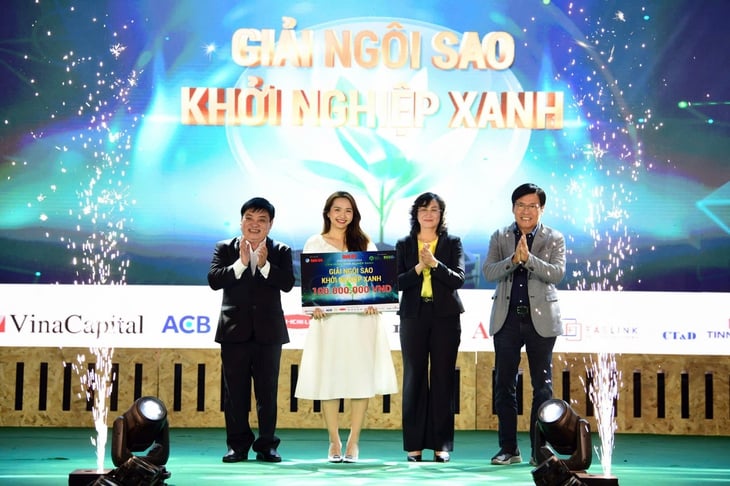
Ms. Phan Thi Thang - Deputy Minister of Industry and Trade (second from the right), Mr. Le The Chu - Editor-in-Chief of Tuoi Tre newspaper (far left), and Mr. Pham Phu Ngoc Trai - Chairman of the PRO Vietnam Packaging Recycling Alliance - present the Green Startup Star award to the start-up AirX Carbon - Photo: QUANG DINH
Opportunities for international interaction are needed.
Finland, a country with just over 5.5 million inhabitants but boasting one of the world's top 15 startup ecosystems, is inviting global startups, including those from Vietnam, to establish themselves there.
According to Ms. Le Van Anh, Director of Human Resource Development in Vietnam at Business Finland, to elevate Vietnamese startups, Ho Chi Minh City needs to proactively connect with international learning opportunities: participating in founder communities abroad, organizing regular knowledge-sharing forums with global partners, and participating in startup acceleration programs like those in Finland.
"These initiatives will give Vietnamese founders the opportunity to experiment, expand, and strengthen their position in the international market," a representative from Business Finland stated.
Start-ups are giving wings to Singapore.
Speaking to Business Times, a venture investor recounted that even when Anthony Tan, co-founder of Grab, was sleeping on the floor at the office, he believed the startup would succeed.
success.
"Singapore was then shining as a financial hub, and its government was doing everything it could to build a startup ecosystem that the world would look up to," he added.
As predicted, by 2021, seven years later, Grab went public with a valuation of nearly $40 billion, bringing Singapore and the Southeast Asian technology industry to the forefront of global attention.
This boost solidified Singapore's position as a leading destination for startups. As early as 1999, the island nation implemented a series of policies to attract venture capital, provide funding, and enhance startup capabilities, spending billions of dollars.
Singapore ranks 9th in Startup Genome's global startup ecosystem ranking, valued at approximately US$144 billion. According to Beinsure, Singapore's 30 "unicorn" startups have a combined value of over US$135 billion, proving that the island nation has become a regional "capital magnet".
"Start-ups are not a marginal community. They are businesses that are shaping Singapore's future," Edward Lim emphasized to Tuoi Tre newspaper.
Furthermore, Singapore has over 400 active venture capital funds, along with an open policy, a strong legal system, and an international workforce.
Source: https://tuoitre.vn/de-start-up-chap-canh-cho-tp-hcm-20251021233835663.htm
![[Photo] General Secretary and President To Lam presides over a meeting on assessing national development resources.](https://vphoto.vietnam.vn/thumb/1200x675/vietnam/resource/IMAGE/2026/05/20/1779253785852_a1-bnd-2943-8519-jpg.webp)








































































Comment (0)