

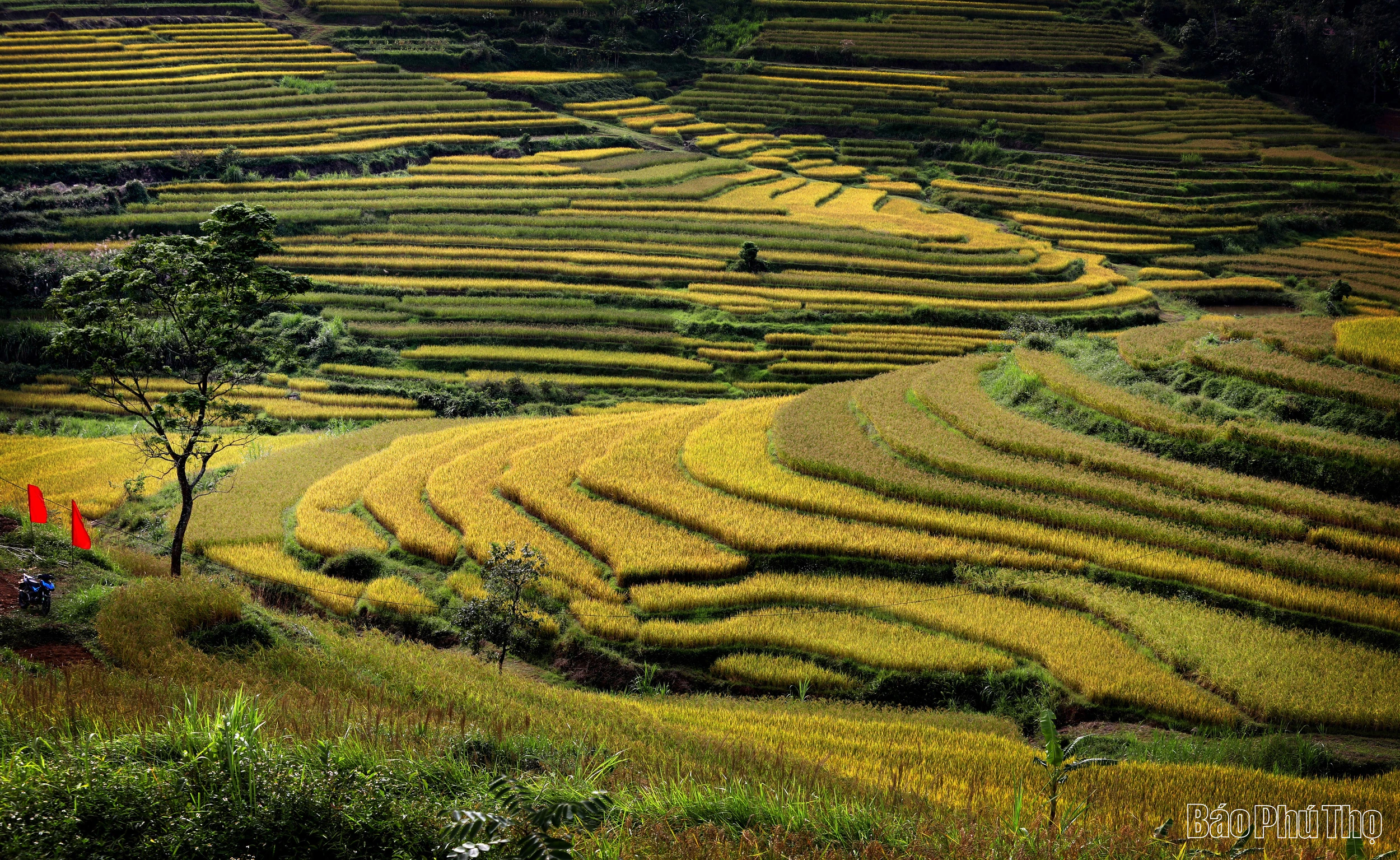
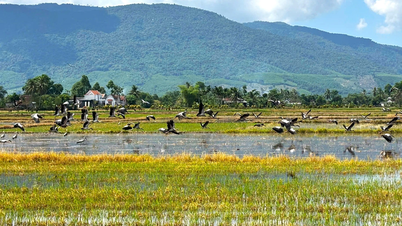
Terraced rice fields during the harvest season in the old Hill Region, now Thuong Coc commune.
Fossilized rice grains and a thousand-year-old story in Muong Vang.
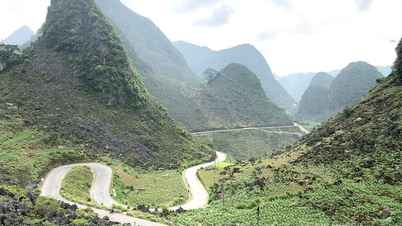
The road that led me to Muong Vang (formerly comprising Quy Hoa, Tuan Dao, and Tan Lap communes) winds through endless rice paddies, embracing the Tan Lap valley. The Muong people say that here, they not only "eat rice" but also "worship rice," venerating the grain as a part of their soul.
The story begins at Đá Trại cave in the former Tân Lập commune. In 1982, archaeologists discovered fossilized rice grains inside the cave – proof that thousands of years ago, the Mường people knew how to cultivate wet rice. It's no coincidence that Mường Vang rice is famous for its fragrant stickiness. It's the culmination of nature's bounty and the skillful hands of generations. Standing at the cave entrance, the wind from the valley carried the scent of ripe rice mingled with the aroma of damp earth, and I suddenly understood: the rice here is not simply food, but also memory, a cultural identity.
Today, Muong Vang is no longer confined to just two rice crops per year. Since 1987, new varieties such as Khang Dan, AT77, and sticky rice 352 have been introduced to the fields, increasing yields and expanding the cultivated area to thousands of hectares each year. Mechanization has been introduced to the fields, and farmers are utilizing land previously used for two rice crops to grow additional winter corn, achieving yields of over 45 quintals/hectare. Fields lacking water have been converted to growing vegetables, mulberry trees, and fruit trees, creating a stable income.
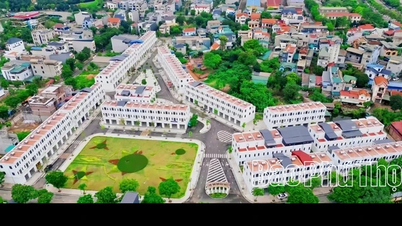
In the village, red-tiled stilt houses mingle with modern multi-story houses, the sounds of children reciting their lessons blending with the gentle murmur of the stream. It's a rural area undergoing modernization and development, yet still preserving its unique identity and culture.
Sticky Rice from Khe - a treasure from the mountain fields.
Leaving Tan Lap, I made my way to Mien Doi commune (now Thuong Coc) - where the ancient glutinous rice variety Trung Khe, called "Tlởng khe" in the Muong language, is still preserved. Elderly people say that the grains of this rice are small and round like a tadpole's egg, golden yellow like the first rays of sunshine, and fragrant.
The Muong people cherish this rice variety so much that they consider it a gift for weddings, festivals, and holidays. Not only is it delicious, "Tlởng khe" is also a measure of the Muong people's skill, from selecting the seeds and preparing the seedlings to managing water for the rice fields.
This glutinous rice variety thrives in the terraced rice paddies of the Hill Region, characterized by cold water and high-altitude, mineral-rich soil. The "Trung Khe" rice grains are highly nutritious, short, round, and cook up soft, fragrant, and sweet. They command a much higher price than regular rice.
Ms. Bui Thi Nguyet, a member of the Mien Doi Agricultural and General Services Cooperative, shared: “We grow rice without fertilizer or pesticides, yet it thrives with few pests and diseases. Yields may be lower than some newer varieties, but the economic value is high, at 350,000 - 450,000 VND per 10 kg. This allows us to both preserve tradition and create a branded product.”
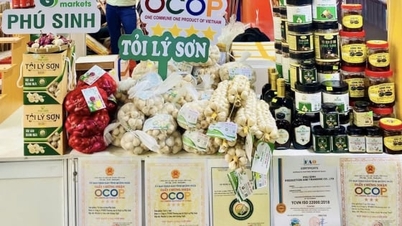
In early 2023, Mien Doi commune developed an OCOP (One Commune One Product) program for Trung Khe sticky rice. The Mien Doi Agricultural and General Services Cooperative took the lead, providing technical training and guidance to farmers on organic farming practices to ensure quality. By the end of the year, "Trung Khe Sticky Rice" was recognized as a 3-star OCOP product – a source of pride for the Muong people. In 2024, the cultivated area expanded to 18 hectares, with 130 participating households, aiming for commercial production linked to experiential tourism and export.
Preserving the spirit of rice, enriching oneself from the rice grains of the homeland.
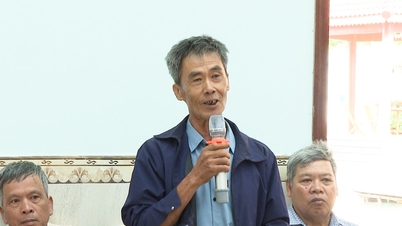
Mr. Bui Van Vu, an elderly man in Tan Lap, enthusiastically recounted the customs surrounding rice cultivation. From the time the seedlings are sown, the villagers go to the forest to gather Du leaves to bury the seeds, then cover them with Giau leaves, entrusting their hopes to the rice plant: "enough" to eat, "rich" to wear. After transplanting, anyone passing by who sees the roots of the rice plant exposed will bend down and replant it, even if it's not their own field. This is considered a good deed, witnessed by heaven, which will bless the harvest.
On the 7th day of the first lunar month, the entire village holds a ceremony to pray for favorable weather and abundant harvests. These rituals, despite changing times, are preserved as a thread connecting the past with the present.
Beyond simply ensuring bountiful harvests, Muong Vang and Thuong Coc are writing a new chapter: preserving indigenous rice varieties while simultaneously developing a sustainable economy. Comrade Bui Van Cuong, Vice Chairman of the Thuong Coc Commune People's Committee, emphasized: “Nếp Trứng Khe is a treasure. We are not only maintaining it, but also building the OCOP brand to a higher level, developing organic products, and serving experiential tourism .”
Meanwhile, the leaders of Muong Vang commune affirmed: "Rice remains the mainstay, but we must do it in a new way - safe, organic production, increasing value instead of chasing after quantity. The commune encourages the expansion of high-quality varieties, mechanization, and connections with businesses so that Muong Vang rice can have a firm foothold."
These directions show that, along with preserving traditional farming knowledge, the Muong people today have learned to innovate. They link production with the market, incorporate cultural values into their products, transforming rice not only into food but also into a brand, a source of pride, and a means of wealth creation.
Anyone who has ever set foot in Muong Vang or the terraced rice fields in the mountainous region will understand why the rice from the Muong region never loses its appeal. And perhaps, what captivates visitors from afar is not only the fragrant, sticky rice, but also the sincerity and hospitality of the Muong people, people who live fully with the land and love their homeland's rice to the core.
Hong Duyen
Source: https://baophutho.vn/deo-thom-com-lua-xu-muong-237188.htm

































































Comment (0)