

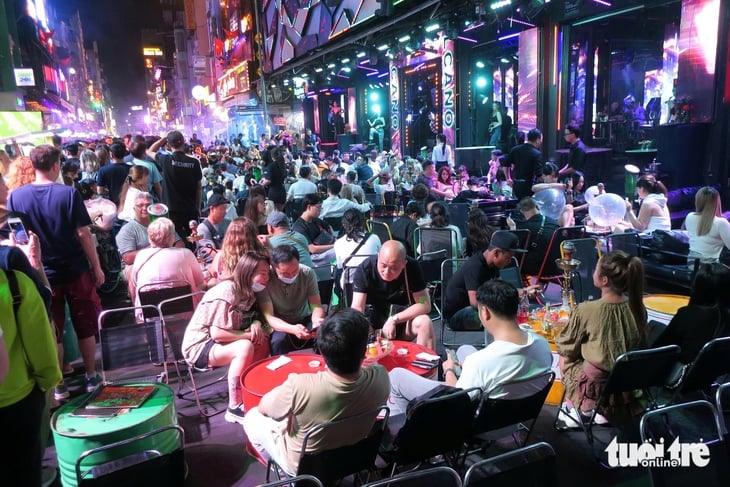
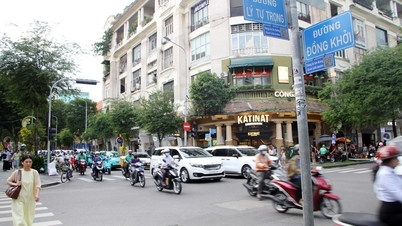
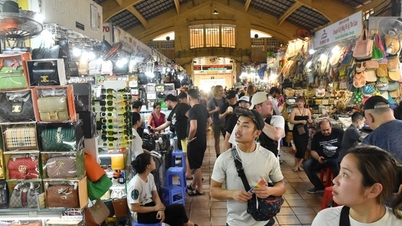
The bustling life in Bui Vien Street, Ben Thanh Ward, Ho Chi Minh City, attracts a large number of tourists - Photo: TTD
We often talk about culture as something lofty, like art exhibitions, classical concerts, or magnificent architectural works. But culture is not something far away.
It could be a bowl of fish noodle soup at a roadside stall that you choose to eat because you miss the smell of the An Giang river, a regular weekend morning at the gym, or a routine medical check-up because you believe that "living healthy is living beautifully."
All of these things, when repeated intentionally and linked to spiritual, aesthetic, or social values, constitute cultural behavior.
Culture isn't just in the theater.
When we analyzed data from Google Maps of hundreds of thousands of locations in Ho Chi Minh City, an interesting finding emerged: areas with many cafes, gyms, bookstores, tea rooms, health clinics, or even popular TikTok food stalls... tend to be places with strong economic vitality, a vibrant lifestyle, and a diverse community.
Cultural behavior doesn't need to be luxurious. It can happen in a Japanese restaurant with rooftop performance art and a view of the Bitexco Tower, but it can also begin with a bowl of fish noodle soup or a small cup of coffee on the side of Ba Chieu Market, where old men and young people alike stop to read the newspaper or browse their phones each morning, finding a moment to breathe and start their day.
If we view Ho Chi Minh City as a grand stage, then millions of its residents are performing countless "cultural plays" together every day…
A group of young people go to see a movie at Landmark 81 and take photos for social media, a characteristic of the new culture of visual consumption. It could also be a three-generation family eating beef noodle soup in District 10, where the mother used to work as a garment factory worker, simply to reminisce and connect generations. Or like a pho restaurant owner letting customers use their phone chargers during a power outage – a cultural act of sharing.
These small, seemingly insignificant actions, when combined, form the soul of the city.
A culturally rich city doesn't necessarily need grand theaters or modern museums (although those are also essential). It needs spaces where people can live, experiment, and share behaviors that have value beyond mere survival.
And what is so valuable about Ho Chi Minh City?
Here, you can go boxing at a high-end, brightly lit 24/7 gym in Thao Dien, and then the next day eat pork offal porridge at a street corner vendor you've known for 10 years. It's a city where rich and poor, luxurious and ordinary, formal and informal, coexist and interact. That's diversity and inclusiveness, a form of city-level cultural behavior.
In a city like Ho Chi Minh City, where the service industry is increasingly playing a significant role in the economy, the diversity of cultural behaviors is not just an artistic element; it is the lifeblood of the commercial-consumer-creative ecosystem.
When people have a greater intrinsic need to "go out for pleasure" rather than just out of necessity, then sectors such as food and beverage, healthcare, non-formal education, visual arts, and community spaces will have the opportunity to develop strongly and deeply.
We believe that a modern trade and industry policy needs to foster the "space for existence" of cultural behaviors, including traditional and spiritual spaces.
From sidewalk newsstands and sugarcane juice carts to neighborhood karaoke bars, boutique gyms, independent bookstores, and studios for young artists, all play a role in the city's socio-economic landscape, albeit at different levels.
Cultural behavior doesn't need to be grandiose. It starts with small but meaningful choices about where to go, what to do, and with whom. And a cultural city like Ho Chi Minh City will be a place where such behaviors are not only permitted but also nurtured and developed, from the streets to the skyscrapers, from immigrants to locals.
To achieve this, Ho Chi Minh City needs to design policies that support the development of small-scale creative models such as art studios, independent bookstores, and non-formal extracurricular classes… through preferential rental packages, access to digital infrastructure, or microfinance.
Integrating public space planning with contemporary cultural needs, including night markets, art streets, and street performance spaces, aims to create attractive destinations for consumption and experiences.
Finally, it is necessary to acknowledge the role of informal and semi-formal services in the urban consumer ecosystem, namely the street economy , in order to adopt an inclusive approach, rather than restricting or marginalizing development.
Because the city's new competitive advantage lies not only in technology, logistics, or investment capital, but also in its ability to allow people to live diverse lives, interact naturally, and constantly innovate within culturally rich contexts.
The most beautiful city isn't one that "looks like a foreign country," but one that allows you to live your life in a way that you find meaningful.
Together we contribute ideas for the development of industry and trade in Ho Chi Minh City.
The Tuoi Tre newspaper, in collaboration with the Ho Chi Minh City Department of Industry and Trade, is holding a forum titled "Proposing Ideas for the Development of Industry and Trade in Ho Chi Minh City". The forum aims to gather ideas and solutions from businesses, researchers, and citizens to build and develop industry and trade for the new Ho Chi Minh City, creating a strong industrial, commercial, and service-oriented urban center with international competitiveness.
Mr. Bui Ta Hoang Vu, Director of the Ho Chi Minh City Department of Industry and Trade, stated that he will respectfully listen to every suggestion from citizens and businesses in order to advise the Ho Chi Minh City People's Committee on breakthrough solutions for the development of industry, trade, and services.
Readers participating in the forum can send their comments to the Tuoi Tre newspaper editorial office, 60A Hoang Van Thu Street, Duc Nhuan Ward, Ho Chi Minh City, or send their opinions via email: kinhte@tuoitre.com.vn.
Source: https://tuoitre.vn/do-thi-tp-hcm-can-khong-gian-hanh-vi-van-hoa-da-dang-20250804191147387.htm
![[Image] National Assembly discusses the implementation of the socio-economic development plan.](https://vphoto.vietnam.vn/thumb/1200x675/vietnam/resource/IMAGE/2026/04/20/1776696707422_ndo_br_img-20260420-185419-jpg.webp)
![[Photo] General Secretary and President To Lam meets with National Assembly delegates from ethnic minorities.](https://vphoto.vietnam.vn/thumb/1200x675/vietnam/resource/IMAGE/2026/04/20/1776696701056_a1-bnd-8331-3342-jpg.webp)
















































Comment (0)