

At the Ministry of Science and Technology 's (MST) regular press conference in October, held on the morning of October 31st in Hanoi, Mr. Pham Duc Nghiem, Deputy Director of the Department of Startups and Technology Enterprises, stated that Decree No. 264 for the first time includes new regulations on financial investment and venture capital funds.
Accordingly, this new mechanism allows for the mobilization of private capital into high-risk but high-potential research and development projects, instead of relying solely on the state budget as before.
This breakthrough aims to promote innovation through public-private partnerships, encouraging businesses to boldly invest in new technologies.
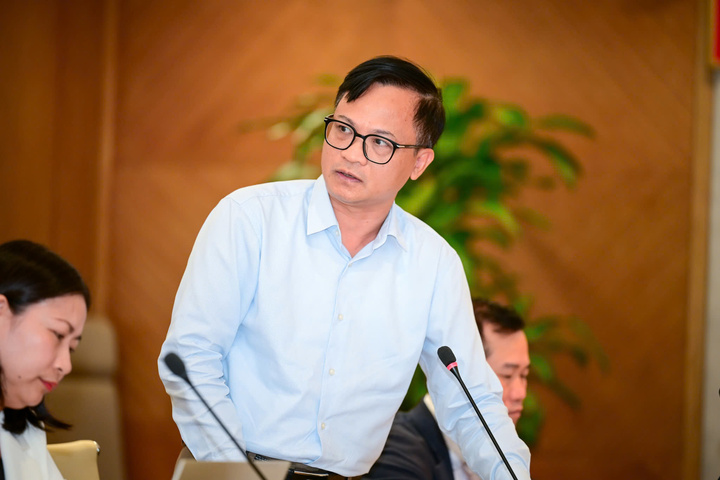
Mr. Pham Duc Nghiem, Deputy Director of the Department of Startups and Technology Enterprises, Ministry of Science and Technology, speaks at the press conference. (Photo: Minh Son)
Emphasizing this point, Deputy Minister of Science and Technology Bui Hoang Phuong stated that the current policy is to entrust domestic enterprises with undertaking the State's "major projects." This not only helps businesses enhance their self-reliance but also creates opportunities for "Make in Vietnam" technology products and services to find markets.
In the coming period, the Ministry of Science and Technology will continue to refine detailed guidelines, especially the "sandbox" mechanism – a controlled testing model in the field of industry and digital technology . Once the legal framework is established, businesses will have more favorable conditions to test, apply, and expand new technology models.
Improving the legal framework for science and technology and innovation.
Also at the press conference, Deputy Minister Bui Hoang Phuong stated that in October, the Ministry of Science and Technology submitted to the Government and the Prime Minister for promulgation one resolution, seven decrees, and seven important decisions, covering almost all key areas of the sector. In October 2025, a series of important legal documents were issued, contributing to the completion of the institutional framework and promoting the development of science, technology, and innovation – a field considered a key driver for economic growth and national digital transformation.
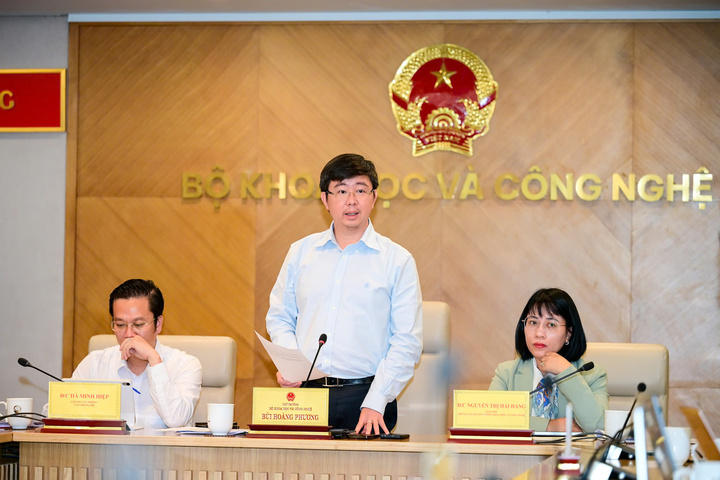
Deputy Minister of Science and Technology Bui Hoang Phuong speaks at the press conference. (Photo: Minh Son)
In particular, the inclusion of the Artificial Intelligence (AI) Law project in the agenda of the 10th Session of the 15th National Assembly marks a major turning point in the process of building a legal framework for a globally groundbreaking field.
At the ministerial level, the Ministry of Science and Technology issued 5 specialized circulars, such as: Regulations on technical auditing of electronic signatures and trusted services; guidance on preliminary nuclear safety assessment for nuclear power plant sites during the investment policy decision-making phase; and regulations on the procedures for approving telecommunications numbering plans and Internet resources.
Additionally, there are regulations on managing, connecting, and sharing data on the National Information System on Science, Technology, and Innovation; and guidelines for identifying specialized job positions related to digital transformation.
These documents contribute to perfecting the legal framework, standardizing technical procedures, and improving the effectiveness of state management in the fields of science, technology, and innovation.
The government has allocated an additional 25 trillion VND to implement Resolution 57.
Regarding the implementation of Resolution 57, Deputy Minister Bui Hoang Phuong said that the Central Steering Committee on Science, Technology, Innovation and Digital Transformation is closely monitoring the progress through weekly briefings covering hundreds of related tasks.
According to the Deputy Minister, unlike before when tasks were simply assigned, this time the assignment of tasks to implement Resolution 57 is accompanied by specific resources. The Deputy Minister cited an example: this year the Government has allocated an additional 25,000 billion VND, and ministries, sectors, and localities have registered approximately 16,000 billion VND for implementation.
The government has also directed ministries, agencies, and localities to request support if they encounter difficulties. Major Vietnamese technology companies such as Viettel, VNPT, and FPT are partnering and ready to provide support. Therefore, the focus of implementation is on building national, specialized, and local digital platforms and databases.
In November 2025, the Ministry of Science and Technology will focus on finalizing five draft laws to be submitted to the National Assembly for consideration and approval at its 10th session, including: the Law on Digital Transformation, the Law on High Technology (amended), the Law amending the Law on Intellectual Property, the Law amending the Law on Technology Transfer, and the Law on Artificial Intelligence.
At the same time, in November 2025, the Ministry will continue to accelerate the drafting of Decrees and Circulars guiding the implementation of Laws passed by the National Assembly at its 9th session.
Simultaneously, the Ministry of Science and Technology is implementing key projects such as: the Project to promote intellectual property work to serve socio-economic development; the Project to statistically assess the contribution of biotechnology; the Strategy for the development and application of atomic energy for peaceful purposes until 2035, with a vision to 2050; and the Project for training and developing human resources in atomic energy.
Source: https://vtcnews.vn/doanh-nghiep-tu-nhan-duoc-dau-tu-cac-du-an-cong-nghe-rui-ro-cao-tiem-nang-lon-ar984413.html
![[Image] Leaked images ahead of the 2025 Community Action Awards gala.](/_next/image?url=https%3A%2F%2Fvphoto.vietnam.vn%2Fthumb%2F1200x675%2Fvietnam%2Fresource%2FIMAGE%2F2025%2F12%2F16%2F1765882828720_ndo_br_thiet-ke-chua-co-ten-45-png.webp&w=3840&q=75)
![[Image] The tenacious fighting spirit of Vietnamese women's football](/_next/image?url=https%3A%2F%2Fvphoto.vietnam.vn%2Fthumb%2F1200x675%2Fvietnam%2Fresource%2FIMAGE%2F2025%2F12%2F17%2F1765990260956_ndo_br_4224760955870434771-copy-jpg.webp&w=3840&q=75)
![[Photo] Prime Minister Pham Minh Chinh receives the Governor of Tochigi Province (Japan)](/_next/image?url=https%3A%2F%2Fvphoto.vietnam.vn%2Fthumb%2F1200x675%2Fvietnam%2Fresource%2FIMAGE%2F2025%2F12%2F16%2F1765892133176_dsc-8082-6425-jpg.webp&w=3840&q=75)
![[Photo] Prime Minister Pham Minh Chinh receives Lao Minister of Education and Sports Thongsalith Mangnormek](/_next/image?url=https%3A%2F%2Fvphoto.vietnam.vn%2Fthumb%2F1200x675%2Fvietnam%2Fresource%2FIMAGE%2F2025%2F12%2F16%2F1765876834721_dsc-7519-jpg.webp&w=3840&q=75)

![[Live] 2025 Community Action Awards Gala](/_next/image?url=https%3A%2F%2Fvphoto.vietnam.vn%2Fthumb%2F1200x675%2Fvietnam%2Fresource%2FIMAGE%2F2025%2F12%2F16%2F1765899631650_ndo_tr_z7334013144784-9f9fe10a6d63584c85aff40f2957c250-jpg.webp&w=3840&q=75)
























































![[Live] Closing Ceremony and Award Presentation for the "Impressive Vietnam Tourism" Video/Clip Creation Contest 2025](https://vphoto.vietnam.vn/thumb/402x226/vietnam/resource/IMAGE/2025/12/17/1765974650260_z7273498850699-00d2fd6b0972cb39494cfa2559bf85ac-1765959338756946072104-627-0-1338-1138-crop-1765959347256801551121.jpeg)
















Comment (0)