

Palm fruit stew is a dish made from palm fruit – a fruit from the land of King Hung ( Phu Tho ). It doesn't attract diners with its impressive aroma from spices or special seasonings, but rather with its simple yet deeply memorable flavor.
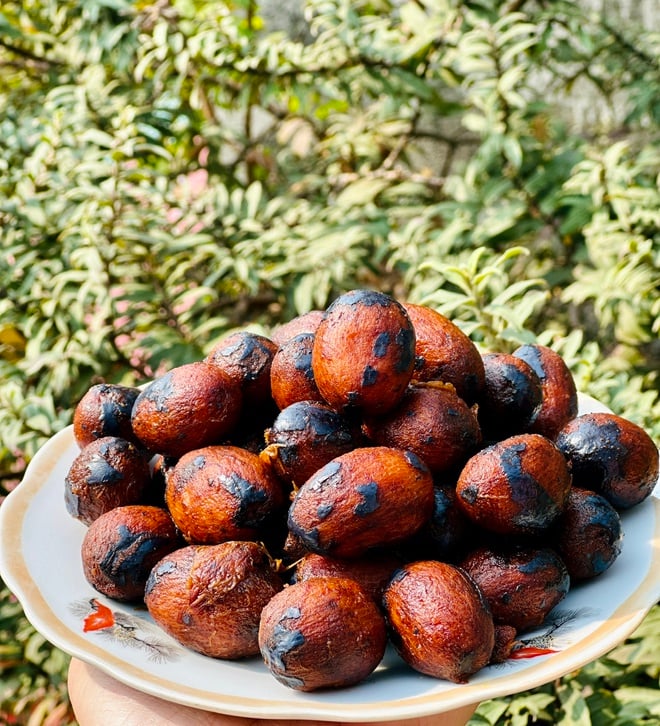

Braised palm fruit - a rustic dish with a unique flavor from the countryside of Phu Tho province.
Photo: Thuy Giang
According to Thuy Giang (from Phu Tho province), who works in journalism, "om," as it's called locally, refers to palm fruit that is prepared by simmering, but only at a moderately hot temperature, not boiling at 100 degrees Celsius like other dishes. The water used to make "om palm" is boiled to about 70 degrees Celsius, then the palm fruit is added and the pot is covered with a lid.
Ms. Giang explained that the palm fruits selected for this dish are sticky palm fruits (small, thick-fleshed), ripe, with a glossy, usually dark purple color, plump and round, and need to be thoroughly washed and scrubbed clean. During the simmering process, the water temperature must be just right to prevent the palm fruits from becoming mushy and to achieve the perfect softness.
When first tasting stewed palm fruit, diners are often surprised by the fact that the palm fruits, which are straw-yellow in color, plump and "firm" when presented on the plate, are actually very soft, nutty, and creamy when eaten.
In the cool spring air, a bowl of hot rice or sticky rice served with braised palm fruit and a piece of pork sausage (made from local pork) is truly a unique and delicious experience. If you have the chance to visit Phu Tho in the early days of the year, braised palm fruit is a dish you shouldn't miss.
In everyday life, palm fruit is considered a food, processed from its flesh (pulp). Biochar produced from palm fruit also helps absorb color from bodies of water, contributing to the removal of pollutants in an environmentally friendly way.
In medicine, palm fruit exhibits strong antioxidant activity thanks to phenolic compounds such as caffeic acid and its derivatives. Additionally, the extract has antibacterial effects, the mechanism of which involves the destruction of bacterial cell membranes. In the digestive and metabolic systems, oil from palm kernel pulp shows anti-ulcer and hepatoprotective effects, and some extracted fractions have the ability to inhibit PTP1B and α-glucosidase, suggesting potential applications in supporting the control of metabolic disorders, especially diabetes.
Dr. Phan Minh Duc (Deputy Head of the Department of Traditional Medicine, University of Medicine and Pharmacy, Vietnam National University , Hanoi )
Source: https://thanhnien.vn/doc-dao-mon-co-om-vung-dat-to-185260210172045641.htm

![[Photo] General Secretary and President To Lam presides over the meeting to approve the draft report on the results of the second inspection by the Politburo of the Standing Committee of the Hanoi City Party Committee.](https://vphoto.vietnam.vn/thumb/1200x675/vietnam/resource/IMAGE/2026/05/26/1779789811432_a2-bnd-4430-9620-jpg.webp)






























































Comment (0)