

The technology marketplace
Since the implementation of the Market 4.0 model, the appearance of many traditional markets in the Mekong Delta has changed significantly. The image of customers withdrawing and counting money has gradually been replaced by quick and convenient QR code scanning and money transfers.
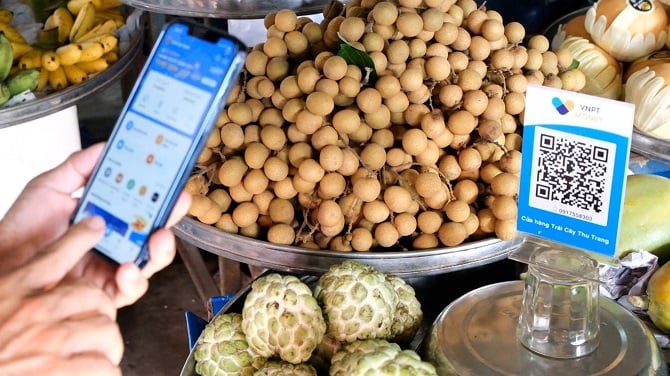
Customers scan a QR code to pay at a retail location.
At Vinh Long market, more than 200 vendors have registered to become cashless payment acceptance points. Ms. Nguyen Thi Thu, a fruit vendor, shared: “At first, I was hesitant, afraid it would be cumbersome. But once I got used to it, I found it very convenient. Customers just need to scan the QR code and it's done, no need to worry about paying too little or too much.”
In Dong Thap province , the "Cù Lao Market 4.0" model implemented at Tan Thuan Dong Market (Cao Lanh ward) is considered a significant step forward in local commerce. The market management board collaborates with banks to support traders in opening accounts and affixing QR codes to each stall for convenient payment. After only a few months of implementation, businesses have already conducted electronic transactions, demonstrating the clear effectiveness of this model.
In Ca Mau , Rach Goc central market is one of the first places to apply this model. Ms. Tran Kim Sang, a grocery vendor, said: "Before, I had to exchange small change every day. Now, customers transfer money, and I receive it quickly and safely, without worrying about counterfeit money." According to statistics from local authorities, more than 90% of vendors at this market have equipped themselves with QR codes, with over 1,000 transactions per month.
According to a representative from the Department of Industry and Trade of Vinh Long province, the Market 4.0 model helps small traders improve their business capabilities, access digital technology, increase transparency in cash flow, support tax management, and prevent commercial fraud. "This is an important step in digital transformation in the traditional trade sector, creating a foundation for expansion throughout the province," the representative emphasized.
Market 4.0 is not just a "market of technology," but also a "market of trust." When payments become simple, transparent, and fast, both buyers and sellers feel more secure, thereby contributing to building an image of a civilized and modern market while still retaining the familiar and welcoming atmosphere of the riverine region.
Rural markets are getting a new look.
The emergence of Market 4.0 has significantly changed people's transaction habits. Instead of carrying a bulky wallet, now with just a smartphone, buyers can easily pay for even the smallest expenses.
In Can Tho City, the Market 4.0 model is being piloted at An Thoi Market, attracting a large number of traders and residents. Ms. Tran Thi Tham, a regular customer at the market, said: “I only need to bring my phone to the market in the morning. Buying fish, vegetables, meat… I just scan the QR code, it’s quick and convenient. Even when I don’t have cash on me, I can still go to the market with peace of mind.”
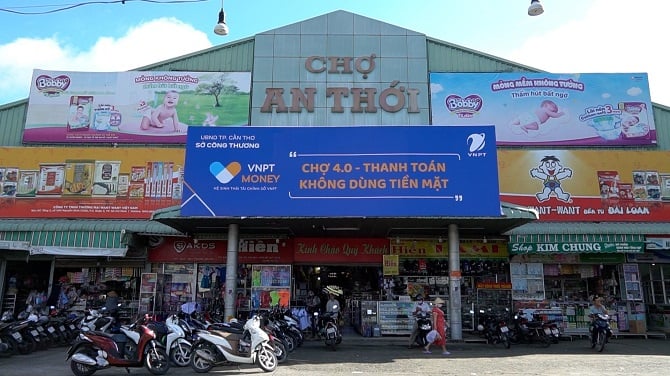
The Market 4.0 model is being piloted at An Thoi Market (Can Tho).
According to the Department of Industry and Trade of Dong Thap province, thanks to specific communication and guidance, people have begun to form a new habit of scanning QR codes instead of taking out their wallets. This method saves time, reduces the risk of loss, and contributes to building a civilized and safe buying and selling environment.
Besides providing convenience for consumers, Market 4.0 also helps management agencies easily monitor business conditions, control revenue, and ensure transparency in transactions. A representative from the Department of Industry and Trade of An Giang province stated that when markets adopt electronic payments, transaction data is stored and retrieved easily, facilitating state management and helping small traders access credit support and promotional programs more easily.
In reality, integrating technology into markets is not just about payment, but also about changing business mindsets. Many small traders, after becoming familiar with digital payments, have boldly sold goods through social media and e-commerce platforms, expanding their customer base and increasing revenue.
With the results achieved, the Market 4.0 model is becoming a symbol of digital transformation in daily life. When people, small traders, and the government work together, the familiar rural markets have taken on a new look – more dynamic, civilized, and modern, while still retaining their strong local identity.
After three years of implementation, the Market 4.0 model has proven its effectiveness: facilitating transactions for small traders, providing easy access to modern payment methods for citizens, and increasing transparency in commercial activities for regulatory agencies. From its initial stages in a few localities, Market 4.0 is now spreading rapidly throughout the country, contributing to the formation of cashless payment habits and promoting comprehensive digital transformation in commerce and social life.
Source: https://doanhnghiepvn.vn/chuyen-doi-so/don-bay-so-hoa-cho-truyen-thong/20251027093942068



![[Photo] General Secretary and President To Lam meets with National Assembly delegates from ethnic minorities.](https://vphoto.vietnam.vn/thumb/1200x675/vietnam/resource/IMAGE/2026/04/20/1776696701056_a1-bnd-8331-3342-jpg.webp)

![[Image] National Assembly discusses the implementation of the socio-economic development plan.](https://vphoto.vietnam.vn/thumb/1200x675/vietnam/resource/IMAGE/2026/04/20/1776696707422_ndo_br_img-20260420-185419-jpg.webp)















































































Comment (0)