

No longer a daily sight as before, wicker baskets, winnowing trays, and rice containers now mainly appear in cultural performances, as a way of remembering a layer of heritage that is gradually fading away.
For the Muong people, weaving is inseparable from their self-sufficient agricultural production. From bamboo, rattan, and other readily available materials in the forest, they have created a system of tools and implements for daily work and living. Each product reflects their understanding of nature, accumulated experience over generations, and a philosophy of living in harmony with the environment.
While not elaborate in form, Muong woven products achieve precision in functionality and durability. From rice drying trays and sieves to storage chests and carrying baskets, every detail is meticulously calculated in each weave and each slat shaping. Many items require high skill, and only skilled craftsmen can complete them, demonstrating that this is not just simple manual labor but a genuine folk art.
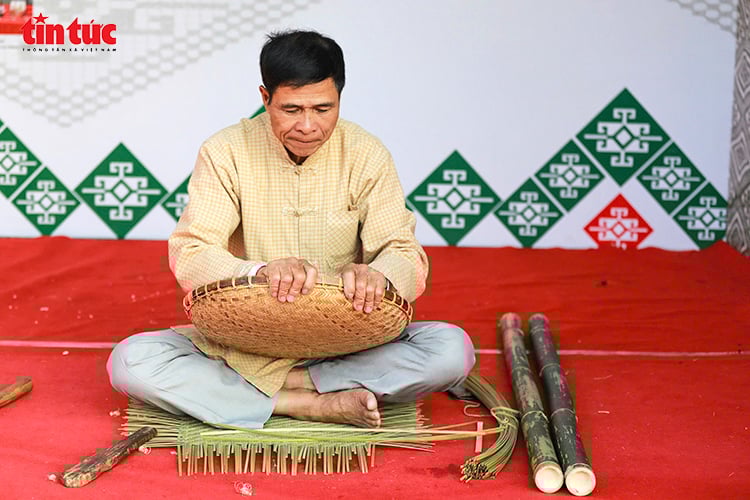
However, with changes in production methods and lifestyles, traditional weaving has gradually lost its former prominence. Plastic and metal products, with their advantages of being lightweight, inexpensive, convenient, and having diverse designs, have quickly replaced handcrafted woven items in many Muong families. Spending a lot of time searching for materials, processing the bamboo strips, and weaving a complete product is no longer suitable for today's fast-paced lifestyle.
This reality leads to a worrying consequence: the next generation of craftspeople is dwindling. Those who still possess the techniques of splitting bamboo strips, weaving baskets, and making mats are mostly elderly. Meanwhile, the younger generation has limited opportunities to learn and access these skills, and some are no longer interested in their ethnic group's traditional crafts. The risk of extinction is therefore real, posing a preservation challenge not only in terms of technique but also in terms of cultural awareness.
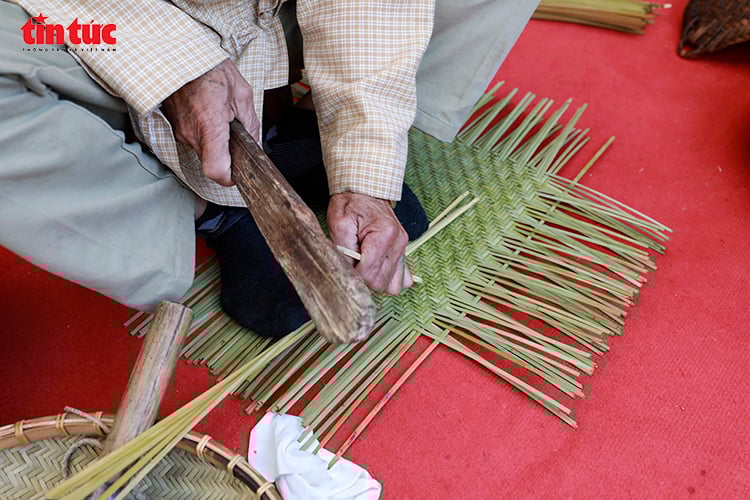
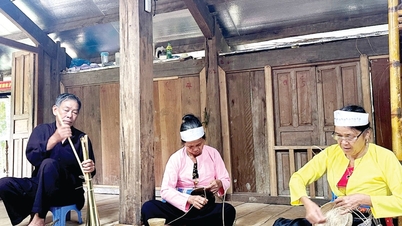
Against this backdrop, bringing the craft of weaving back into community life through cultural activities is considered a necessary direction. At the 2nd Muong Ethnic Culture Festival held at the Vietnam Ethnic Culture and Tourism Village (Hanoi), Muong artisans from various localities such as Hanoi, Phu Tho, Son La, Lao Cai, and Thanh Hoa directly demonstrated their traditional weaving skills.
The calloused hands patiently whittling bamboo strips, weaving, and shaping each basket not only attract the attention of locals and tourists but also create a vibrant experiential space for young people. Through each stage, the value of the craft is "recounted" through visual images, helping viewers understand that completing a woven product is a process requiring skill, perseverance, and years of experience.
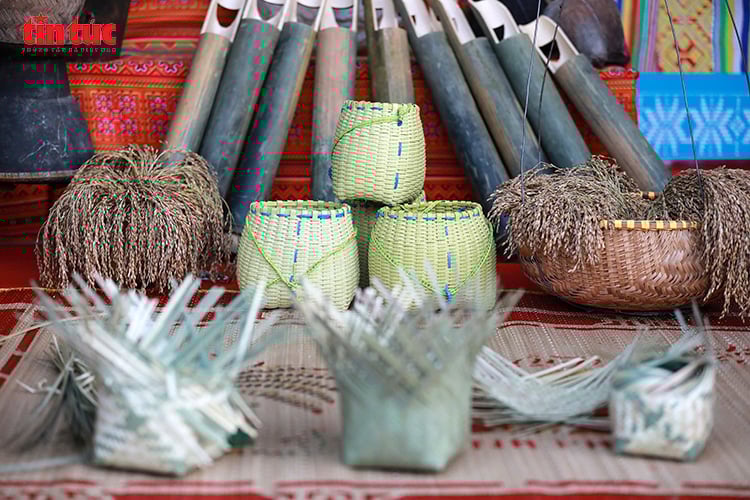
According to the artisans, the demonstrations are not only about showcasing the products but, more importantly, about conveying the cultural story behind each item. It's how the Muong people express their memories of labor, their close relationship with the mountains and forests, and their philosophy of living a restrained life and respecting nature. When a bamboo basket is neglected, it's not just a replacement of an object, but also the erosion of a layer of intangible cultural values.
Cultural researchers argue that preserving the Muong weaving craft should be placed within the overall strategy of preserving ethnic minority heritage, linked to community education and sustainable cultural tourism development. When traditional crafts are given the opportunity to thrive in contemporary life, through experiences, performances, and storytelling, the chances of revival will become clearer.
Preserving the craft of weaving is not only about creating products for economic purposes, but also about preserving a part of the identity of the Muong people. In the context of rapid modernization, conservation activities like the Muong Ethnic Culture Festival are considered a "key" to connecting the past with the present, so that heritage does not remain only in memory but continues to be passed on to future generations.
This article was commissioned by the Legal Department, Ministry of Culture, Sports and Tourism.
Source: https://baotintuc.vn/van-hoa/giu-nghe-dan-lat-cua-nguoi-muong-giua-nhip-song-hien-dai-20251215212441299.htm

![[Image] Leaked images ahead of the 2025 Community Action Awards gala.](/_next/image?url=https%3A%2F%2Fvphoto.vietnam.vn%2Fthumb%2F1200x675%2Fvietnam%2Fresource%2FIMAGE%2F2025%2F12%2F16%2F1765882828720_ndo_br_thiet-ke-chua-co-ten-45-png.webp&w=3840&q=75)
![[Photo] Prime Minister Pham Minh Chinh receives Lao Minister of Education and Sports Thongsalith Mangnormek](/_next/image?url=https%3A%2F%2Fvphoto.vietnam.vn%2Fthumb%2F1200x675%2Fvietnam%2Fresource%2FIMAGE%2F2025%2F12%2F16%2F1765876834721_dsc-7519-jpg.webp&w=3840&q=75)
![[Live] 2025 Community Action Awards Gala](/_next/image?url=https%3A%2F%2Fvphoto.vietnam.vn%2Fthumb%2F1200x675%2Fvietnam%2Fresource%2FIMAGE%2F2025%2F12%2F16%2F1765899631650_ndo_tr_z7334013144784-9f9fe10a6d63584c85aff40f2957c250-jpg.webp&w=3840&q=75)

![[Photo] Prime Minister Pham Minh Chinh receives the Governor of Tochigi Province (Japan)](/_next/image?url=https%3A%2F%2Fvphoto.vietnam.vn%2Fthumb%2F1200x675%2Fvietnam%2Fresource%2FIMAGE%2F2025%2F12%2F16%2F1765892133176_dsc-8082-6425-jpg.webp&w=3840&q=75)








































![[Live] Closing Ceremony and Award Presentation for the "Impressive Vietnam Tourism" Video/Clip Creation Contest 2025](https://vphoto.vietnam.vn/thumb/402x226/vietnam/resource/IMAGE/2025/12/17/1765974650260_z7273498850699-00d2fd6b0972cb39494cfa2559bf85ac-1765959338756946072104-627-0-1338-1138-crop-1765959347256801551121.jpeg)



















Comment (0)