

 |
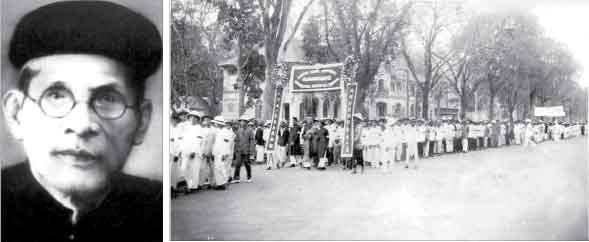
| Huynh Thuc Khang was wholeheartedly loyal to his comrade (left photo) and at Phan Chau Trinh's funeral in Saigon. Photo: Archival material. |
He wrote the epitaph for the tomb of Tran Quy Cap.
When Tran Quy Cap was executed in Khanh Hoa , Huynh Thuc Khang was imprisoned in Hoi An prison. Unable to attend the funeral in person, Mr. Huynh sent his condolences through a poem and a couplet as a substitute for the two incense sticks offered in farewell. The book "Thi Tu Tung Thoai" (Nam Cuong Publishing House, Saigon, 1951), compiled by Mr. Huynh in classical Chinese and translated into Vietnamese by himself, records this story on pages 17 and 18.
The couplet is translated into Vietnamese: "The elder, educated in Western ways, suddenly loses an arm, his vision blurred for miles around; his young friends weep mournfully. / Life is full of both virtue and fame, difficult to achieve; a small official position, his elderly mother leans at the door, heartbroken."
The poem is similar: Swords and books traverse vast distances / Serving as an official for one's mother, not for money / Determined to replace slavery with new learning / Who knows the power of the people will bring about disaster? / The wind on the island has not yet carried away the dream / Ancient Nha Trang has already wept for its sacred spirit / Farewell, the wine still warm / Da Nang bids farewell as we board the boat.
Notably, Huynh Thuc Khang was the one who wrote the inscription for the tomb of Tran Quy Cap, which still remains today at his grave in Bat Nhi village (Dien Phuoc commune, Dien Ban town). In 1938, the people of Dien Ban and the Tran clan renovated the tomb and erected a stele for Tran Quy Cap. Huynh Thuc Khang was entrusted with writing the inscription. He wrote "Thai Xuyen Tran Quy Cap Tien Sinh Tieu Truyen" (A Short Biography of Mr. Thai Xuyen Tran Quy Cap). This text, although only about 2,000 words long and written under colonial rule, uses concise language and is rich in information, fully describing the thoughts, activities, personality, and especially the hidden "confessions" of Tran Quy Cap.
Researcher Tran Viet Ngac stated: "Reading the tomb inscription, anyone would know that Tran Quy Cap was an intelligent student, avid reader, a very thoughtful person, a loyal friend, a filial son, a tireless teacher, and a revolutionary who advocated for people's rights..."
Write a biography of Phan Châu Trinh
For Phan Châu Trinh, Huỳnh Thúc Kháng was also a witness to his final moments, reading the eulogy, seeing him off to his final resting place, and writing a biography about the life of the "first politician and revolutionary" of Vietnam.
Although Phan Châu Trinh, having returned to Vietnam in June 1925, was eager to meet Huỳnh Thúc Kháng for both public and private matters, they had to wait until the end of March 1926 before they could meet, by which time it was already too late.
In the book "Huynh Thuc Khang's Chronology and Letter in Reply to Prince Cuong De" (Culture and Information Publishing House, 2000), the author states on page 61: "In the first year of Bao Dai's reign (Binh Dan - 1926), in February, I received news that Tay Ho was seriously ill, urging me to go south. However, I had to go through the procedures to obtain an identity card, which took several days. By the time I arrived in Saigon, Tay Ho's illness had worsened; he couldn't even sit up. We could only look at each other and smile, but when we spoke, there were final words: 'It is enough that we have seen each other on this earth for such a short time; our lifelong courage has illuminated each other, there is no need to discuss further.' From that night, Tay Ho passed away!"
In the article "Portrait of Phan Châu Trinh in the Eyes of His Son," abridged by Nguyễn Văn Xuân, quoting Mrs. Phan Thị Châu Liên (Phan Châu Trinh's eldest daughter) and published in the special March 1974 issue of Bách Khoa magazine (commemorating the 48th anniversary of Phan Châu Trinh's death), there is a passage that reads: “Mr. Huỳnh Thúc Kháng, my uncle's close friend, was also eager to come but was hindered by Sogny with paperwork and had to travel by sea, so he arrived late… It was almost evening on March 24th that Mr. Huỳnh finally arrived, just long enough for my uncle to exchange one last smile…” (Quoted from Lê Thị Kinh in "Phan Châu Trinh through new documents," Da Nang Publishing House, pages 618, 621).
At Phan Châu Trinh's funeral on the morning of April 4, 1926, Huỳnh Thúc Kháng, representing Central and Northern Vietnam, delivered a eulogy that was considered brief but moving, bidding farewell to his comrade as he was laid to rest. This eulogy was read after the eulogy by the Chairman of the Gò Công Mutual Aid Association and the eulogy by revolutionary Lê Văn Huân.
Unfortunately, we do not have the original eulogy, but we know that a "well-meaning" newspaper assessed the eulogies as: "...emotionally charged and very evocative praise for a great man, representing a great idea who has passed away, and with a commitment to continue his noble and enduring example." (Quoted from Le Thi Kinh, op. cit., page 657).
In his eulogy, Huynh Thuc Khang also stated that "Mr. Phan Chau Trinh was not only a patriotic intellectual but truly the first revolutionary politician of Vietnam."
After the funeral, Huynh Thuc Khang returned to Tien Phuoc and began writing a biography of Phan Chau Trinh. He then went to Da Nang and gave the manuscript to Professor Le Am and his wife, instructing them to keep it safe and publish it when the time was right. It wasn't until 1959 that Anh Minh Publishing House in Hue published it under the title "Phan Tay Ho Tien Sinh Dat Su" (Unofficial History of Mr. Phan Tay Ho). This is considered the first book written about Phan Chau Trinh. (It is rumored that Phan Khoi had previously written a similar book, but it was confiscated by the French authorities and never published, leaving no trace).
Indeed, Huynh Thuc Khang brilliantly fulfilled his duty to his two compatriots, fellow students, classmates, and above all, comrades!
LE THI
Source: https://baodanang.vn/channel/5433/202505/het-long-nghia-tan-with-comrade-4006283/


































































Comment (0)