

To usher the country into a new era, it is necessary to shift the foundation from "financial capital" to "data capital," transforming traditional production relations/methods into new ones in a rational, efficient, and successful manner.
| EDITORIAL NOTE - NEW ERA FORUM After being elected General Secretary of the 13th Central Committee of the Communist Party of Vietnam at the Central Committee meeting on August 3, 2024, General Secretary To Lam has delivered important directives in various fields. Specifically, in three recent articles such as "Determined to build a strong Party, a prosperous, democratic, just, and civilized Vietnam" (August 4); "Digital transformation - An important driving force for developing productive forces, perfecting production relations, and bringing the country into a new era" (September 2); and "Continuing to innovate the Party's leadership and governance methods, an urgent requirement of the new revolutionary stage" (September 16), General Secretary To Lam frequently mentions the concepts of "new starting point," "new era," and "the era of the Vietnamese nation's rise." Assessing the opportunities, advantages, difficulties, and challenges in the domestic, regional, and global situation, the Party, led by General Secretary To Lam, affirmed: “The country is facing a new historical moment, a new era, an era of national resurgence. The urgent need for strong innovation in leadership methods and improved leadership and governance capabilities to continue advancing the nation is paramount.” In particular, this is also a major orientation agreed upon by the 10th Central Committee Conference in the draft documents submitted to the 14th Party Congress. Accompanying the country into this new era, VietNamNet newspaper is launching the forum "The New Era of the Nation," aiming to bring together articles, voices, and suggestions from intellectuals, scholars, and readers near and far on the path and methods of Vietnam's national resurgence... |

General Secretary To Lam receives Nick Ammann, Vice President for Global Government Relations at Apple. Photo: Lam Khanh/VNA.
First, we need to understand what digital transformation is. Digital transformation is a revolution in thinking towards a new form of social organization. In this, technology is the driving force, the digital society is the foundation, and it is led by the shift from financial capital to data capital. This concept comprehensively addresses the nature, role, and position of the digital transformation process as described above. It indicates that the digital transformation process, through a revolution in thinking, will contribute to creating new production relations or new forms of social organization, helping to unlock the potential of new productive forces that science and technology, along with the digital revolution, have brought about and impacted all aspects of political , economic, and social life. This new production relationship will also correspond to a new production environment and a new mode of production – the digital mode of production – in a new environment (digital society). In this, data becomes a crucial resource or means of production, where data capital will become as important as financial capital. The digital transformation process needs to be driven by four key priorities identified by the General Secretary: Firstly , perfecting institutions and the legal system, steadfastly pursuing the goal of building a socialist-oriented market economy , while continuously innovating to keep pace with the development trends of the times; Secondly , unlocking and maximizing all social resources, accelerating modernization; Thirdly , reforming and building a streamlined, effective, and efficient state apparatus; Fourthly , promoting digital transformation while ensuring security and safety is an objective necessity for Vietnam to break through in the new era. For the digital transformation process to truly become a new development method (digital development method) leading Vietnam to a new level of development through "developing productive forces, perfecting production relations, and ushering the country into a new era," we need to: Clearly understand : How the digital transformation process becomes a new development method in order to realize it in policies, guidelines, projects, activities, and actions – through perfecting a theory of digital transformation as a new development method. Clearly grasp : What the digital transformation process encompasses, its nature, methods, and objectives; that is, clearly understand what we will transform, through what process, and by what means, and what it will transform into. Deep understanding : Based on this, the digital transformation process is clearly defined, encompassing specific levels, stages, and processes to ensure a standardized, systematic, synchronized, and effective approach nationwide, from the central to local levels, encompassing the Party, State, and government systems, as well as individual ministries, organizations, agencies, localities, citizens, and businesses, all participating effectively in the digital transformation process, transforming development methods, and achieving successful transformations. Correct action : Accordingly, implementation is carried out through specific programs, plans, and proposals tailored to the practical realities, characteristics, requirements, conditions, capabilities, and objectives of each level, sector, organization, locality, and entity. This is done proactively, consistently, and with concerted effort, ensuring the digital transformation process achieves optimal speed. At the same time, effectively transform traditional production relations/methods into new production relations/methods in a rational, efficient, and successful manner. Based on the above orientations, some directions to realize these specific proposals are: Firstly , through the completion and publication of the book "Promoting the National Digital Transformation Process" (National Political Publishing House, September 2023 - commissioned by the State), we have completed a comprehensive and holistic theory on digital transformation as a new development method to lead Vietnam to a new level of development. Specifically, this is concretized with content that fully, correctly, and effectively addresses the guidance of the General Secretary: + Clearly stating the vision of the digital transformation process as building the capacity to proactively participate in the Fourth Industrial Revolution (Resolution 52-NQ/TW). + This study conceptualizes and specifically explains the concept of digital transformation, encompassing its inner meaning, outer scope, and nature, as well as the fundamental concepts related to digital transformation in a systematic way. This forms the basis and foundation for building relevant content to shape how to create that capacity. + Simultaneously, it concretizes this through the three pillars of the national digital transformation process: Digital Government, Digital Economy, and Digital Society, clearly showing the dialectical relationship between these three pillars, as well as how to promote each pillar within this dialectical relationship. These are crucial foundations for understanding what we need to do and how to do it. + In conjunction with this, to ensure the Party's leadership role and the State's management, the digital transformation process will contribute through administrative and institutional reforms, enhancing the Party's leadership role and the State's management to be modern, effective, and efficient, thus guiding the national digital transformation process. + Furthermore, guidance should be provided on how to evaluate and measure the digital transformation process in conjunction with political, economic, and social goals so that the digital transformation process truly contributes to transformation, acting as a method, a process, and a tool to lead and manage socio-economic development to achieve the set goals. + Place the digital transformation process at the heart of the country's rapid and sustainable development. It is necessary to clearly state that rapid and sustainable development based on science and technology, innovation, and digital transformation will create a qualitative shift in development, a new development orientation that needs to be created. Therefore, the digital transformation process is the leading focus, science and technology is the driving force, and innovation is the driving force. + Specifically, it clarifies the viewpoints, objectives, tasks, and solutions of the National Digital Transformation Program (Decision 749/QD-TTg) in a concrete, focused, solution-oriented, foundational, and strategic manner. + Finally, it clarifies how the national digital transformation process will contribute to bringing Vietnam towards a new level of development.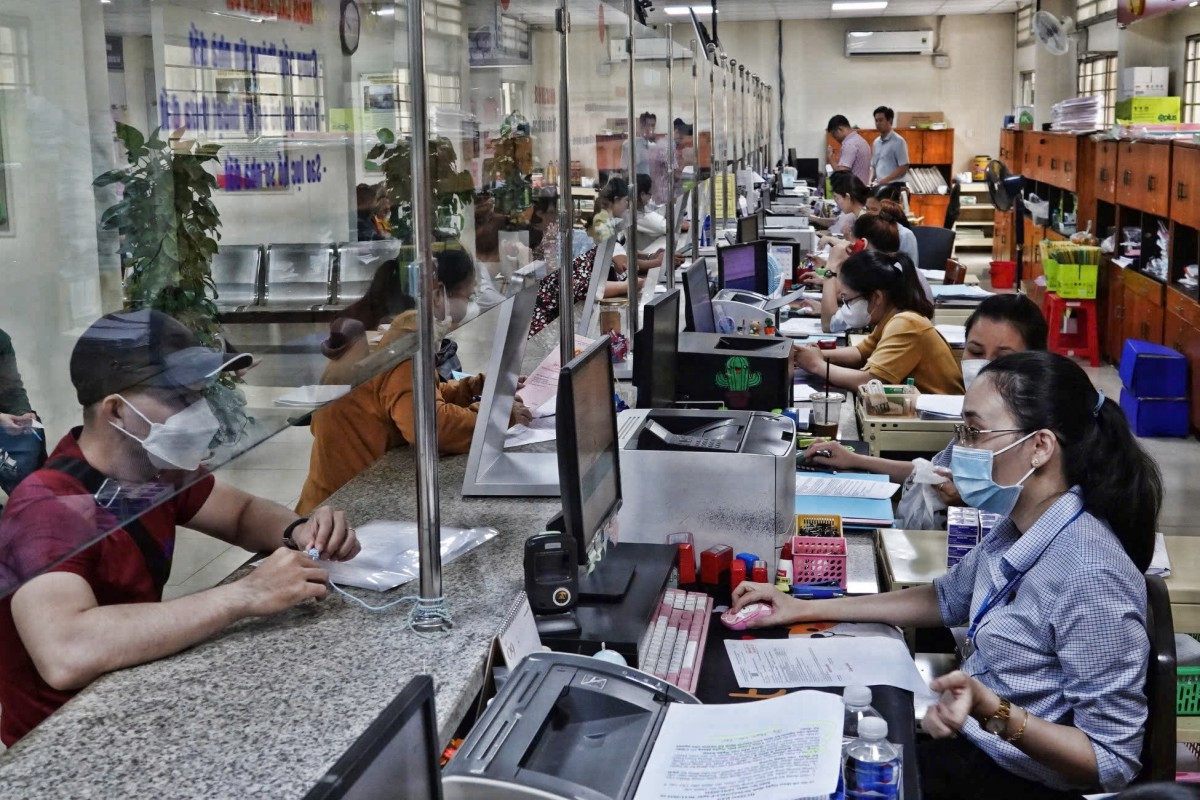
By 2025, Ho Chi Minh City will move its entire public service system to the digital environment. Photo: Ho Van
Secondly , it is necessary to place the "steering wheel" of the digital transformation process in the hands of the highest authorities to truly coordinate in a unified, systematic, synchronized, and effective manner the national digital transformation process at all levels, ministries, sectors, localities, and the entire society on a common ship. Through this: i) Building a comprehensive master plan for the entire national digital transformation process, encompassing planning, architecture, implementation, and governance of the digital transformation process within a national digital strategy. On this basis, all relevant policies, guidelines, strategies, etc., should be integrated into a single overall framework, ensuring the integration of these specific contents into a systematic, synchronized standard that creates effective synergy. Simultaneously, this should serve as a guide for concretizing, implementing, and realizing related contents from the legislative, executive, and judicial branches. ii) To establish a national-level Data Agency directly under the Central Party Committee to ensure the integration of all data hub systems, database systems, data infrastructure systems, and data usage systems into a national Data Platform Architecture, enabling the formation of a data-driven Social Operating System. This is crucial for the role of "holding" and "mastering" the most important productive forces of the new era through "holding" and "mastering" the foundation of new production relations/modes - the digital mode of production. iii) Assigning the responsibility of leading and managing the digital transformation process to top leaders at all levels, departments, and organizations, along with systematic and comprehensive training on digital transformation as a new development method, is crucial. This will enable leaders to gain a deep understanding, which will lead them to act correctly and clearly recognize the significance of their role in the digital transformation process, transforming this understanding into their leadership and management strength. Currently, this is a major obstacle and bottleneck in the digital transformation process, as many top leaders at all levels do not truly understand the nature, role, and position of digital transformation. It is essential and urgent to include this content as mandatory in formal leadership training and development programs at all levels. iv) Based on a thorough understanding of digital transformation, it is necessary to build a specific mechanism for the digital transformation process to shape budget structures, investment, and investment management, allowing for the effective mobilization of resources from the entire society to contribute effectively to investment in the digital transformation process.Vietnamnet.vn
Source: https://vietnamnet.vn/hieu-sau-hanh-dong-dung-ve-chuyen-doi-so-giup-dat-nuoc-phat-trien-2334734.html
![[Photo] Prime Minister Pham Minh Chinh receives the Governor of Tochigi Province (Japan)](/_next/image?url=https%3A%2F%2Fvphoto.vietnam.vn%2Fthumb%2F1200x675%2Fvietnam%2Fresource%2FIMAGE%2F2025%2F12%2F16%2F1765892133176_dsc-8082-6425-jpg.webp&w=3840&q=75)
![[Live] 2025 Community Action Awards Gala](/_next/image?url=https%3A%2F%2Fvphoto.vietnam.vn%2Fthumb%2F1200x675%2Fvietnam%2Fresource%2FIMAGE%2F2025%2F12%2F16%2F1765899631650_ndo_tr_z7334013144784-9f9fe10a6d63584c85aff40f2957c250-jpg.webp&w=3840&q=75)
![[Image] Leaked images ahead of the 2025 Community Action Awards gala.](/_next/image?url=https%3A%2F%2Fvphoto.vietnam.vn%2Fthumb%2F1200x675%2Fvietnam%2Fresource%2FIMAGE%2F2025%2F12%2F16%2F1765882828720_ndo_br_thiet-ke-chua-co-ten-45-png.webp&w=3840&q=75)
![[Photo] Prime Minister Pham Minh Chinh receives Lao Minister of Education and Sports Thongsalith Mangnormek](/_next/image?url=https%3A%2F%2Fvphoto.vietnam.vn%2Fthumb%2F1200x675%2Fvietnam%2Fresource%2FIMAGE%2F2025%2F12%2F16%2F1765876834721_dsc-7519-jpg.webp&w=3840&q=75)






















































![[Video] Independence and self-reliance linked with international integration through 40 years of reform](https://vphoto.vietnam.vn/thumb/402x226/vietnam/resource/IMAGE/2025/12/16/1765899635777_1-1-8054-png.webp)





























Comment (0)