

My wife says that after drinking alcohol, her breath smells strongly of alcohol, and kissing transfers alcohol, resulting in a positive breathalyzer test. I've never encountered a case like this before. Is this true? (Son, 33 years old, Hanoi )
Reply:
The majority of alcohol in the body is eliminated through urine. A portion is also eliminated through sweat and breath. When a person drinks alcohol, their breath and saliva will contain alcohol, especially gastric reflux, which has a relatively high concentration of alcohol.
Therefore, when kissing a drunk person for a relatively long time, you may "catch" some alcohol. At this time, your mouth also absorbs a small amount of alcohol from the drunk person's saliva or refluxed stomach fluids. However, the amount of alcohol entering the mouth and respiratory tract of the person you are kissing is low in concentration and is quickly metabolized in the liver, so it cannot cause intoxication.
Therefore, kissing someone who has just drunk alcohol can still result in contracting alcohol, although it is very rare.
In China, on June 6, 2020, a woman was found to have a blood alcohol level exceeding the legal limit while driving. However, the woman insisted she hadn't drunk alcohol. A blood alcohol test showed zero. She explained that she had driven to pick up her intoxicated boyfriend and they had kissed before getting into the car, a kiss that may have lasted a considerable amount of time.
Based on blood test results and the woman's explanation, traffic police believe the two may have kissed for an extended period, causing the woman's oral alcohol level to exceed the legal limit. To date, no similar case has been recorded worldwide .
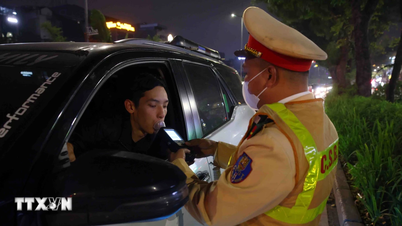
In Vietnam, by law, drivers of cars, motorbikes, and scooters are not allowed to have alcohol in their blood while driving. Therefore, if you kiss someone who is drunk, a breathalyzer test might still show alcohol. In this case, you can request a blood test for more accurate results.
We cannot accurately calculate how long it takes for the alcohol in our breath and blood to disappear after consuming alcoholic beverages. On average, the body eliminates 15 milligrams of alcohol from the blood every hour. The higher the alcohol content of the drink, the longer it takes for the body to metabolize it.
You can calculate your blood alcohol level and the time it takes to reach zero after drinking, using the table below.
Experts recommend that men should not drink more than two units of alcohol a day, women no more than one unit a day, and not drink more than five days a week. One unit of alcohol is equivalent to 10 grams of pure alcohol in a beverage, which is about three-quarters of a 330 ml bottle or can of beer (5%), or a 330 ml glass of draft beer, or a 100 ml glass of wine (13.5%), or a 30 ml shot of spirits (40%).
Doctor Tran Van Phuc
Saint Paul Hospital
Source link



![[Photo] General Secretary and President To Lam receives Amazon's Senior Vice President David Zapolsky](https://vphoto.vietnam.vn/thumb/1200x675/vietnam/resource/IMAGE/2026/05/22/1779466547770_a1-bnd-3513-6601-jpg.webp)



























































































Comment (0)