

 |
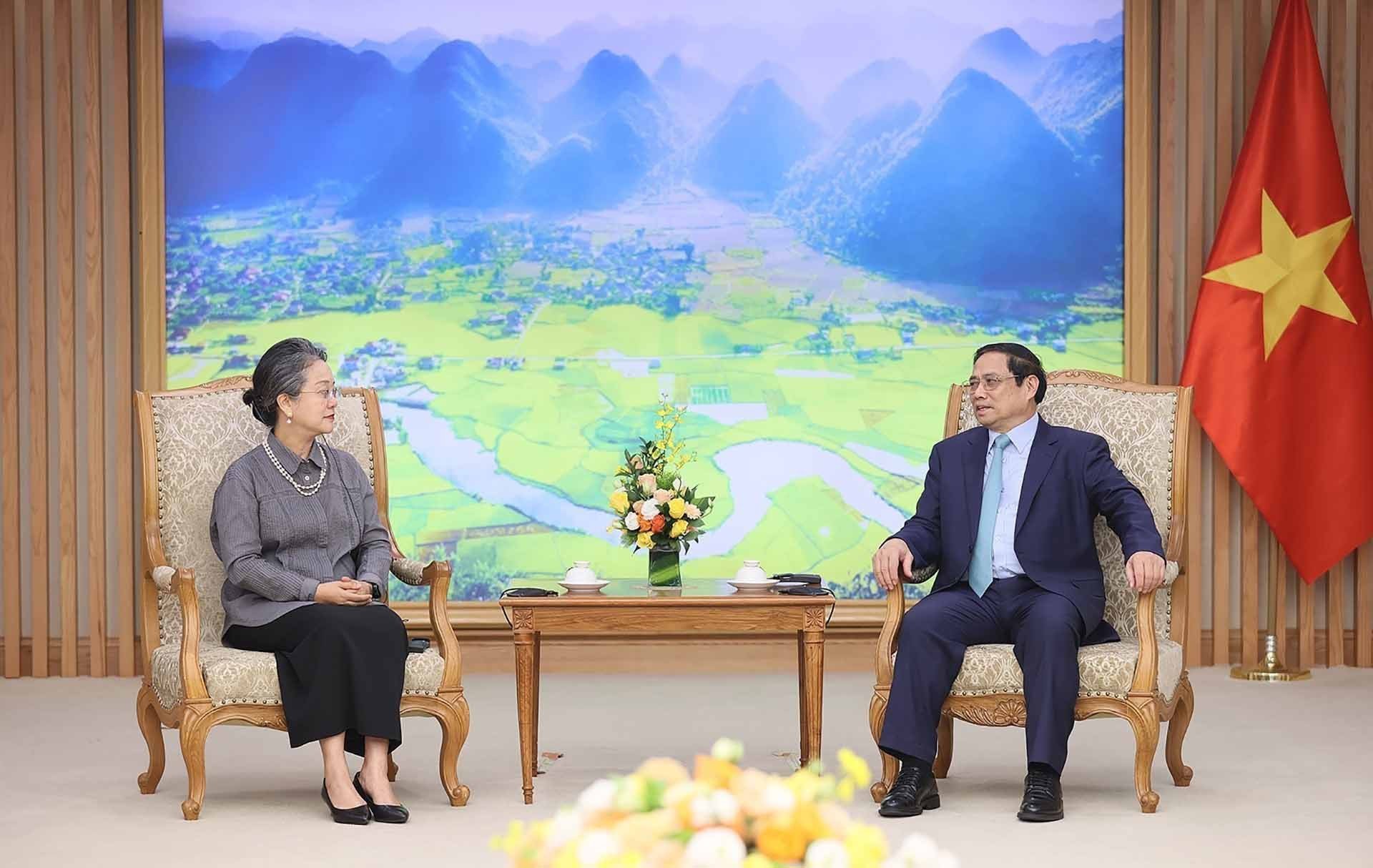
| Prime Minister Pham Minh Chinh received Ms. Armida Salsiah Alisjahbana, Deputy Secretary-General and Executive Secretary of the United Nations Economic and Social Commission for Asia and the Pacific . (Source: VNA) |
During the visit, Ms. Armida Salsiah Alisjahbana paid a courtesy call on Prime Minister Pham Minh Chinh, held talks with Foreign Minister Bui Thanh Son, worked with leaders of several ministries and agencies, and participated in activities such as listening to reports on initiatives aimed at achieving the Green School goal.
Ms. Armida Salsiah Alisjahbana's visit to Vietnam follows the visit of UN Secretary-General Antonio Guterres in October 2022, demonstrating the high regard and importance that the UN in general and ESCAP in particular have for Vietnam's role, position, and contributions in the Asia-Pacific region.
On the Vietnamese side, the invitation extended by Foreign Minister Bui Thanh Son to the UN Deputy Secretary-General and Executive Secretary of ESCAP to visit Vietnam also affirms ESCAP's important position in Vietnam's multilateral foreign policy and highly appreciates its role and position in the Asia-Pacific region.
This also serves as a thank you for ESCAP's practical support over the years and demonstrates Vietnam's strong commitment to further strengthening cooperation with ESCAP in the future.
A new approach is needed.
A reality recognized by both the UN and Vietnam is that although the world and the region are halfway to achieving the 2030 Agenda for Sustainable Development, they are facing significant challenges. The Asia-Pacific region in general, and Vietnam in particular, are confronting intractable problems related to climate change.
In addition, the severe and profound impacts of the Covid-19 pandemic and current global challenges such as conflict, food and water insecurity, natural disasters, biodiversity degradation, environmental pollution, etc., have affected the current socio-economic recovery and development process.
Therefore, international cooperation, enhancing the role of multilateralism, and ensuring that "no one is left behind" continue to be the guiding principles and key elements emphasized by Vietnam and the UN in their exchanges on this occasion.
During his meeting with Ms. Armida Salsiah Alisjahbana, Prime Minister Pham Minh Chinh emphasized that global issues affecting all people require a global, people-to-people approach; especially ensuring fairness and justice. Vietnam highly values the role of the UN in promoting multilateral cooperation to address global issues, as well as the important contributions of ESCAP to socio-economic development in the Asia-Pacific region.
As a responsible partner of the international community, facing challenges that are universal to Vietnam, Vietnam is one of the leading countries in the region in its commitments to promoting sustainable development, especially its strong commitment to net-zero emissions by 2050 and its recent green and sustainable energy transition.
Vietnam is building an independent and self-reliant economy, coupled with proactive and comprehensive international integration that is substantive and effective. In this process, Vietnam places people at the center, as the subject, goal, driving force, and resource of development; it will not sacrifice progress, social justice, or the environment for mere economic growth; it affirms that Vietnam highly values efforts to promote a peaceful, cooperative, and developing environment in the world; and it is determined to develop its people and protect nature and the living environment.
Witnessing Vietnam's impactful journey, from "words to action," in its efforts and commitments to implementing the Sustainable Development Goals (SDGs), responding to climate change, deploying the Just Energy Transition Partnership (JETP), digital transformation, socio-economic development, and sustainable post-Covid-19 recovery, Ms. Armida Salsiah Alisjahbana believes that Vietnam will achieve its socio-economic development goals and become a model that can share experiences with many other countries.
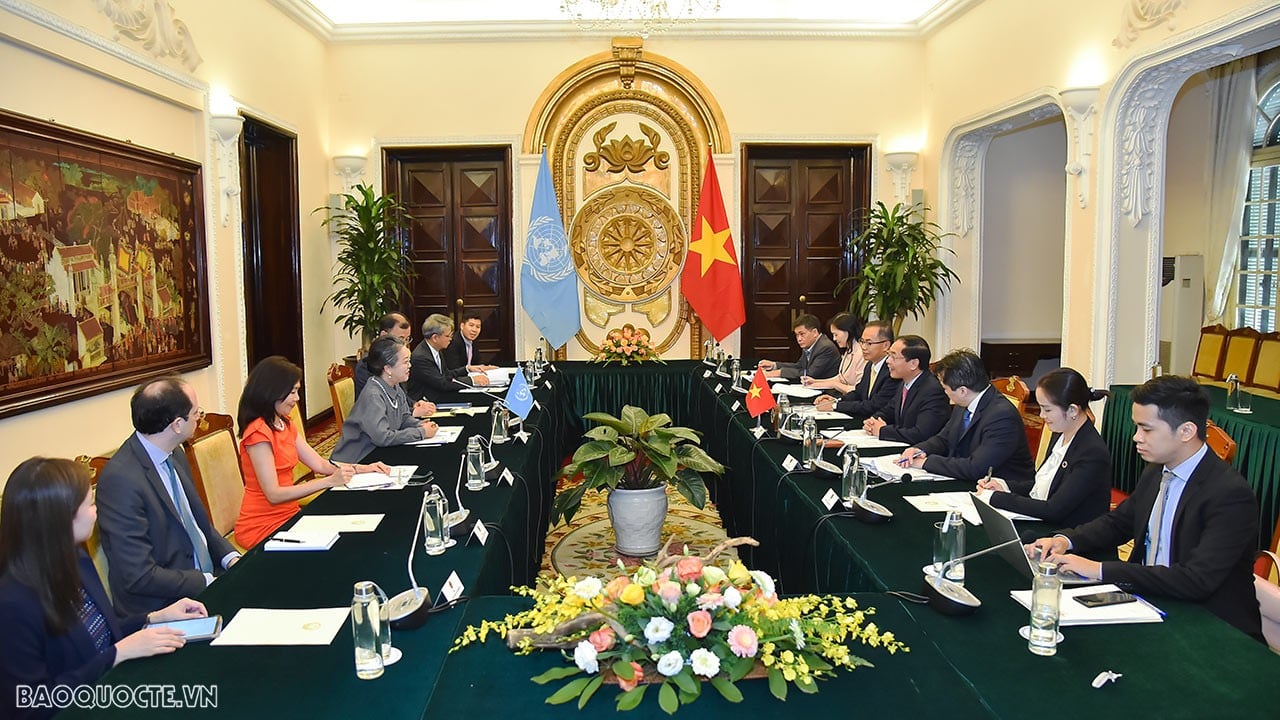 |
| Foreign Minister Bui Thanh Son held talks with the Deputy Secretary-General of the United Nations and Executive Secretary of ESCAP, Armida Salsiah Alisjahbana, on July 3. (Photo: Tuan Anh) |
Take advantage of practical support.
ESCAP is the largest and most important international organization in the Asia-Pacific region for promoting sustainable development, and has been implementing many important initiatives to support development in the region. Vietnam and other developing countries in the region have benefited greatly from ESCAP's advisory activities, policy coordination, and projects. In return, Vietnam has always actively and effectively contributed to ESCAP. Both sides affirmed their desire to strengthen cooperation with each other.
In the context of Vietnam's current situation, the issues that ESCAP prioritizes are also major issues of concern to the Vietnamese Government. This alignment creates favorable conditions for ministries and agencies to strengthen cooperation and leverage ESCAP's assistance.
During the visit of the UN Deputy Secretary-General, both sides exchanged views and highly appreciated the positive developments in their cooperative relationship in recent times, and discussed measures to further strengthen cooperation in the future.
Over the past period, Vietnam has implemented many collaborations and secured practical support from ESCAP, especially in three areas: policy and strategy planning for socio-economic development; directions and policies to address difficulties in a specific field or issue; and capacity building for officials through training courses and specialized workshops on macroeconomic policies, social issues, agricultural development, transportation, information and communication, statistics, disaster prevention and mitigation, and environmental protection.
Some recent projects include: a comprehensive study on inclusive business models in Vietnam; an assessment of Vietnam's readiness in the field of cross-border paperless trade; and the development of a national database on SDG implementation.
Through these collaborative projects, Vietnam has had the opportunity to access new knowledge, exchange experiences, and expand its network of partners in the region. This has contributed to enhancing Vietnam's understanding and capacity in sustainable and inclusive socio-economic development, as well as improving the effectiveness and sustainability of policies, and creating favorable conditions for Vietnam to move further towards achieving the SDGs.
| ESCAP is one of five regional economic and social commissions under the United Nations Economic and Social Council (ECOSOC), entrusted by ECOSOC with the responsibility of being a "Center for Economic and Social Development in the Asia-Pacific Region". |
A National Forum on SDGs in 2024
It can be affirmed that the most important and common "destination" at this time for both Vietnam and ESCAP is the implementation of the SDGs.
In numerous multilateral forums, Vietnam has urged the international community to continue cooperating with and supporting Vietnam in implementing the SDGs, its commitments at COP26, and the Partnership for a Just Energy Transition; while emphasizing that Vietnam will continue to cooperate closely with ESCAP and other international partners to promote peace, stability, and prosperity in the region and the world based on the principle of "leaving no one behind".
That message was further conveyed by the Vietnamese side to the Deputy Secretary-General of the UN on this occasion.
In response, Ms. Armida Salsiah Alisjahbana affirmed her readiness to discuss with Vietnam the possibility of organizing a National Forum on SDGs in 2024; and her willingness to support Vietnam in accelerating the implementation of SDGs, preparing to participate in the SDG Summit organized by the UN Secretary-General in September 2023 in New York, on just energy transition, climate change adaptation, and digital transformation.
Both sides also agreed to strengthen cooperation in areas such as climate change adaptation, JETP implementation, transition to green electricity and energy for transportation, development of green transport infrastructure, capacity building in statistics, digital transformation, science and technology, and innovation for sustainable development…
Thus, the visit of the UN Deputy Secretary-General to Vietnam at a crucial time for both the region and the world, when the 2030 "target" faces many obstacles, has yielded practical results for both Vietnam and ESCAP, opening a new phase in substantive and effective cooperation between the two sides, contributing to promoting the implementation of the SDGs in the Asia-Pacific region.
Source


![[Photo] Two flights successfully landed and took off at Long Thanh Airport.](/_next/image?url=https%3A%2F%2Fvphoto.vietnam.vn%2Fthumb%2F1200x675%2Fvietnam%2Fresource%2FIMAGE%2F2025%2F12%2F15%2F1765808718882_ndo_br_img-8897-resize-5807-jpg.webp&w=3840&q=75)































































Comment (0)