

On December 12th, the Legal Department (Ministry of Agriculture and Environment) and the Food and Agriculture Organization of the United Nations (FAO) in Vietnam organized a technical workshop titled "Implementing Article 6 of the Paris Agreement on Climate Change in Sustainable, Low-Emission Food Systems in Vietnam".
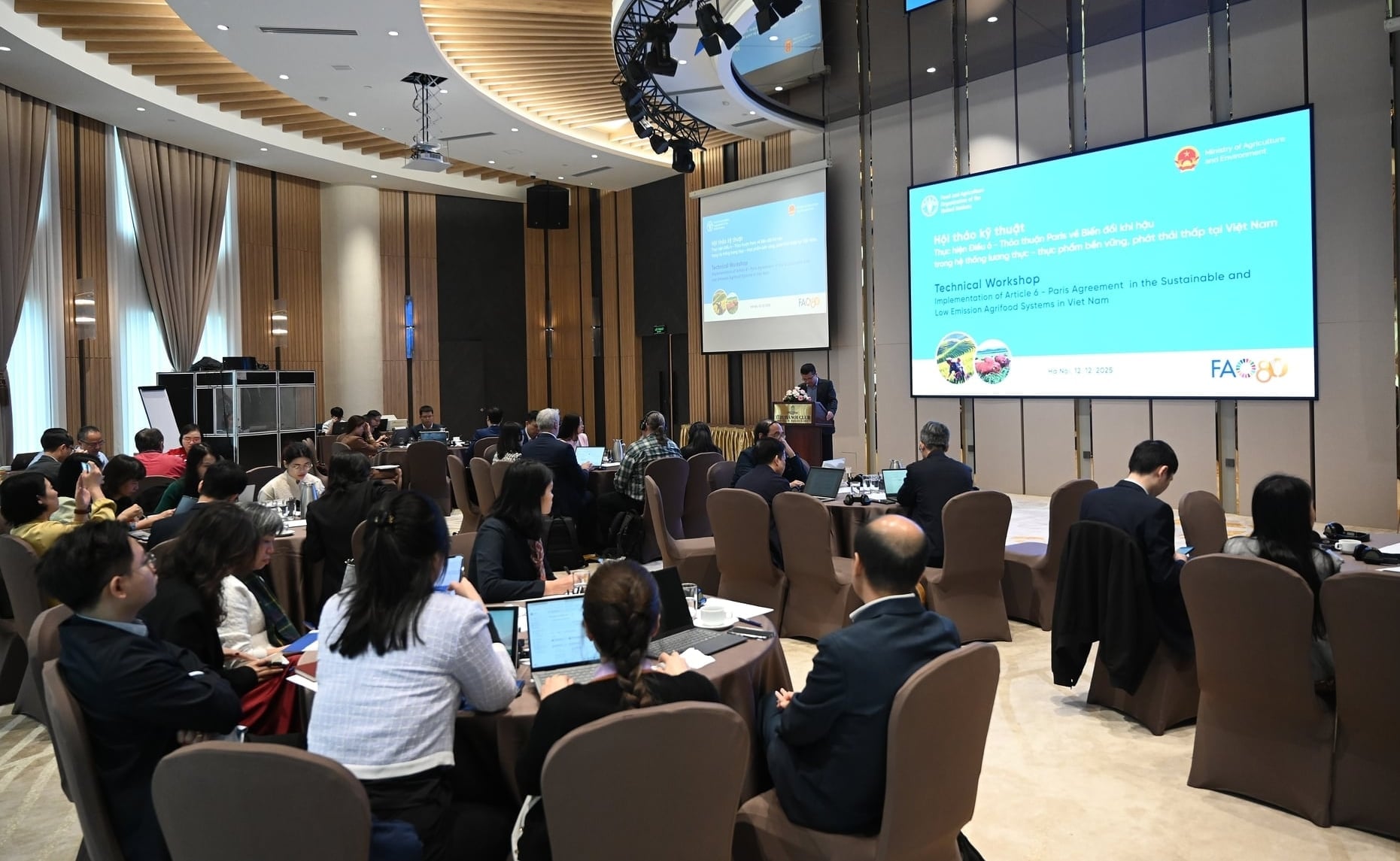
Parties contributed ideas on the roadmap for implementing carbon market participation for sectors within the low-emission agro-food system. Photo: Kieu Chi.
Great potential for participation in the global carbon market.
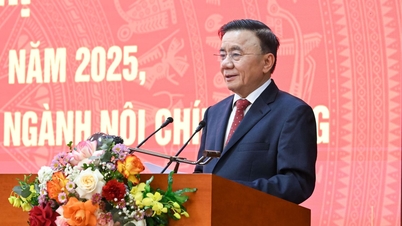
Ms. Ha Thu Trang, Deputy Director of the Legal Department (Ministry of Agriculture and Environment), stated that a robust legal framework for the carbon market allows Vietnam to implement Articles 6.2 and 6.4 and integrate deeply into the global carbon market.
Some important documents directly related to this include Decision No. 232/QD-TTg approving the Project on establishing and developing a domestic carbon market with a pilot emissions trading system (ETS) from June 2025 and full implementation by 2029, and Decree 119/2025/ND-CP amending and supplementing some articles of Decree No. 06/2022/ND-CP on greenhouse gas emission reduction and ozone layer protection...
Vietnam has signed three cooperation agreements with Japan (JCM since 2013), South Korea, and most recently Singapore, creating a foundation to more strongly promote the bilateral transfer of global mitigation outcomes. Financially, the TCAF Fund ( World Bank) has committed to supporting the purchase of carbon credits worth approximately US$40 million and the development of an MRV system.

Ms. Ha Thu Trang, Deputy Director of the Legal Department (Ministry of Agriculture and Environment), speaks at the event co-organized with FAO Vietnam. Photo: Kieu Chi.
"These advancements open up great opportunities for carbon projects in the agricultural sector, especially rice, where low-emission farming models can generate certified carbon credits and participate in the ETS system," Ms. Trang commented.
According to Mr. Nguyen Song Ha, Assistant Head of FAO Representation in Vietnam, the cost of responding to climate change is increasing, accounting for 3-5% of GDP, while the budget only covers nearly 30%. Vietnam is facing a financial gap to implement NDC measures, agricultural transformation, and a low-carbon agro-food system.
The carbon credit trading mechanism stipulated in Article 6 of the Paris Agreement on climate change opens up significant opportunities to mobilize additional international climate finance for the implementation of emission reduction commitments in Vietnam's NDC, and in the agriculture and food sector in particular.
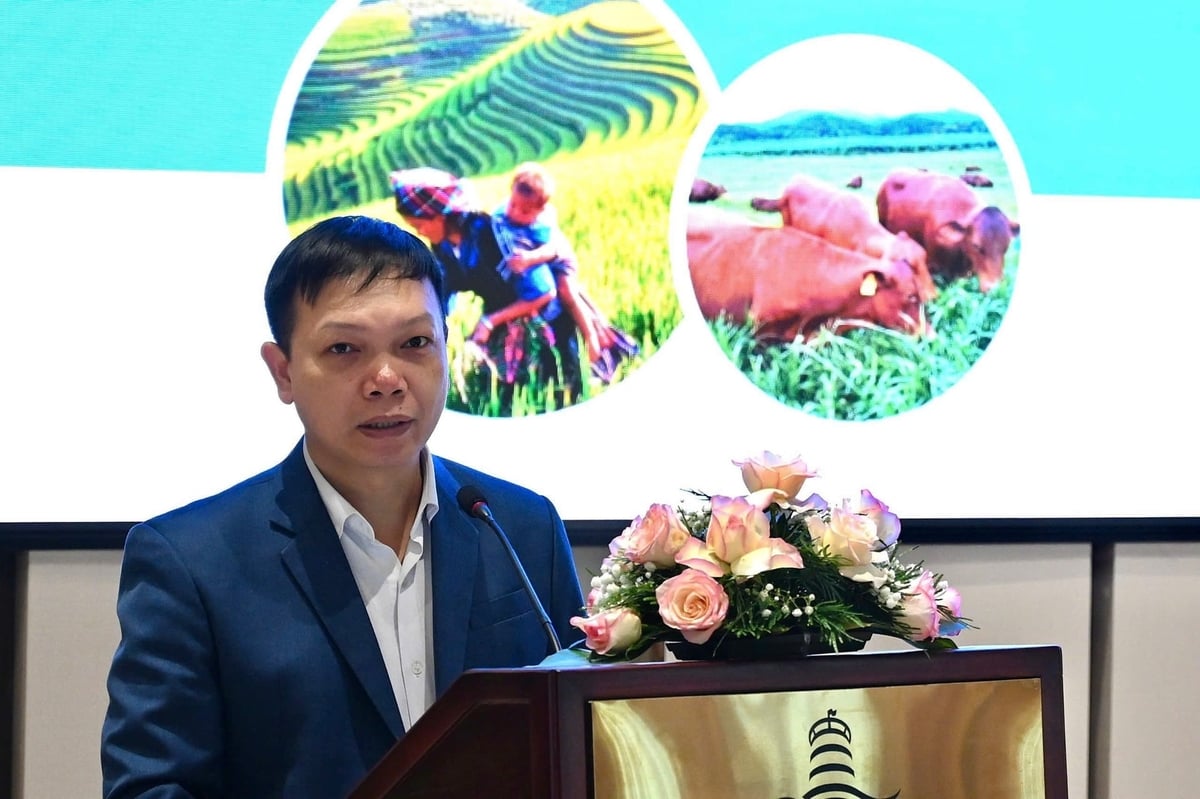
According to Mr. Nguyen Song Ha, Vietnam possesses enormous potential in developing carbon-exchange projects under the mechanism of Article 6 of the Paris Agreement within the food system. Photo: Kieu Chi.
Agriculture and livestock farming aim for high emission reduction targets.
For the crop production sector, the roadmap to participating in the carbon market requires integrating multiple plans simultaneously: applying emission reduction techniques, mechanization, high-quality rice varieties, and implementing major projects such as the 1 million hectare program for high-quality, low-emission rice and the crop production emission reduction project. The crop production sector aims to reduce emissions by 43.5% by 2030.
According to experts, for carbon-based agricultural projects to succeed, they need careful planning, thorough documentation, and assurance that emission reduction measures are maintained in accordance with regulations.
In the livestock industry, there is currently a lack of emission reduction solutions based on animal digestive enzymes. It is projected that by 2030, the industry could reduce approximately 47 million tons of CO2.
The roadmap is designed based on the plan to build a domestic carbon market, focusing on the readiness of policies, governance, processes, and project operations. The period from 2025 to 2028 will be a pilot phase, including proposals for institutional improvements, capacity building, and model testing; while clearly defining the scope, types of implementation, and coordination methods for emission reduction projects in livestock farming.
Next, it is necessary to improve the legal regulations and procedures for registering and transferring project results, and to establish a unified and transparent national registration system. Along with that, the MRV system also needs to be upgraded and updated; especially in agriculture, many second-order emission factors related to animal feed digestion are missing and need to be developed.
Finally, it is necessary to improve the organizational and coordination mechanisms throughout the livestock industry, strengthen biosecurity management, and organize farms in a way that encourages participation in carbon projects.
Mr. Pham Nam Hung, representative of the Climate Change Department (Ministry of Agriculture and Environment), noted that over the past five years, the carbon market has seen strong development, creating clear opportunities for businesses to achieve emission reduction results. For Vietnam's NDC, the ambitious goal of reducing emissions by 15.8% by 2030, in the context of economic growth, requires strong commitment and support to help businesses enhance their competitiveness.
Source: https://nongnghiepmoitruong.vn/lap-lo-trinh-tham-gia-thi-truong-cac-bon-cho-he-thong-luong-thuc-thuc-pham-d788956.html





































































Comment (0)