

"After 5 years of establishment, the National Partnership for Action (NPAP) on Plastics in Vietnam has gradually affirmed its role as a platform for substantive action," Deputy Minister of Agriculture and Environment Le Cong Thanh stated in the opening remarks at the 7th NPAP Implementation Working Group Workshop on December 16th.
Beyond just public-private dialogue, NPAP is an effective collaborative mechanism where partners jointly identify problems, provide scientific evidence to support policy development, test solutions, share implementation experiences, and aim for tangible and sustainable impacts.
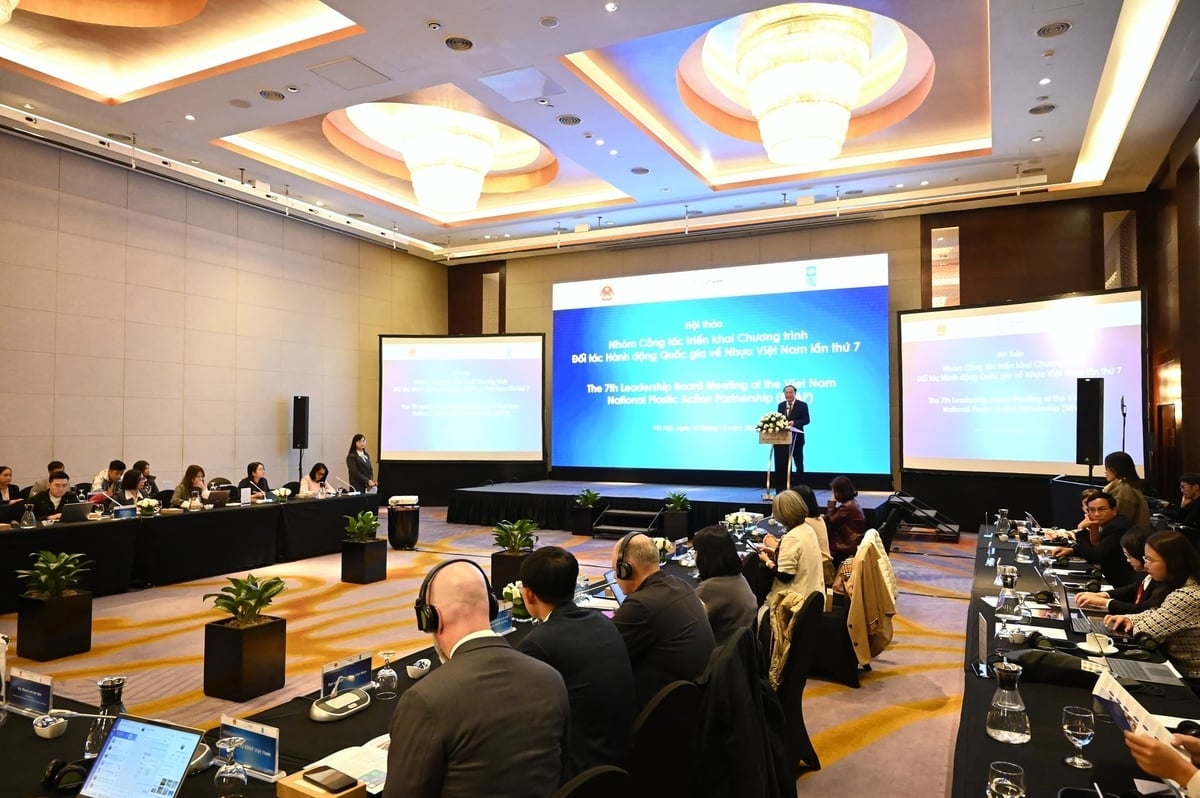
On December 16th, the Ministry of Agriculture and Environment, in collaboration with UNDP Vietnam, organized the 7th Working Group Workshop on NPAP Implementation. Photo: Kieu Chi.
Deputy Minister of Agriculture and Environment Le Cong Thanh - Head of the NPAP group - affirmed the promotion of mobilizing and effectively utilizing financial resources for plastics-related actions, with a focus on strengthening connectivity, encouraging private sector participation, and facilitating the transformation of domestic and international capital into concrete projects and initiatives.
Announced at the conference, the NPAP financing roadmap in Vietnam until 2030 is estimated to require between $7.5 and $8.5 billion to comprehensively address plastic pollution, from upstream interventions: reducing and replacing plastic use; to downstream: collecting and developing infrastructure for plastic processing.
Furthermore, the Ministry of Agriculture and Environment continues to refine policies for transforming business models related to the collection, recycling, and treatment of plastic waste in accordance with environmental standards, aiming to create significant momentum for scaling up and replicating sustainable solutions. Actions regarding plastic will be closely linked to Vietnam's sustainable development goals.
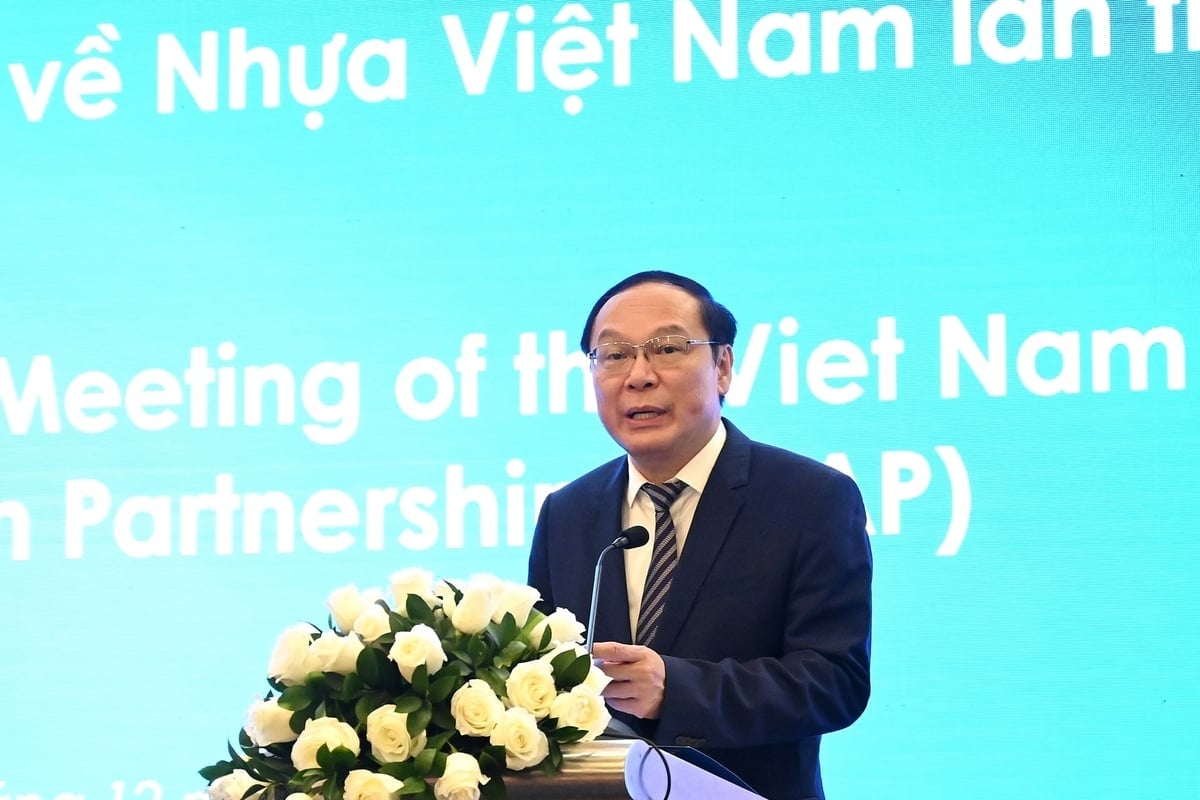
Deputy Minister Le Cong Thanh emphasized the need to transform financial investments, innovation, policy frameworks, and private sector participation into tangible impacts on the plastics industry. Photo: Kieu Chi.
Deputy Minister Thanh emphasized that Vietnam has proactively chosen a proactive approach focused on prevention and transformation, rather than simply addressing the resulting consequences. Plastic pollution is not merely an environmental issue, but a problem of socio-economic development, closely linked to production-consumption models, market structure, and the way in which social resources are mobilized.
Therefore, the solution to plastic pollution cannot stop at collection or processing alone, but requires a systemic approach based on appropriate policies, market mechanisms, innovation, and multilateral cooperation.
Ms. Ramla Khalidi, UNDP Representative in Vietnam, noted the impressive figures achieved by NPAP after five years. To date, the partnership program has involved 200 organizations, mapping over 160 projects to address plastic pollution, thereby catalyzing more than 570 innovative solutions. Private sector participation is increasing, driven by green credit products from banks and investment flows for startups.
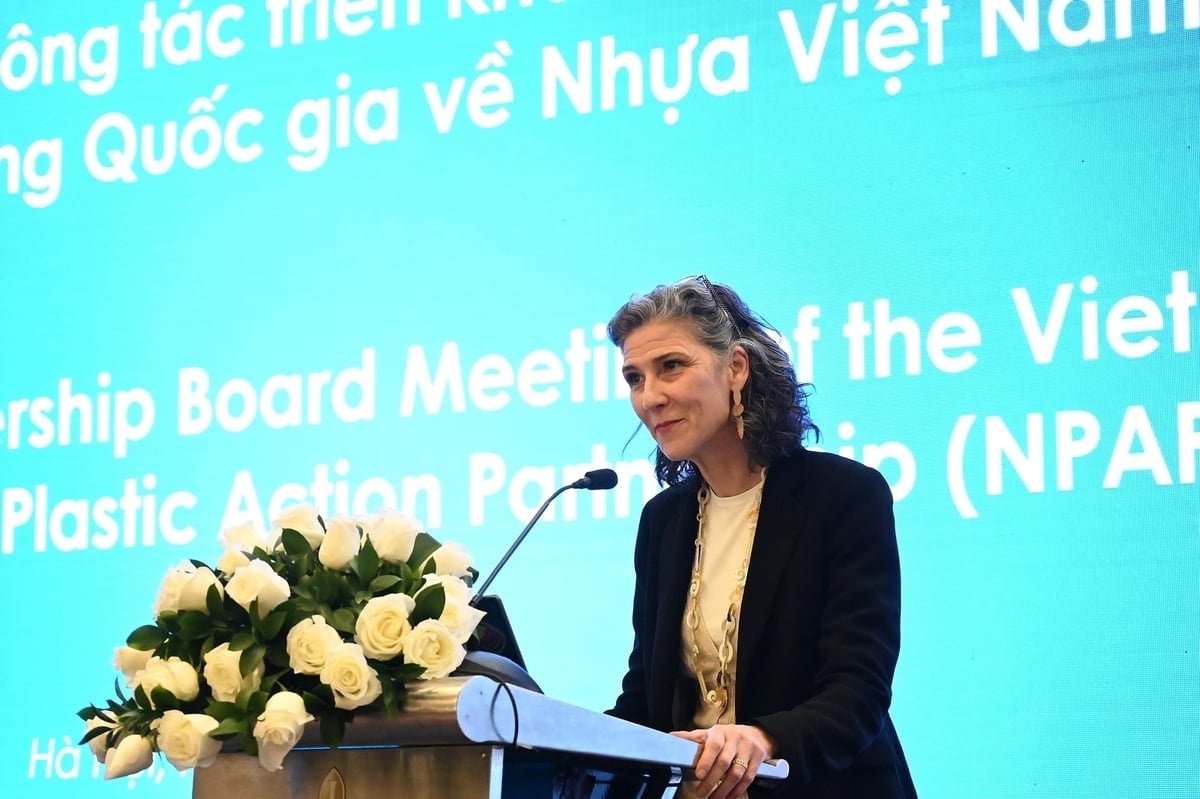
Ramla Khalidi, Head of UNDP Vietnam, highlighted two priorities for 2026 and Vietnam's ambition to significantly reduce plastic pollution by 2030. Photo: Kieu Chi.
"Large-scale financial mobilization, public finance, is necessary, but it will not be enough. Filling this gap depends on private investment in projects with clearly managed risks and returns," Ramla Khalidi shared, adding that connecting policy and investment projects is where NPAPs create value.
According to the UNDP Representative in Vietnam, Vietnam has made a "leap forward" in policy, successfully transitioning from voluntary incentive measures to a more comprehensive and mandatory EPR framework.
In the future, the sustainable impact of NPAP will depend on the shared responsibility of development partners and NGOs to invest in, innovate, and scale up solutions. As an active partner, UNDP Vietnam calls on all stakeholders to contribute financially and technically to support future initiatives.
Beyond financial objectives, the NPAP Vietnam Secretariat expects to strengthen institutional coordination among regulatory agencies and develop a synchronized recycling market ecosystem, aiming to integrate and support the informal sector in plastic waste management. Simultaneously, it seeks to promote resilient and inclusive waste management in urban and suburban areas.
Speakers updated on the progress and shared the results of several important studies conducted by NPAP member organizations, including: the Plastics Innovation Transition Study 2020-2025; initial findings from the Biodiversity and Plastics Study in Vietnam; a summary of some international research results and experiences relevant to Vietnam conducted by the World Bank; and practical lessons on plastic recycling from Coca-Cola.
The Financial Roadmap for Plastic Action in Vietnam to 2030 report serves as a key reference point for stakeholders in policy development, program design, and implementation of specific initiatives within the framework of the NPAP Vietnam Program.
Source: https://nongnghiepmoitruong.vn/huy-dong-nguon-luc-cong--tu-cho-muc-tieu-tuan-hoan-nhua-d789674.html

![[Live] 2025 Community Action Awards Gala](/_next/image?url=https%3A%2F%2Fvphoto.vietnam.vn%2Fthumb%2F1200x675%2Fvietnam%2Fresource%2FIMAGE%2F2025%2F12%2F16%2F1765899631650_ndo_tr_z7334013144784-9f9fe10a6d63584c85aff40f2957c250-jpg.webp&w=3840&q=75)
![[Image] Leaked images ahead of the 2025 Community Action Awards gala.](/_next/image?url=https%3A%2F%2Fvphoto.vietnam.vn%2Fthumb%2F1200x675%2Fvietnam%2Fresource%2FIMAGE%2F2025%2F12%2F16%2F1765882828720_ndo_br_thiet-ke-chua-co-ten-45-png.webp&w=3840&q=75)
![[Photo] Prime Minister Pham Minh Chinh receives the Governor of Tochigi Province (Japan)](/_next/image?url=https%3A%2F%2Fvphoto.vietnam.vn%2Fthumb%2F1200x675%2Fvietnam%2Fresource%2FIMAGE%2F2025%2F12%2F16%2F1765892133176_dsc-8082-6425-jpg.webp&w=3840&q=75)

![[Photo] Prime Minister Pham Minh Chinh receives Lao Minister of Education and Sports Thongsalith Mangnormek](/_next/image?url=https%3A%2F%2Fvphoto.vietnam.vn%2Fthumb%2F1200x675%2Fvietnam%2Fresource%2FIMAGE%2F2025%2F12%2F16%2F1765876834721_dsc-7519-jpg.webp&w=3840&q=75)



































![[Photo] Prime Minister Pham Minh Chinh attends the Vietnam Economic Forum 2025](https://vphoto.vietnam.vn/thumb/402x226/vietnam/resource/IMAGE/2025/12/16/1765893035503_ndo_br_dsc-8043-jpg.webp)


















Comment (0)