

The Israeli military announced on March 19 that it had resumed ground operations in central and southern Gaza Strip to expand Tel Aviv's control over the Netzarim corridor.
In addition to expanding control over the Netzarim corridor, the Israeli military said the ground operation also aimed to create a partial buffer zone between the north and south of the Gaza Strip.
According to The Guardian , this move represents a significant escalation in Israel's latest offensive on Gaza, coming less than 36 hours after a major wave of airstrikes killed more than 400 people.
Israeli army begins new ground operation in Gaza.
The Netzarim Corridor is an area in the Gaza Strip occupied by the Israeli military since 2023. This corridor divides the Gaza Strip into two halves, located just south of Gaza City and stretching from the Gaza-Israel border to the Mediterranean Sea.
The Israel Defense Forces (IDF) consider this corridor essential for carrying out raids in northern and central Gaza, as well as safely delivering aid into the area.
Israeli Prime Minister Benjamin Netanyahu said the decision to resume attacks in Gaza was made after Hamas rejected a proposal to extend the first phase of the ceasefire agreement in the Gaza Strip by 30-60 days.
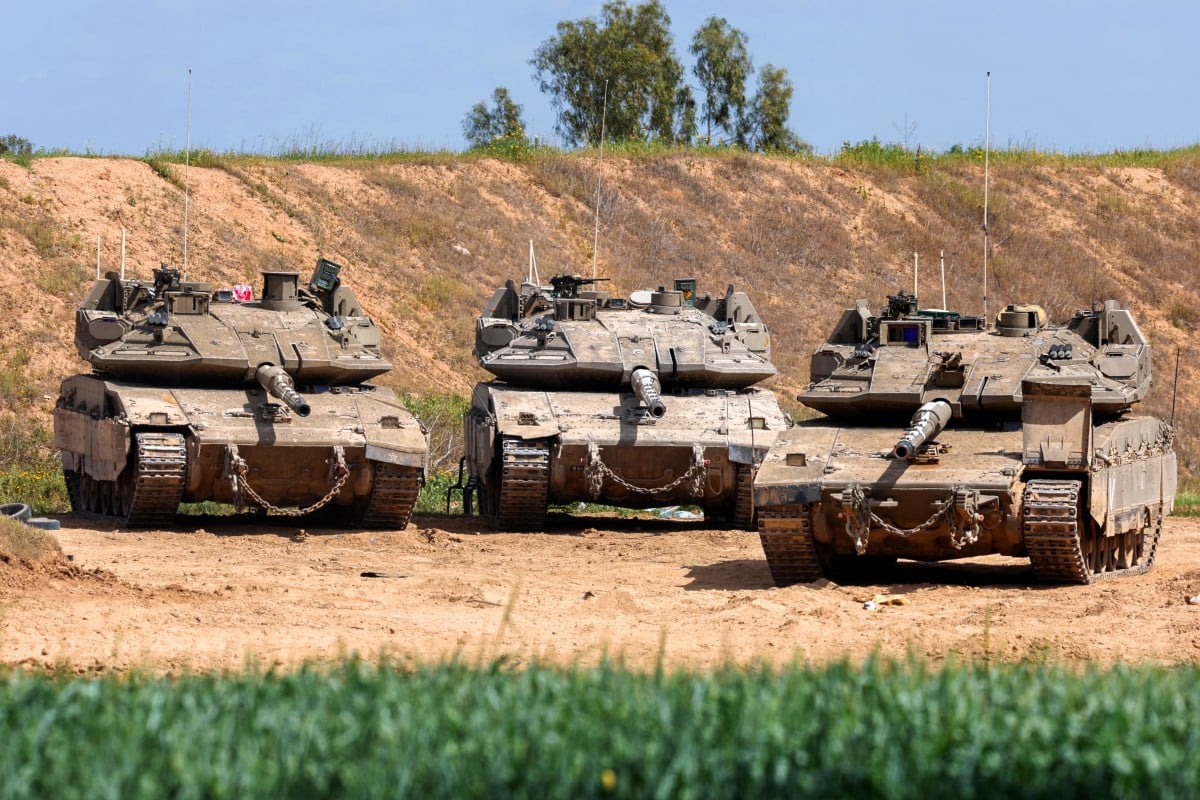
Israeli military tanks were deployed along Israel's southern border with the northern Gaza Strip on March 19, 2025.
Hamas said the ground operation and the incursion into the Netzarim corridor constituted a "new and dangerous violation" of the ceasefire agreement between the group and Israel. In a statement, the group reaffirmed its commitment to the agreement and called on the mediating parties to "fulfill their responsibilities."
"Hamas is not closing the door to negotiations, but we maintain that there is no need for new agreements," Hamas official Taher al-Nunu said on March 19.
The U.S. State Department criticized Hamas for continuing hostilities in the Gaza Strip, while leaving open the possibility of a U.S. "The opportunity is still there, but it's slipping away quickly," a State Department spokesperson said.
The United Nations says an Israeli airstrike on central Gaza on March 19 killed one UN staff member and injured five others. UN Secretary-General Antonio Guterres called for a full investigation and condemned any attacks on UN personnel.
On March 19, French President Emmanuel Macron and King Abdullah II of Jordan also called for an end to the fighting between Hamas and Israel through diplomatic means. Airstrikes in the Gaza Strip have caused instability in Israel, including recent protests in Jerusalem.
Analysts say Israel launched new airstrikes to "break the deadlock." Professor Danny Orbach, a military history expert at the Hebrew University (Israel), assessed: "There is a very good reason why Israel does not want to move to phase 2 of the ceasefire agreement. If it agrees, Hamas will remain in Gaza and in power, while Israel will also have to lift the siege. There is a complete disagreement between the interests of the two sides."
Source: https://thanhnien.vn/israel-phat-dong-chien-dich-บน-bo-de-kiem-soat-hanh-lang-netzarim-o-gaza-185250320072823579.htm

![[Photo] Prime Minister Pham Minh Chinh receives Lao Minister of Education and Sports Thongsalith Mangnormek](/_next/image?url=https%3A%2F%2Fvphoto.vietnam.vn%2Fthumb%2F1200x675%2Fvietnam%2Fresource%2FIMAGE%2F2025%2F12%2F16%2F1765876834721_dsc-7519-jpg.webp&w=3840&q=75)

![[Image] Leaked images ahead of the 2025 Community Action Awards gala.](/_next/image?url=https%3A%2F%2Fvphoto.vietnam.vn%2Fthumb%2F1200x675%2Fvietnam%2Fresource%2FIMAGE%2F2025%2F12%2F16%2F1765882828720_ndo_br_thiet-ke-chua-co-ten-45-png.webp&w=3840&q=75)
![[Photo] Prime Minister Pham Minh Chinh receives the Governor of Tochigi Province (Japan)](/_next/image?url=https%3A%2F%2Fvphoto.vietnam.vn%2Fthumb%2F1200x675%2Fvietnam%2Fresource%2FIMAGE%2F2025%2F12%2F16%2F1765892133176_dsc-8082-6425-jpg.webp&w=3840&q=75)
![[Live] 2025 Community Action Awards Gala](/_next/image?url=https%3A%2F%2Fvphoto.vietnam.vn%2Fthumb%2F1200x675%2Fvietnam%2Fresource%2FIMAGE%2F2025%2F12%2F16%2F1765899631650_ndo_tr_z7334013144784-9f9fe10a6d63584c85aff40f2957c250-jpg.webp&w=3840&q=75)


















































![[Photo] Prime Minister Pham Minh Chinh attends the Vietnam Economic Forum 2025](https://vphoto.vietnam.vn/thumb/402x226/vietnam/resource/IMAGE/2025/12/16/1765893035503_ndo_br_dsc-8043-jpg.webp)






























Comment (0)