

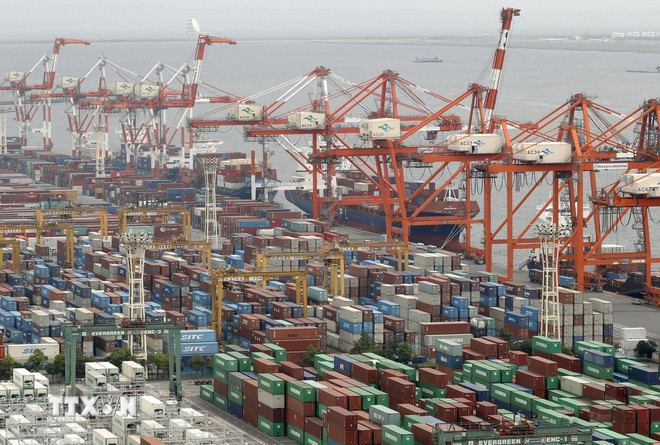
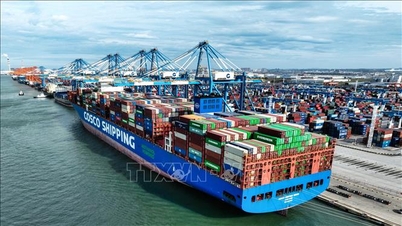
View of a cargo port in Tokyo, Japan. Photo: Kyodo/VNA
According to a VNA correspondent in New York, the United Nations Conference on Trade and Development (UNCTAD) has released its Trade and Development Report 2025, which states that changes in financial markets are affecting global trade, almost equivalent to real economic factors, thereby affecting the overall growth outlook. The report said that although new technologies such as artificial intelligence (AI) bring positive momentum, global growth in 2026 is still forecast to remain at a low level of 2.6%. UNCTAD also noted that the forecast is calculated using market exchange rates (MER), different from the purchasing power parity (PPP) method of the Organization for Economic Cooperation and Development (OECD), which has a higher global growth forecast.
On the same day, the OECD also announced a forecast that world GDP growth will slow from 3.2% in 2025 to 2.9% in 2026.
UNCTAD Secretary-General Rebeca Grynspan said the figures showed that financial conditions increasingly determine the direction of global trade. “Trade is not just about supply chains, it is also about credit flows, payment systems, money markets and capital flows,” she stressed. Grynspan noted that the financial and trade systems are so closely linked that any market volatility or instability has a strong impact on global trade.
The report also highlights that more than 90% of global trade relies on bank financing, with US dollar liquidity and cross-border payment systems essential. This makes trade closely linked to global financial and monetary conditions; any change in interest rates or investor sentiment in a major financial center can impact trade volumes worldwide.
UNCTAD forecasts that developing economies will grow by 4.3% in 2025, significantly faster than developed economies. However, high financing costs, volatile capital flows and climate-related risks are limiting the fiscal space and investment capacity needed to sustain growth. Many developing countries, with small domestic financial markets, still have to borrow from abroad, at interest rates of 7-11%, compared with 1-4% in large developed economies. In addition, countries that regularly experience extreme weather pay an additional $20 billion a year in interest.
In this context, UNCTAD calls for reforms to reduce financial vulnerabilities, improve predictability and strengthen the links between trade, finance and development. Suggested measures include modernizing trade rules, reforming the international monetary system, limiting exchange rate and capital flow volatility, developing capital markets to expand long-term financing, and building an integrated policy framework that recognizes the links between trade, finance and sustainable development.
Ms. Grynspan emphasized that trade cannot be separated from finance and true resilience requires integrated policies that recognize the links between trade, finance and sustainable development.
Thanh Tuan - Linh To (Vietnam News Agency)














![[Photo] Worshiping the Tuyet Son statue - a nearly 400-year-old treasure at Keo Pagoda](/_next/image?url=https%3A%2F%2Fvphoto.vietnam.vn%2Fthumb%2F1200x675%2Fvietnam%2Fresource%2FIMAGE%2F2025%2F12%2F02%2F1764679323086_ndo_br_tempimageomw0hi-4884-jpg.webp&w=3840&q=75)
![[Photo] Parade to celebrate the 50th anniversary of Laos' National Day](/_next/image?url=https%3A%2F%2Fvphoto.vietnam.vn%2Fthumb%2F1200x675%2Fvietnam%2Fresource%2FIMAGE%2F2025%2F12%2F02%2F1764691918289_ndo_br_0-jpg.webp&w=3840&q=75)

























































Comment (0)