

NINH BINH: To obtain organic certification for chrysanthemum flowers used in herbal tea production, the Riti Cooperative had to adhere to extremely strict production processes.
A self-taught organic farmer .
Despite graduating from the University of Transport, young Hoang Minh Thanh harbored a passionate love for agriculture. This love blossomed from a young age and grew over the years as he learned from his mother (an agricultural engineer) about farming and gained inspiration for it. Driven by this passion, Thanh made a surprising decision: to leave the city and return to his hometown to pursue agriculture.
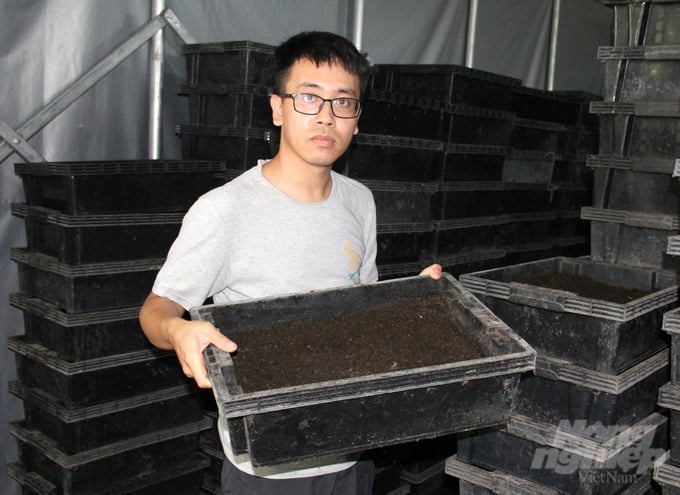
According to Mr. Hoang Minh Thanh, Director of Riti Cooperative, it is difficult to produce organic agricultural products without perseverance. Photo: Trung Quan.
Recognizing the growing popularity of herbal teas among consumers, Thanh harbored the ambition to create his own brand. In 2020, after a period of preparation and testing, the Riti Cooperative, headed by Thanh as Director, specializing in the production of organic chrysanthemum tea, was established.
To produce quality products and ensure compliance with the requirements of organic certification organizations, the cooperative relocated its growing area from Ninh Tien commune ( Ninh Binh city) to Bai village, Son Lai commune (Nho Quan district, Ninh Binh province) to avoid negative impacts from the surrounding non-organic areas.
Upon settling in the new area, the cooperative tightened management in all stages, built standard fences, and dug a system of canals to isolate it from the surrounding area. The cultivated area was also expanded to nearly 2.5 hectares.
Mr. Thanh shared that switching to agriculture and immediately starting with organic production – a relatively new type of production requiring a high level of knowledge, precision, and patience – presented significant challenges. Furthermore, this production method is costly, driving up product prices and making it difficult to compete in the market, while the cooperative's brand was still relatively unfamiliar to many people.
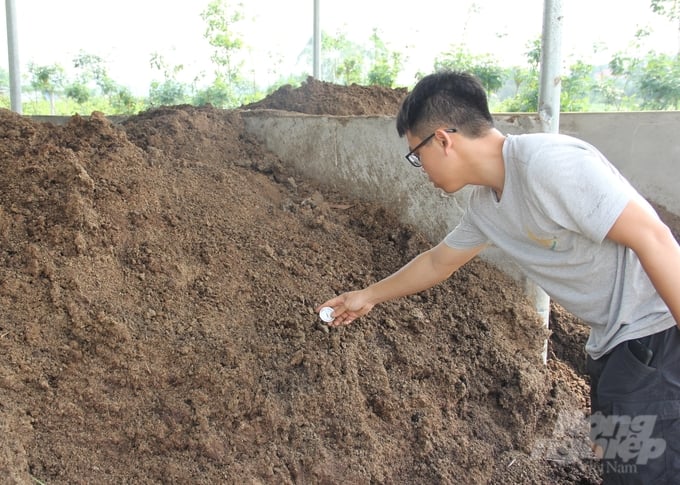
To ensure quality, Riti Cooperative has built a separate fertilizer production area to compost cow manure using the aerobic method. Photo: Trung Quan.
Undeterred, the cooperative members persistently introduced their cultivation process and were ready to welcome customers to visit the production area if needed. As a result, the cooperative's raw and processed chrysanthemum products are increasingly attracting consumer interest and orders.
Getting organic certification is difficult, but maintaining it is even harder.
Providing quality products to the domestic market is not enough to satisfy a young, energetic, and ambitious person like Thanh. Riti's organic chrysanthemum tea must be on the shelves of international markets.
That idea quickly translated into action as the cooperative dedicated all its resources and efforts to maintaining its existing organic certification and striving to achieve international organic certifications. This was no easy feat, given the extremely stringent requirements. Organic certifications must be re-evaluated every two years; failure to meet standards will result in revocation. Therefore, every stage of production is managed very strictly.
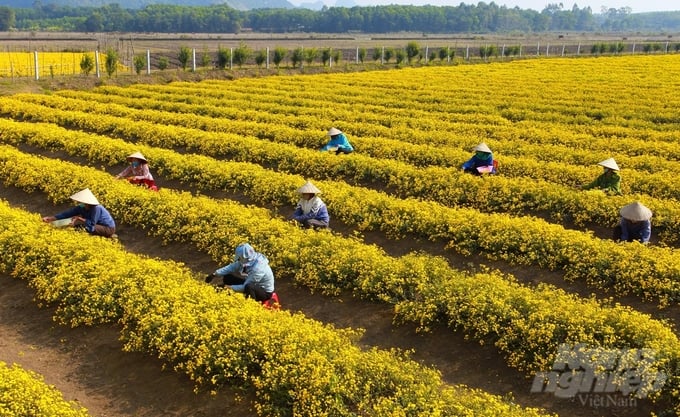
Strictly managing all stages according to organic standards has helped Riti Cooperative elevate the quality of herbal tea in Ninh Binh. Photo: Cooperative.
Regarding seedlings, if the cooperative cannot maintain its own organically certified seedling production area, it may only use seedlings purchased from units with equivalent organic certification. If such seedlings are unavailable and must be purchased from non-organic areas, they cannot be used directly but must be transferred to the cooperative's buffer zone for one year before being transferred to the organically certified zone.
Regarding fertilizers, absolutely no chemical inputs are allowed. Even licensed organic microbial fertilizers, if they do not comply with organic farming standard 11041-2:2017, cannot be used in the cooperative's farming area.
To overcome this, the cooperative established a separate fertilizer production area to compost cow manure using aerobic methods. After 40-45 days, the manure decomposes, turning a coffee-colored hue. Part of it is used to improve soil quality, and part is used to raise earthworms. Mixing composted manure and earthworm castings for crops allows the cooperative to maximize the use of microorganisms that thrive at high temperatures (30-80°C in composted manure) and low temperatures (10-30°C in earthworm castings) to manage soilborne pathogens, minimize pest and disease damage, and reduce the need for pesticides. In areas lacking phosphorus or with low pH, Ninh Binh fused phosphate fertilizer is used as a substitute for single fertilizers to remedy the situation (Ninh Binh fused phosphate fertilizer is permitted for use in organic farming areas).

Harvesting chrysanthemum flowers at Riti Cooperative. Photo: Trung Quân.
Regarding pest and disease management, the cooperative follows the principle of "occupying space," using beneficial fungi and bacteria to inhibit harmful ones. For mealybugs and aphids, they rely on natural ladybug populations for control. For thrips hidden in flowers, they use cold drying and fan blowing methods to eliminate them. Root rot caused by bacteria is controlled using antagonistic fungi. The cooperative cultivates a microbial system in earthworm castings to the maximum quantity (fed with molasses and aerated with oxygen) and then distributes it through drip irrigation pipes to the fields, allowing it to permeate the soil and inhibit bacteria.
Regarding water resources, the cooperative dug a system of ponds and water reservoirs inside the surrounding canal to avoid risks from pesticide residue discharged into the water source by neighboring households.
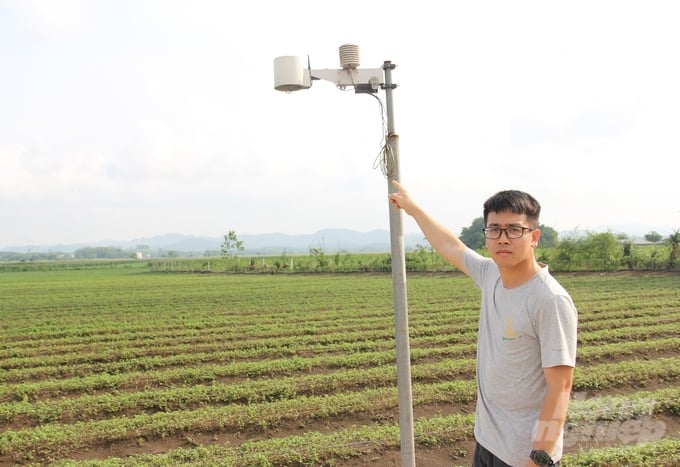
According to Mr. Thanh, obtaining organic certifications is difficult, but maintaining them is even more challenging. Photo: Trung Quan.
According to Mr. Thanh, obtaining organic certifications is difficult, but maintaining them is even more challenging. Therefore, without determination and perseverance, it's impossible to succeed. Currently, although the cooperative has been granted Vietnam Organic certification, it continues to take samples for analysis according to USDA, JAS standards, etc., for over 1,000 active ingredients in order to achieve these certifications and meet the requirements to introduce its products to demanding markets.
“Achieving organic certifications isn't about chasing achievements or boosting reputation, as these certifications are very difficult and costly to obtain. However, the cooperative still pursues them because we want to revive the medicinal tea tradition at a higher quality level. At the same time, we want to affirm that Ninh Binh in particular, and Vietnam in general, are fully capable of creating products of world- class quality,” Mr. Thanh confided.
Source: https://nongsanviet.nongnghiep.vn/kham-pha-trang-trai-trong-hoa-cuc-chi-huu-co-voi-quy-trinh-cuc-nghiem-ngat-d386755.html
![[Photo] Prime Minister Pham Minh Chinh receives the Governor of Tochigi Province (Japan)](/_next/image?url=https%3A%2F%2Fvphoto.vietnam.vn%2Fthumb%2F1200x675%2Fvietnam%2Fresource%2FIMAGE%2F2025%2F12%2F16%2F1765892133176_dsc-8082-6425-jpg.webp&w=3840&q=75)


![[Photo] Prime Minister Pham Minh Chinh receives Lao Minister of Education and Sports Thongsalith Mangnormek](/_next/image?url=https%3A%2F%2Fvphoto.vietnam.vn%2Fthumb%2F1200x675%2Fvietnam%2Fresource%2FIMAGE%2F2025%2F12%2F16%2F1765876834721_dsc-7519-jpg.webp&w=3840&q=75)
![[Image] Leaked images ahead of the 2025 Community Action Awards gala.](/_next/image?url=https%3A%2F%2Fvphoto.vietnam.vn%2Fthumb%2F1200x675%2Fvietnam%2Fresource%2FIMAGE%2F2025%2F12%2F16%2F1765882828720_ndo_br_thiet-ke-chua-co-ten-45-png.webp&w=3840&q=75)
![[Live] 2025 Community Action Awards Gala](/_next/image?url=https%3A%2F%2Fvphoto.vietnam.vn%2Fthumb%2F1200x675%2Fvietnam%2Fresource%2FIMAGE%2F2025%2F12%2F16%2F1765899631650_ndo_tr_z7334013144784-9f9fe10a6d63584c85aff40f2957c250-jpg.webp&w=3840&q=75)



















































![[Live] Closing Ceremony and Award Presentation for the "Impressive Vietnam Tourism" Video/Clip Creation Contest 2025](https://vphoto.vietnam.vn/thumb/402x226/vietnam/resource/IMAGE/2025/12/17/1765974650260_z7273498850699-00d2fd6b0972cb39494cfa2559bf85ac-1765959338756946072104-627-0-1338-1138-crop-1765959347256801551121.jpeg)



















Comment (0)