

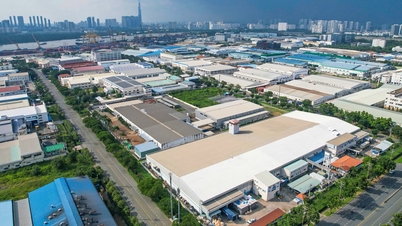
In the Northern Key Economic Zone, the total supply of industrial park land has reached 23,563 hectares, a 37% increase compared to before the administrative boundary merger.
In the third quarter of 2025 alone, the market continued to surge with three new industrial park projects in Phu Tho, Hai Phong, and Ninh Binh, adding more than 700 hectares of land for lease – a figure that shows the North is accelerating to catch up with the industrialization pace of the South.
According to the latest report by Cushman & Wakefield, the average occupancy rate in industrial parks in Northern Vietnam reached 67%. Many localities have very strong actual demand for leased land: Hanoi is almost 100% occupied, and Bac Ninh maintains an 86% occupancy rate. Electronics, circuit boards, and high-tech components are the leading sectors.
The average rental price reached US$133/m2/lease cycle, a 4% increase compared to the same period in 2024, reflecting a long-term upward price trend.
From now until 2028, the North is expected to have an additional 6,500 hectares of new industrial land, with Ninh Binh standing out with the Dong Van V and VI Industrial Park projects by Western Pacific, offering nearly 500 hectares for lease and an investment of approximately 2,900 billion VND in phase I.
Developed under the Industrial Park & Logistics Cluster (LIC) model, Dong Van V Industrial Park has ready-made infrastructure, 5-story factory buildings, and flexible plot sizes starting from 0.5 hectares, suitable for both foreign direct investment (FDI) and small and medium-sized enterprises (SMEs).
Mr. Tran Anh Vuong, CEO of Western Pacific, stated: “Our goal is not only to develop physical infrastructure, but also to create a complete integrated logistics industrial park ecosystem – where billion-dollar FDI investors, SMEs, and supporting industries connect, optimize the value chain, and promote sustainable supply chain development for the entire region.”
In particular, Dong Van V Industrial Park focuses on creating conditions for SMEs and suppliers in the multi-tiered industrial chain to participate more deeply in the manufacturing ecosystem. Tier 2 suppliers – specializing in producing specialized components or sub-assemblies for Tier 1 (units directly integrated into the final product of OEMs – original equipment manufacturers) – will be given priority support. In addition, Tier 3 suppliers, specializing in supplying raw materials or basic processed inputs for Tier 2, are also encouraged to participate, creating a closed three-tier supply chain that supports production at various levels of complexity and scale. The project also develops a system of internationally standardized ready-built warehouses and factories (RBFs), helping businesses significantly shorten deployment time and quickly bring projects into operation.
According to Cushman & Wakefield, as of Q3/2025, Ninh Binh has 5,000 hectares of industrial land, along with 3,000 hectares planned for expansion, with rental prices of only 130-140 USD/m2/lease cycle, significantly lower than many neighboring localities, strongly attracting investment from South Korea, Japan, China, the US, and Europe.
Major companies like Honda, Canon, Hyundai, and LG Display have chosen Ninh Binh as their production base, creating an "industrial beehive" effect that spreads throughout the region.
Reportedly, the supply of ready-built factory space (RBF) in the North reached 5.1 million m2, an increase of 14%. In Q3/2025 alone, nearly 100,000 m2 of new space was recorded, including KTG Industrial VSIP Bac Ninh 2 (43,000 m2) and a project in Hung Yen.
The occupancy rate of industrial parks is quite high, reaching 87%, an increase of 4 percentage points compared to the previous quarter. Hot spots such as Hanoi are nearly 100% occupied, Hung Yen at 93%, Hai Phong at 87%, and Bac Ninh at 86%.
The ready-built warehouse (RBW) segment was equally vibrant, especially in Bac Ninh and Hai Phong. Total supply reached 3.4 million m2, an increase of 7.6%. The occupancy rate was 77%, a sharp increase of 7 percentage points thanks to the demand for inventory stockpiling at the end of the year.
The expansion of administrative boundaries has helped form the Northern Industrial Belt, with superior regional connectivity. A series of key projects such as Gia Binh International Airport (level 4E) and the expanded North-South Expressway will be the new "backbone" of logistics, helping to reduce supply chain costs for businesses.
Mergers and infrastructure investments are creating a seamless logistics-industrial ecosystem, paving the way for large-scale e-commerce distribution centers.
It can be said that the North is entering a double growth cycle, simultaneously expanding the scale and improving the quality of projects. Administrative mergers not only expand the map but also reposition the North as a new industrial growth pole.
Source: https://baodautu.vn/khu-vuc-phia-bac-van-khat-nha-xuong-chat-luong-cao-d418572.html





![[Video] Sunset at Lap An Lagoon – Where the sun sets over the fishing nets](https://vphoto.vietnam.vn/thumb/1200x675/vietnam/resource/IMAGE/2026/05/31/1780187239592_2222.jpeg)










![[Video] Sunset at Lap An Lagoon – Where the sun sets over the fishing nets](https://vphoto.vietnam.vn/thumb/800x450/vietnam/resource/IMAGE/2026/05/31/1780187239592_2222.jpeg)















































































Comment (0)