

The development of flexible power sources is linked to reforms in the electricity market structure and ancillary services to achieve a carbon-neutral power system.
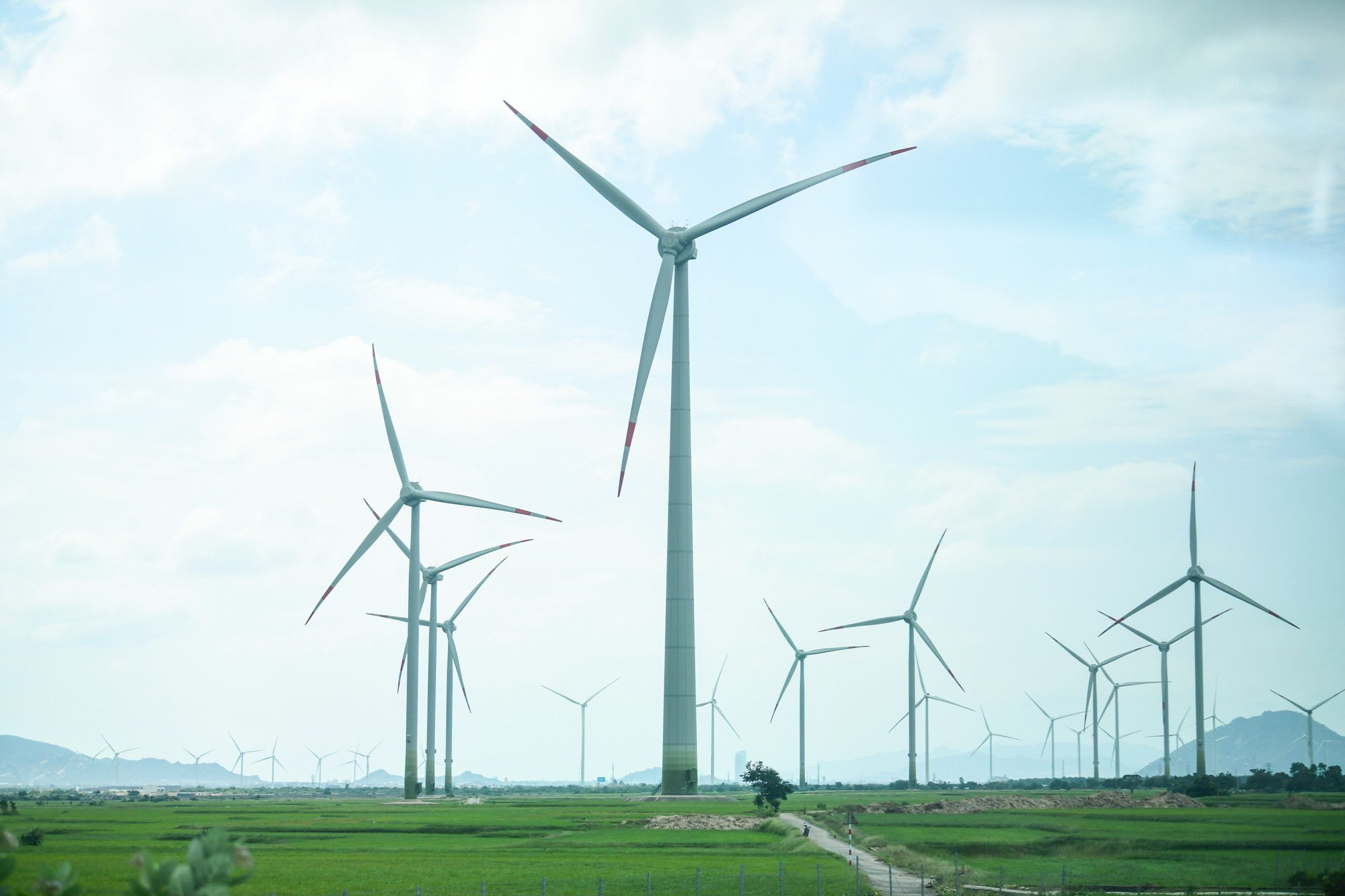
Renewable energy systems, including wind and solar power, need additional flexible power sources to ensure stable system operation - Photo: Q. DINH
According to information provided to Tuoi Tre Online , a representative from Wärtsilä – a global corporation providing carbon emission reduction solutions for the Finnish energy sector – stated in their recently published report, "The Crossroads on the Net Zero Journey," that to achieve greenhouse gas emission reduction targets, along with prioritizing the development of renewable energy sources and battery storage systems, it is necessary to develop flexible power plants capable of rapidly changing capacity to support balance when renewable energy is unstable.
Overcoming the instability of renewable energy
With a commitment to achieving net zero by 2050 and becoming a regional leader in renewable energy development, Wärtsilä representatives believe that transitioning to a carbon-neutral electricity system by 2050 could save Vietnam approximately 26 billion euros per year.
However, the study also indicates that for every GW of renewable energy capacity, the power system will need approximately 150 MW of flexible power capacity to ensure stability. This is a trend in the global power system, as using flexible power sources offers significant advantages, reducing costs and CO₂ emissions.
Simulations indicate that this path would save approximately €65 trillion by 2050 compared to a path that only includes renewable energy, equivalent to 42% of the cost. This savings average €2.5 trillion per year, equivalent to more than 2% of global GDP in 2024.
A flexible power system also helps reduce the total CO₂ emissions of the power sector by 21% (equivalent to 19 billion tons) between now and 2050. At the same time, the power system is optimized, reducing the wasted renewable energy due to power cuts by up to 88% by 2050 compared to the remaining timeframe.
According to calculations, renewable energy sources could avoid a total of 458,000 TWh of power cuts, enough to supply the entire world (based on current electricity consumption) for more than 15 years.
Meanwhile, when these plants are put into operation, they will help halve the amount of renewable energy capacity and land area required to achieve carbon neutrality.
According to a Wärtsilä representative, while battery storage systems provide energy balance at the second and minute levels, flexible power plants using piston-type internal combustion engines can handle fluctuations at the hour, day, and even season levels.
What needs to be done to build an electricity market according to Power Development Plan 8?
In Vietnam, the Power Development Plan 8 recognizes flexible power sources within the total power structure, with 300MW to be implemented before 2030, and significantly increasing to 46,200MW before 2050. Therefore, building appropriate market mechanisms to support the deployment of these technologies is essential to achieving the plan's objectives.
Mr. Pham Minh Thanh, Vietnam Country Director for Energy at Wärtsilä Group, recommended that Vietnam needs to facilitate the rapid expansion of renewable energy by upgrading the power transmission system, streamlining licensing procedures, and investing in inter-regional grid connectivity infrastructure.
This requires the rapid expansion of flexible technologies that help balance power sources, ensuring the stable and sustainable operation of the power grid system, while also mobilizing financial resources.
At the same time, it is necessary to reform the structure of the electricity market to increase the proportion of renewable energy. A mechanism for balancing power sources should be in place to provide flexible and optimal supply to the system.
This includes reducing the transaction cycle in the competitive electricity market to 5 minutes, providing new ancillary services, and establishing appropriate payment mechanisms. It also involves selecting technologies that can adapt to sustainable fuels such as natural gas for flexible balancing, and building the necessary infrastructure.
"Vietnam is demonstrating its strong commitment to the net-zero target by 2050. The key now is to ensure that Power Development Plan 8 is implemented in a timely manner."
"Increasing the proportion of renewable energy along with flexible power generation sources to balance the electricity system is essential in the next decade, helping Vietnam achieve its set goals," Mr. Thanh recommended.
Source: https://tuoitre.vn/lam-gi-de-viet-nam-tiet-kiem-26-ti-euro-khi-tang-nguon-dien-tai-tao-de-dat-net-zero-20241213092607417.htm
![[Live] 2025 Community Action Awards Gala](/_next/image?url=https%3A%2F%2Fvphoto.vietnam.vn%2Fthumb%2F1200x675%2Fvietnam%2Fresource%2FIMAGE%2F2025%2F12%2F16%2F1765899631650_ndo_tr_z7334013144784-9f9fe10a6d63584c85aff40f2957c250-jpg.webp&w=3840&q=75)

![[Photo] Prime Minister Pham Minh Chinh receives Lao Minister of Education and Sports Thongsalith Mangnormek](/_next/image?url=https%3A%2F%2Fvphoto.vietnam.vn%2Fthumb%2F1200x675%2Fvietnam%2Fresource%2FIMAGE%2F2025%2F12%2F16%2F1765876834721_dsc-7519-jpg.webp&w=3840&q=75)

![[Image] Leaked images ahead of the 2025 Community Action Awards gala.](/_next/image?url=https%3A%2F%2Fvphoto.vietnam.vn%2Fthumb%2F1200x675%2Fvietnam%2Fresource%2FIMAGE%2F2025%2F12%2F16%2F1765882828720_ndo_br_thiet-ke-chua-co-ten-45-png.webp&w=3840&q=75)
![[Photo] Prime Minister Pham Minh Chinh receives the Governor of Tochigi Province (Japan)](/_next/image?url=https%3A%2F%2Fvphoto.vietnam.vn%2Fthumb%2F1200x675%2Fvietnam%2Fresource%2FIMAGE%2F2025%2F12%2F16%2F1765892133176_dsc-8082-6425-jpg.webp&w=3840&q=75)
















































































Comment (0)