

In Nghe An province , people in Phan Thanh commune, Yen Thanh district, have switched from catching and selling eels to buying and processing eel products, earning more than 50 million VND per household per month.
Phan Thanh is a small village located in the low-lying area at the end of Long Thanh commune, Yen Thanh district, with nearly 200 households. In the 1990s, in addition to farming , the villagers also set eel traps and nets in the fields and ponds in the area to use as food or sell to earn extra income.
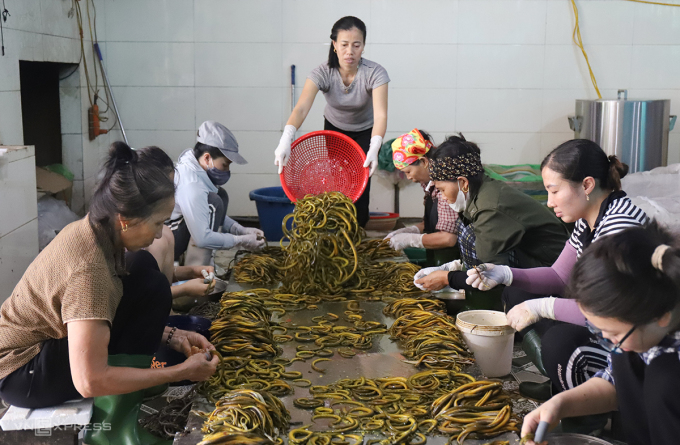
Locals gather to process eels at a business facility in Phan Thanh village, Long Thanh commune, Yen Thanh district in mid-October. Photo: Duc Hung
Through the process of catching and selling eels, many people who were once eel trappers have become traders, traveling throughout villages to collect live eels to supply to restaurants and eateries. Some shrewd families borrowed money to open eel processing facilities and then delivered the eels to partners to earn higher prices. For more than 20 years, Phan Thanh has become a famous eel processing village in Yen Thanh district as well as Nghe An province.
Nguyen Minh Thao's facility, located at the beginning of Phan Thanh village, spans over 50 square meters and houses numerous refrigerators, large specialized aluminum pots, and several machines for packaging. Every day, Thao purchases 300-500 kg of live eels at a price of 130,000-150,000 VND/kg. He then hires 12-15 people to work 8 hours a day, paying them 170,000-350,000 VND each for processing, marinating, packaging, and handling transactions.
Eels are prepared in two ways: fillets (fresh eel) and soup (boiled eel). For fillets, the head and tail are removed. Workers use a wooden board 50 cm long and 10 cm wide, nailing the eel vertically to the board. They hold the tail with their left hand and use a sharp knife with their right hand to cut from the head downwards to remove the bones and intestines. On average, each worker can process 60-70 kg of eel per day.
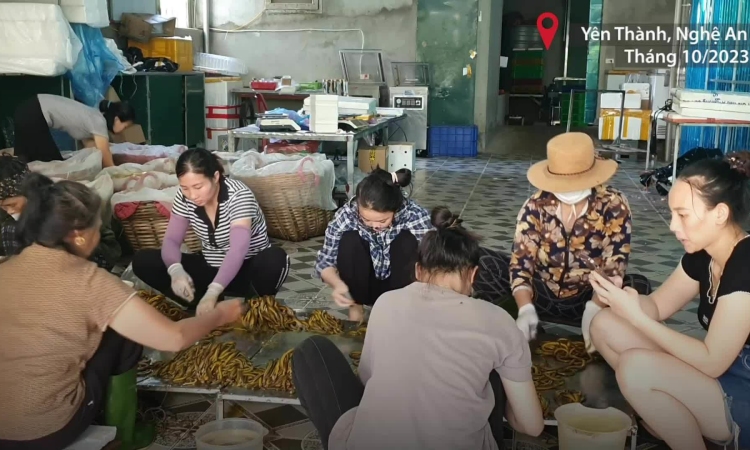
Villagers in Phan Thanh commune, Long Thanh district, are processing eels. Video : Duc Hung
Eel fillets are mainly used in various dishes such as eel rolls, grilled eel, eel stir-fried with lemongrass and chili, eel stew with banana and peanuts, and eel rolls with pickled vegetables. Among these dishes, eel rolls with meat filling are the most elaborate. The chef will mince lean pork, mix it with spices, and roll it around strips of eel meat, securing it tightly with scallions. 18-20 rolls are arranged in a styrofoam tray and placed in the freezer for 2-3 hours. Customers then cook them in 20-30 minutes.
Eel porridge is served at porridge and soup restaurants in the area. This is a specialty of Nghe An, often eaten with rice noodles or bread. The eels must be fresh and live, with the heads and tails removed, then tossed with salt and fresh turmeric or pure turmeric powder to prevent the meat from cracking and to give it a beautiful yellow color. Next, the eels are placed in a special pot and boiled for about 5-7 minutes.
The owner of the facility places dozens of kilograms of boiled eels on a 2-meter wide, 4-meter long aluminum table. Dozens of workers sit in 2-3 rows to process the eels, starting one batch after another. At this stage, removing the bones and intestines doesn't require knives. Workers wearing gloves take a 4 cm long, 2 cm diameter plastic tube with a pointed, arrow-shaped tip attached to the thumb of their dominant hand. The pointed end of the tube is inserted into the head of the eel, then gently and slowly slit down to the tail to separate the internal organs.
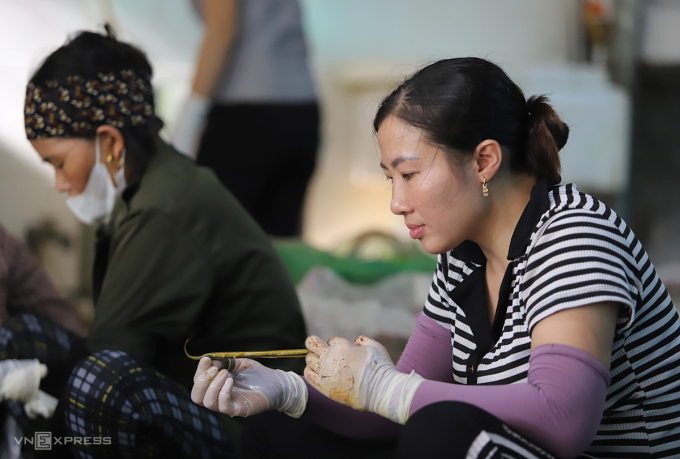
Ms. Thao is filleting boiled eels, which are used to make eel porridge and eel soup - a specialty dish of Nghe An province. Photo: Duc Hung
"This process requires careful handling; if you cut too much, the eel's body will tear, failing to meet the partner's standards. One kilogram of boiled eel, after removing the internal organs, yields about 700 grams of meat," said Nguyen Thi Thao, 37, a resident of Phan Thanh village. Thao has been involved in eel processing for over a decade, earning an additional 4-6 million VND per month in addition to farming.
In Phan Thanh village, there are currently more than 50 families engaged in processing and selling eel products. In addition, there are over 100 households that mainly catch live eels to supply to factories and partners within and outside the commune. The finished products are stored in freezers for preservation. Marinated eel sells for 250,000 VND/kg, eel rolls (18 pieces) for 110,000 VND, and a 200-gram bag of dried eel for 230,000 VND...
Mr. Nguyen Minh Thao added that besides selling to restaurants and eateries in Nghe An province, products from Phan Thanh village are also consumed in Hanoi, Ha Long, Thanh Hoa, Da Nang, Binh Duong, and Ho Chi Minh City. Eels are also shipped to some countries such as Germany, the UK, and South Korea... On average, Mr. Thao's facility consumes 6-7 tons of pre-processed eels domestically each month and exports about 500 kg abroad.
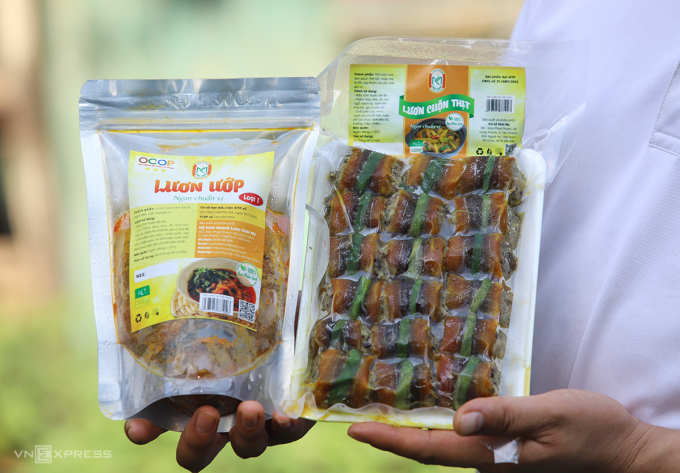
Eel rolls and marinated eel products are packaged and sold by people in Phan Thanh village. Photo: Duc Hung
According to Mr. Thao, the biggest wish of the villagers in the craft village is to export eel products through official channels. Currently, most establishments in Phan Thanh are rural, and the processing is done manually; there hasn't been much investment in machinery to meet the standards for production and packaging for export. "In the near future, we hope to receive support from the government to complete the necessary paperwork and procedures, and to be provided with additional space to overcome this issue," Mr. Thao said.
Mr. Nguyen Van De, Chairman of Long Thanh commune, said that what started as a seasonal job during the agricultural off-season, eel processing, has now become a main occupation, providing stable income for 500-600 people in the area. With more than 50 families opening processing workshops in Phan Thanh craft village, they sell an average of 3-5 quintals of finished eel products per day, earning a profit of 50-60 million VND per household per month after deducting labor, raw material, and supply costs.
Thanks to accumulated income from eel trading, as well as income from carpentry and handicrafts, the people of Phan Thanh have built spacious houses, purchased expensive items, and many households have even bought cars. According to Mr. De, the government will continue to strengthen training in science and technology, encourage people to focus on selling their products on e-commerce platforms, and develop more mechanisms and policies to enable Phan Thanh eels to be sold internationally through official channels.
Source link





Comment (0)