

Russia's efforts have solidified its position, alongside China, as a major and direct geopolitical rival of the West.
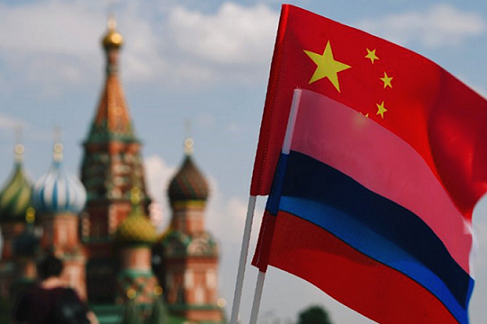 |
| China and Russia have increased transactions in their respective currencies to boost trade, and Russia is increasingly relying on CIPS (China's Cross-Border Interbank Offered System) after being excluded from the Western-run Worldwide Payment Messaging System (SWIFT). (Source: Xinhua) |
In recent years, global geopolitics has undergone significant changes. The Covid-19 pandemic, along with Russia's special military campaign in Ukraine, has increased the polarization of nations worldwide. Once considered a "difficult but viable" partner by Western countries, Moscow's position has drastically changed after the annexation of Crimea (2014) and the launch of its military campaign in Ukraine (2022). Russia's efforts have solidified its position, alongside China, as a major and direct geopolitical rival of the West.
This growing polarization is further exacerbated by ineffective Western sanctions. Meanwhile, the BRICS group of emerging economies , and potential members, have strengthened their alliance.
While Egypt and the United Arab Emirates (UAE) are allies of the United States, most other BRICS members view Western nations as rivals.
Global market developments
Currently, the US dollar accounts for 58% of global currency reserves and 54% of export bills. Together, the US and the European Union (EU) dominate more than 80% of global dollar reserves.
However, since the conflict erupted in Ukraine, the Chinese yuan has surpassed the US dollar to become Russia's most traded currency. Moscow now holds yuan and gold as its main reserve assets.
Over the past two years, China and Russia have increased transactions in their respective currencies to boost trade, and Russia has increasingly relied on CIPS (China's Cross-Border Interbank Payment System) after being excluded from the Western-run Global Payment Messaging System (SWIFT).
Since the 1990s, the growth of the Chinese economy can be described with one word: "extraordinary." By 2001, it had surpassed Japan to become the second-largest economy.
China's growth didn't stop there. In 2017, it surpassed the US in terms of purchasing power parity (PPP), a significant milestone highlighting the rapid rise of the Northeast Asian nation on the international stage.
Although the US economy is still 54% larger when measured by nominal GDP, evaluating economies through the lens of PPP also provides a good comparison of size and living standards. This method adjusts for differences in price levels between countries, offering a more realistic view of what two economies can produce and spend.
Therefore, while the US maintains its nominal lead, China's position under PPP highlights Beijing's significant global influence and the shifting balance of economic power.
China - a new superpower?
It's true that nominal GDP reflects a country's ability to purchase international goods, and we should consider these statistics. But it also shows that, if current trends continue, the US will lose its top spot to China in the near future.
Recent sanctions from Washington and its Western allies have highlighted the crucial role of gold as the safest and most stable asset a nation can accumulate.
As Western countries imposed sanctions on Russia, freezing assets such as foreign exchange reserves and restricting access to global financial systems, gold emerged as a resource they could not seize or prevent Moscow from using. This underscored gold's unique position as a hedge against sanctions and geopolitical instability, offering protection during times of heightened global tension.
Therefore, some BRICS members have increased their gold reserves as part of a broader effort to protect their economies from potential external threats. This trend reflects a growing understanding that, in an era where economic sanctions are often used as geopolitical leverage, holding large gold reserves ensures a certain degree of economic independence.
Therefore, these countries are focusing on gold as a way to reduce their dependence on the US dollar-based financial system and ensure their financial resilience against future sanctions or global market volatility.
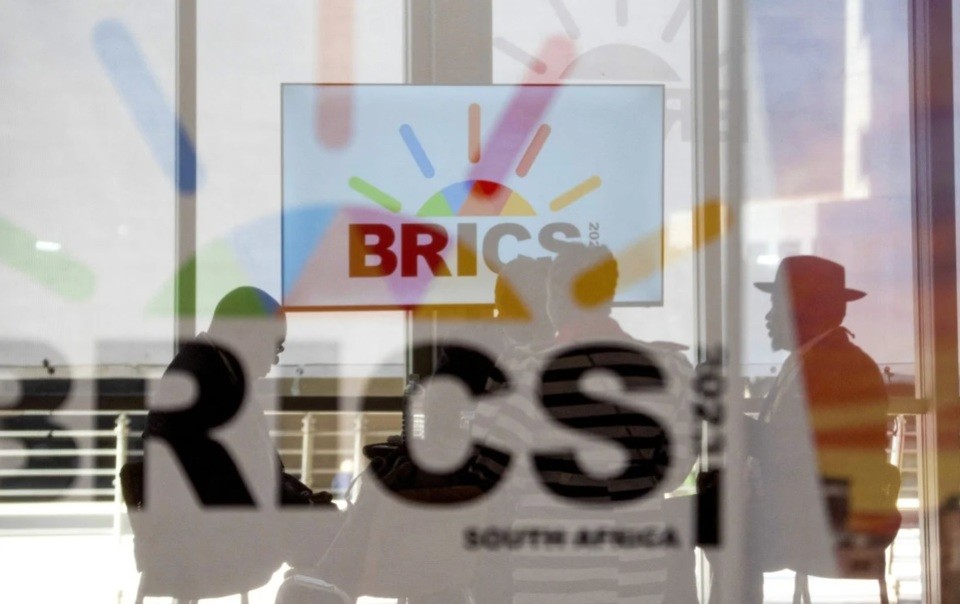 |
| An expanded BRICS group would account for more than 50% of global GDP based on purchasing power parity and represent approximately 71% of the world's population. (Source: Reuters) |
Should we put our faith in gold?
The shift toward gold and de-dollarization seems more logical if we exclude countries without independent monetary policies and with an interest in joining BRICS. Currently, only 35% of countries have autonomous monetary policies.
Most other countries have currencies that are fully pegged or managed against major global currencies such as the USD, Euro, or Swiss Franc. This suggests that many countries may be inclined to “pegate” their currency to the RMB, gold, or even adopt a new BRICS common currency if they want to join the bloc and reduce their economic dependence on Western countries.
"Currency pegging" offers several advantages. Firstly , it provides a country with exchange rate stability, reducing currency volatility and benefiting international trade and investment.
Secondly , inflation is much lower, as developed countries and strong currencies generally have much lower inflation than developing countries with independent monetary policies.
The third benefit is that it instills confidence in investors, as it eliminates uncertainties in the economy and business.
To date, 43 countries from the Middle East, Asia, Africa, and South America have expressed interest or formally applied to join BRICS.
If all of these countries joined BRICS, the bloc would become the world's largest political and economic bloc. An expanded BRICS group would account for over 50% of global GDP based on purchasing power parity and represent approximately 71% of the world's population.
What will the future of the world be like?
Are developed nations losing their global influence? Are domestic welfare and monetary policies stifling wealth creation? Are demographic challenges, such as declining birth rates, an aging population, and increasing migration issues, exacerbating this shift? And therefore, is the world moving toward a new bipolar dynamic?
All the answers remain to be seen, however, one thing we know for sure is that the US dollar is losing its influence, and this is consistent with America's growing global political power.
Data shows that, while the greenback faces challenges, countries not typically aligned with Western allies are actively contributing not only to de-dollarization but also expanding their influence on the global economic and political stage. Is a multipolar future imminent?
Source: https://baoquocte.vn/lenh-trung-phat-cua-my-va-phuong-tay-kem-hieu-qua-nga-trung-quoc-ngay-cang-quyen-luc-brics-chop-thoi-co-noi-day-tuong-lai-nam-o-vang-293750.html


![[Image] Vietnam's colorful journey of innovation](/_next/image?url=https%3A%2F%2Fvphoto.vietnam.vn%2Fthumb%2F1200x675%2Fvietnam%2Fresource%2FIMAGE%2F2025%2F12%2F14%2F1765703036409_image-1.jpeg&w=3840&q=75)






























































![[Image] Vietnam's colorful journey of innovation](https://vphoto.vietnam.vn/thumb/402x226/vietnam/resource/IMAGE/2025/12/14/1765703036409_image-1.jpeg)



























Comment (0)