

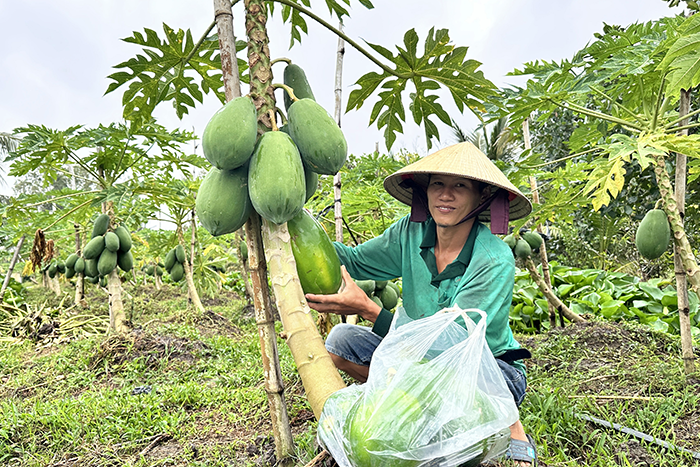
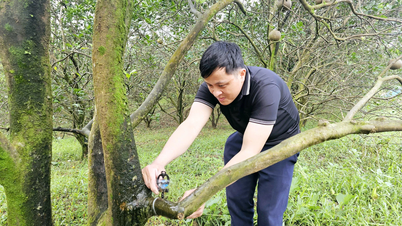
Mr. Van Cong Sach lives in Tan Lap B hamlet, Long Hung commune, next to his family's papaya garden, which is currently being harvested.
No more worries about "bumper harvests leading to falling prices".
In the morning in Tan Hoa A hamlet, Long Hung commune, rows of lush green papaya trees stretch along the small canals, in full harvest season. The sound of motorboats loaded with produce, mixed with the lively calls of farmers, creates a bustling rhythm of life in this land traditionally known for its fruit orchards.
Mr. Vo Thanh Nghe, one of the first to participate in the papaya cultivation cooperative model, shared: “Previously, my family grew oranges and tangerines, but the prices were unstable. In 2024, after being encouraged by the cooperative to switch to growing Japanese papayas in partnership with West Food Company, I was hesitant and only tried planting 4,000m². After the first harvest, seeing the clear economic benefits, in 2025, I boldly expanded to 8,000m², with about 1,200 trees.”
According to Mr. Nghe, Japanese papaya is easy to grow and requires little care. From planting to harvesting takes about 5-6 months, and the fruiting period lasts for nearly 6 months. Currently, his family has been harvesting papayas for over a month, averaging one harvest per week, with a yield of over 1.2 tons of fruit.
Mr. Van Cong Sach, residing in Tan Lap B hamlet, said: “In 2025, I experimented with growing papaya on an area of over 1,000m². Thanks to the support and technical guidance from the cooperative and businesses, the plants grew well and had few pests and diseases. At harvest time, the product was purchased at a stable price, resulting in a good profit.”
Collaboration - the key to sustainable development
In reality, the papaya farming model in Long Hung has formed a fairly complete value chain. Farmers have guaranteed purchase contracts, stable prices, and technical support; cooperatives play a coordinating role, improving management capacity and monitoring the production process; and businesses proactively secure standard raw materials, minimizing the risk of input material shortages.
Mr. Van Cong Phuong, Director of Tan Lap Agricultural Cooperative, affirmed: "Without cooperation, it is very difficult for farmers to sell large quantities, and businesses cannot strictly control product quality. Only when both sides share benefits and responsibilities can the model develop sustainably."
In 2025, Long Hung commune will implement a 15-hectare papaya cultivation project, with 8 households participating. The average investment cost is approximately 70 million VND/hectare. With a stable guaranteed purchase price of 5,000 VND/kg from businesses, the model yields relatively high economic efficiency compared to many traditional crops in the locality.
Mr. Nguyen Thanh Dien, Chairman of the Long Hung Commune People's Committee, assessed: "The model of papaya cultivation linkage between farmers in Long Hung commune and West Food Company has brought clear results in all three aspects: income, production methods, and the business mindset of the people. More importantly, the model helps farmers shift from small-scale, fragmented production to production in a linked chain, adhering to technical procedures, focusing on quality, and ensuring stable output."
According to Mr. Dien, in the coming time, the Long Hung Commune People's Committee will continue to develop the model of sustainable papaya cultivation, closely linking the interests of farmers and businesses. The commune will cooperate with West Food Company to maintain and expand the raw material area, not only for papaya but also for other crops and livestock such as MD2 pineapples, tilapia, etc.
In addition, the locality is stepping up propaganda and mobilization efforts to encourage farmers to produce according to the plan, ensuring technical procedures and product quality for processing and export.
Text and photos: THACH PICH
Source: https://baocantho.com.vn/lien-ket-trong-du-du-o-xa-long-hung-huong-di-ben-vung-cung-doanh-nghiep-a195571.html

![[Photo] Prime Minister Pham Minh Chinh receives the Governor of Tochigi Province (Japan)](/_next/image?url=https%3A%2F%2Fvphoto.vietnam.vn%2Fthumb%2F1200x675%2Fvietnam%2Fresource%2FIMAGE%2F2025%2F12%2F16%2F1765892133176_dsc-8082-6425-jpg.webp&w=3840&q=75)
![[Live] 2025 Community Action Awards Gala](/_next/image?url=https%3A%2F%2Fvphoto.vietnam.vn%2Fthumb%2F1200x675%2Fvietnam%2Fresource%2FIMAGE%2F2025%2F12%2F16%2F1765899631650_ndo_tr_z7334013144784-9f9fe10a6d63584c85aff40f2957c250-jpg.webp&w=3840&q=75)
![[Image] Leaked images ahead of the 2025 Community Action Awards gala.](/_next/image?url=https%3A%2F%2Fvphoto.vietnam.vn%2Fthumb%2F1200x675%2Fvietnam%2Fresource%2FIMAGE%2F2025%2F12%2F16%2F1765882828720_ndo_br_thiet-ke-chua-co-ten-45-png.webp&w=3840&q=75)
![[Photo] Prime Minister Pham Minh Chinh receives Lao Minister of Education and Sports Thongsalith Mangnormek](/_next/image?url=https%3A%2F%2Fvphoto.vietnam.vn%2Fthumb%2F1200x675%2Fvietnam%2Fresource%2FIMAGE%2F2025%2F12%2F16%2F1765876834721_dsc-7519-jpg.webp&w=3840&q=75)





















































Comment (0)