

It is a part of the refreshing childhood that each person carries with them into life. There, their own private world freely plays and immerses itself in sweet contemplation.
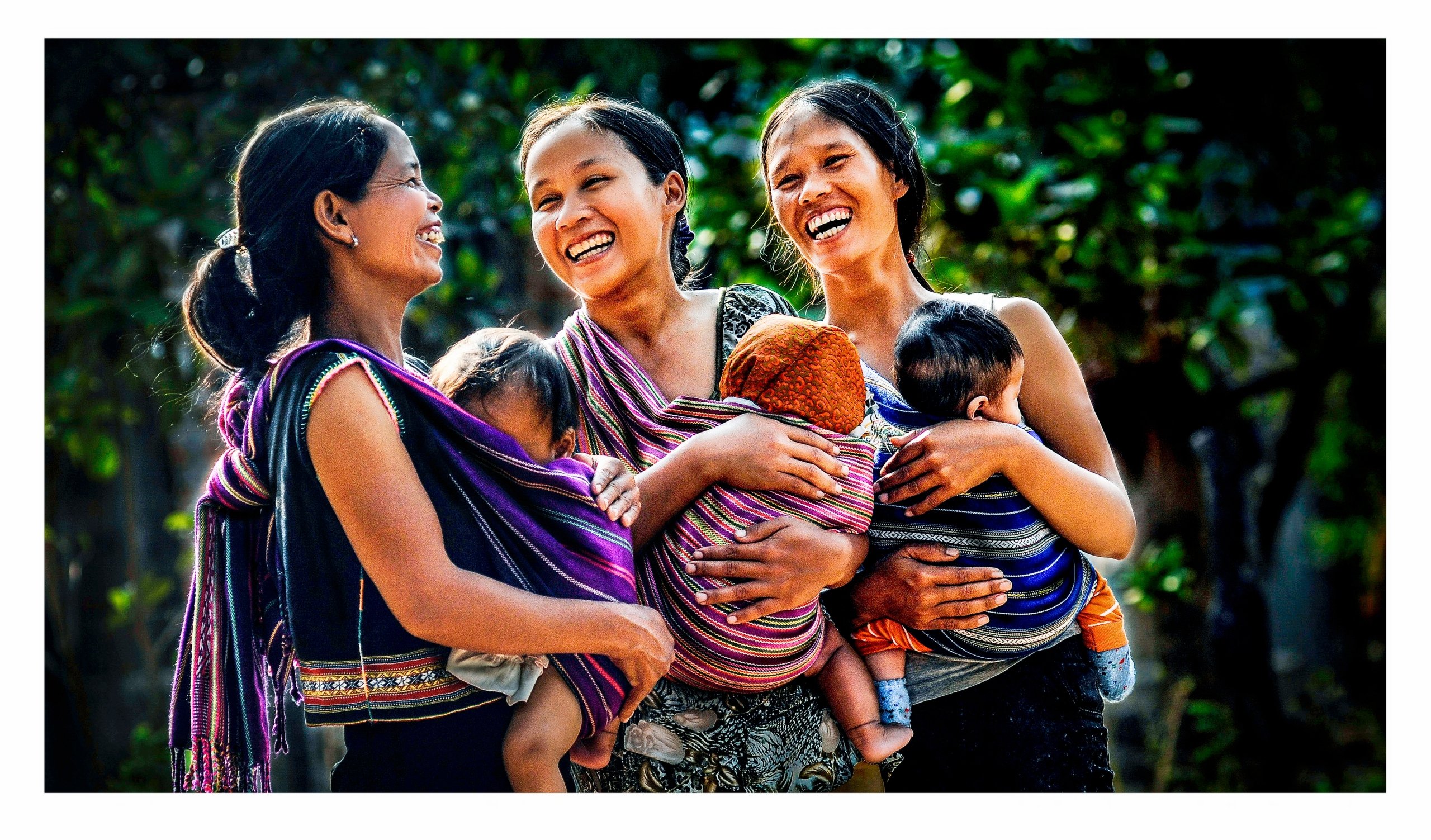
The sweet milk and gentle lullabies of a mother contain so much love and affection.
1. Perhaps it was a disadvantage for children not born in the village like me. Because it wasn't until much later, at the age of twelve or thirteen, that I truly saw the village gate, the banyan tree, the well, the village square... in my mother's lullabies. The difficult life of my parents, struggling to make ends meet in the sun-drenched Central Highlands, kept us children and grandchildren distant from our homeland. My mother's voice wasn't beautiful, but it was warm and soothing, her gentle murmur like a lullaby that quickly lulled my sisters and me into a deep, peaceful sleep.
My first lesson, and probably that of many others, was the melody and lyrics of the song: " A father's love is like Mount Tai/A mother's love is like a flowing spring/With a heart devoted to honoring mother and father/To fulfill filial piety is the true duty of a child ." This love, like an underground stream, seeps into the soul of a child, gradually shaping their filial devotion. And then, as an adult, having my own small family, holding my first child in my arms, I hum the same lullabies my mother sang to me in those bygone years.
My childhood memories lack the presence of a grandmother. My parents left their hometown to build a life in the remote, wild forests, and we could only rely on each other to support our family. Therefore, every time I saw my friends snuggling into the arms of their maternal and paternal grandmothers, being hugged and comforted, a childish sadness would well up inside me. Back then, my house was in the staff housing complex where my parents worked. Each house was separated by a partition made of woven bamboo, so whatever was said in one house could be heard clearly in the next, as if it were my own home. Every time I heard my grandmother's lullaby, I would press my ear against the partition to listen to that soothing, melodious tune, and then drift off to sleep without realizing it. Perhaps in that sleep, a white stork soared leisurely over the vast expanse of rice fields.
2. I learned about the saying "Bờm has a palm-leaf fan/the rich man wants to exchange it for three cows and nine buffaloes" not from the name of the little boy named Bờm at the beginning of the village, but because "Bờm" crept into my mind through my mother's lullabies. Sometimes I would ask my mother, "Why did Bờm only exchange it for a handful of sticky rice? He's too greedy, isn't he, Mom?", and she would stroke my head and laugh, asking, "So, you, you also exchanged a handful of sticky rice to fill your stomach, right?", and then we would both burst into laughter, the innocent, pure laughter of "Bờm".
My childhood world also included rhymes like, "The ant that climbs the banyan tree/climbs a broken branch, going in and out/the ant that climbs the peach tree/climbs a broken branch, going in and out," and "Dragonflies flying low mean rain/flying high mean sunshine/flying at a medium height mean shade," and "The cat that climbs the betel nut tree/asks the mouse where it went, it's not home"... a wonderfully whimsical and adorable world. These animals appeared in my mind, chasing and playing, following my mother's lullabies, and have remained there until now.
Once, my mother sang, "Even a hundred years can wear down a stone monument, but a thousand years will not erase a spoken word," when suddenly, the next door was filled with the clanging of pots, pans, and dishes. My mother seemed startled by her slip of the tongue and fell silent. Later, when I grew up, I understood that the boy next door was born out of impulsiveness and immaturity, and hearing that lullaby had touched his mother's heart.
A little older, I started to babble lullabies to my younger sibling, taking over from my mother. When she cried incessantly, wanting to sleep, and I carried her from upstairs to downstairs, rocking and patting her in every way possible, but she still wouldn't stop crying, I would try singing the songs my mother used to sing to me. Surprisingly, the little one's sobs gradually subsided, and she drifted off to sleep on my shoulder, while I continued to sing whatever lines I could remember. And so, she grew up, lulled to sleep by my lullabies.
Preserving these values for future generations stems from the simplest, most ordinary things in life that few people think of, dismissing them as mere habits. This shows that anything that emerges from life possesses enduring vitality and a wide-ranging influence.
Now that I've chosen language as my life's calling, and have freely explored the profound meaning of lullabies and songs, I've come to understand the layers of value hidden within the language. This spiritual value is the culmination of generations of experience, meant for future generations to ponder and appreciate. Now, I no longer naively ask my mother questions like, "Mom, why does the mustard greens go to heaven, and why do the coriander stay behind instead of following the mustard greens?" when she sings, " The wind carries the mustard greens to heaven / The coriander stays behind to endure the bitterness of life, " as I did when I was a child. Reflecting on these experiences allows me to understand the depths and shallows of life and find a sense of shared understanding.
3. Childhood memories are something almost everyone cherishes. They are the wholesome seeds sown in the soil of each person's soul. Each person tends to that garden differently, allowing the plants to sprout, bloom, and bear sweet fruit. Time passes and never returns, and so does childhood. The feeling of freely swimming and bathing in the cool waters of childhood is always a cherished memory for anyone born and raised by the river of their homeland.
I relied on my mother's lullabies to nurture the gentle warmth within my heart. In the past, my grandmother sang lullabies to my mother, conveying so much love and hope. My mother, in turn, sang lullabies to me with all her love and anticipation. Then, as I grew older and my children were born one after another, I sang lullabies to them using my own innocent childhood memories, allowing me to return to my own childhood. It is these experiences that have fostered in me a love for literature and everything that embodies the cultural identity of my nation and homeland.
The sweet milk, the gentle lullaby of a mother, whispering with so much affection and longing, is the source of love for everyone. That lullaby is the most gentle and radiant river, flowing from childhood to the end of life, carrying a wealth of beautiful memories. Somewhere in the distance, the gentle, warm autumn breeze whispers, " The autumn wind lulls my child to sleep / I stay awake for five long nights... "
Source: https://thanhnien.vn/loi-ru-tao-noi-185240630173817728.htm


![[Photo] General Secretary To Lam receives President of the European Council Antonio Costa](/_next/image?url=https%3A%2F%2Fvphoto.vietnam.vn%2Fthumb%2F1200x675%2Fvietnam%2Fresource%2FIMAGE%2F2026%2F01%2F29%2F1769697816651_a1-bnd-5216-9741-jpg.webp&w=3840&q=75)


![OCOP during Tet season: [Part 3] Ultra-thin rice paper takes off.](/_next/image?url=https%3A%2F%2Fvphoto.vietnam.vn%2Fthumb%2F402x226%2Fvietnam%2Fresource%2FIMAGE%2F2026%2F01%2F28%2F1769562783429_004-194121_651-081010.jpeg&w=3840&q=75)


![OCOP during Tet season: [Part 2] Hoa Thanh incense village glows red.](/_next/image?url=https%3A%2F%2Fvphoto.vietnam.vn%2Fthumb%2F402x226%2Fvietnam%2Fresource%2FIMAGE%2F2026%2F01%2F27%2F1769480573807_505139049_683408031333867_2820052735775418136_n-180643_808-092229.jpeg&w=3840&q=75)




Comment (0)