

Three times Coal Mining Newspaper shone brightly.
During the years 1927-1928, the Vietnam Revolutionary Youth League advocated sending some party members to the mining region to both "proletarianize" them and to build a party base and mobilize the masses for revolution. At the end of 1928, a group of party members from Hai Phong and Thai Binh gathered in Cam Pha and Cua Ong to form a branch, directly under the Hai Phong City Party Committee. This was the first Youth Party branch in Quang Ninh.
At its first meeting, the Party cell decided to publish a newspaper named "Than" (Coal). This name was not only familiar and closely associated with the lives of miners, but also implied a smoldering fire, guiding workers out of the long night of slavery. Comrade Dang Chau Tue, the Party cell secretary, was in charge of the newspaper and also wrote the main articles. The printing was handled by female Party member Vu Thi Mai, a worker at the coal screening plant. The newspaper's editorial office was located in a small house on Booc-do Street (now Quang Trung Street, Cam Pha City).
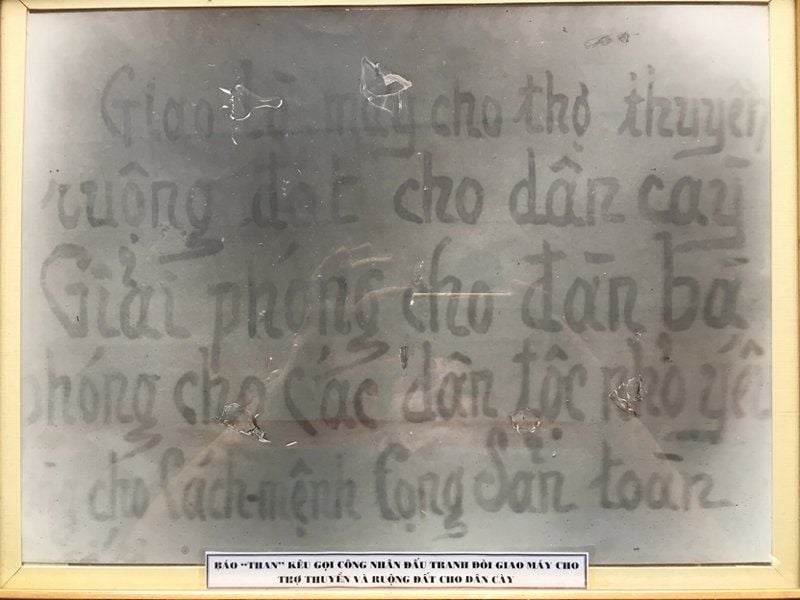
The Coal Newspaper called on workers to fight for the handover of mines and machinery to craftsmen, land to farmers, and the liberation of weak and small ethnic groups. Photo: Quang Ninh Provincial Museum.
With its small size and manual printing using lithography and later lithography, the Coal Mining Newspaper was secretly distributed in limited quantities, with only about 100 copies per issue. Despite its rudimentary form, the content of each issue was incredibly powerful and combative: reflecting the hardships of life, denouncing the brutal exploitation by mine owners, and calling for a struggle to reclaim the rights of workers and farmers. Every issue of the Coal Mining Newspaper featured a slogan at the top of the front page taken from the concluding sentence of Marx and Engels' Communist Manifesto: "Workers of the world unite!", becoming a powerful and deeply influential rallying cry among coal miners in the Cam Pha and Cua Ong coal mining regions.
Following the intense manhunt by secret police in 1929, the Coal Mining Newspaper had to cease publication. On February 23, 1930, when the first branch of the Communist Party of Vietnam in Quang Ninh was established in Mao Khe, the Coal Mining Newspaper was reborn – for the second time – under the direct guidance of comrades Nguyen Van Cu and Nguyen Duc Canh. The key figures in producing the Coal Mining Newspaper were the branch secretary Dang Chau Tue and party member Vu Thi Mai. Before printing, articles were read and directly edited by Comrade Nguyen Van Cu. From then on, the quality of articles encouraging the struggle became more aligned with the right direction. The newspaper's influence extended not only within the Mao Khe mine but also throughout the region, as the workers from Mao Khe were scattered across many communes in Dong Trieu and Kinh Mon districts.
In October 1930, the Regional Party Committee directed the establishment of the Mining Special Zone Party Committee to unite the scattered party branches and cells into a single party committee and appointed a provisional executive committee, with Comrade Vu Van Hieu as Secretary. At this time, the Cam Pha - Cua Ong Party Committee had the Mining Newspaper, and the Mao Khe Party Committee had the Coal Newspaper. The Special Zone Party Committee decided to publish a single newspaper, again named the Coal Newspaper, with the responsibility of being the mouthpiece of the Special Zone Party Committee, thus having a larger scope. The newspaper was published twice a month, with each issue printed in several hundred copies and distributed throughout the mining region.
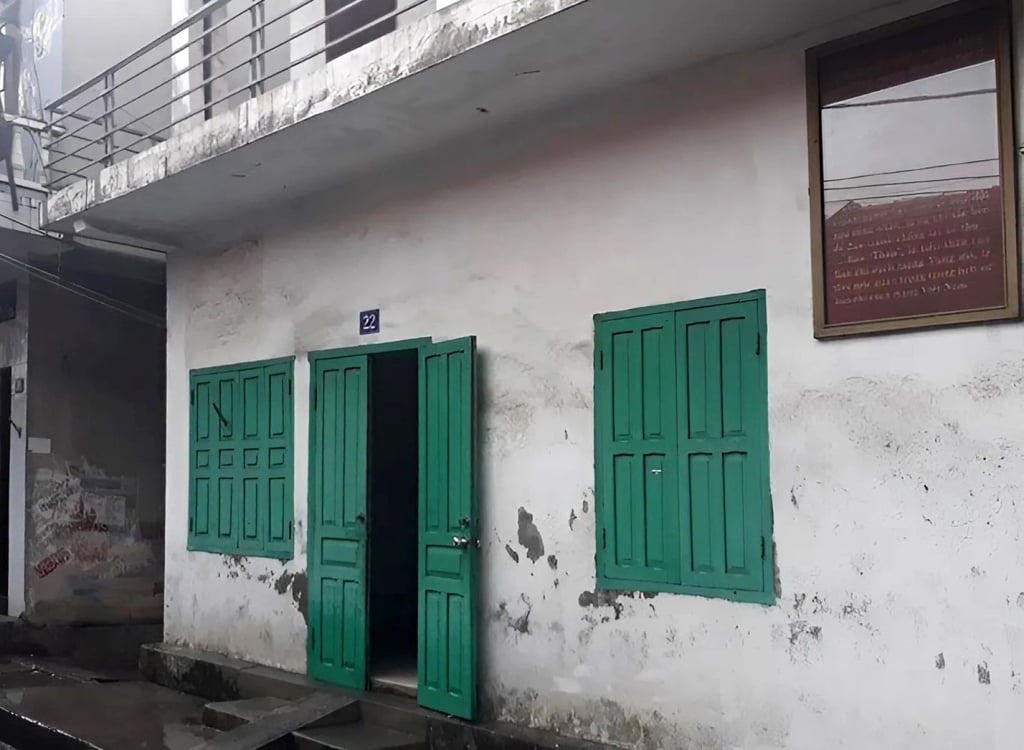
House number 22, Quang Trung Street (Cam Pha) - the former headquarters of the Coal Mining Newspaper in its early days (1928). Photo: Archival material.
Unfortunately, the Coal Mining Newspaper of the Special Zone Party Committee did not last long because from the beginning of 1931, the Party Committee of the Coal Mining Zone was subjected to fierce repression by the enemy. The comrades in the Committee were successively captured by the enemy. The Coal Mining Newspaper ceased publication, but its influence remained deeply ingrained among the workers.
The Coal Mining Newspaper had three periods of brilliance, closely linked to the maturation of the revolutionary movement in Quang Ninh. The newspaper was not only a tool for revolutionary propaganda but also a symbol of the indomitable will and fighting spirit of the working class in the mining region. It was from here that the province's revolutionary journalistic tradition was formed and nurtured, becoming a continuous stream from the clandestine period to the open and modern era.
The first revolutionary journalist of the mining region.
The history of revolutionary journalism in Quang Ninh always records a sacred milestone: the birth of the Coal Newspaper at the end of 1928 in Cam Pha - the first voice of the working class in the mining region in the revolutionary movement. The person directly behind the formation, organization, and maintenance of that "Coal flame" was Dang Chau Tue - the first revolutionary journalist of the mining region, who dedicated his entire life to the revolutionary ideal, from the early days of writing newspapers and engaging in clandestine revolutionary activities, to later becoming a high-ranking leader of the State.
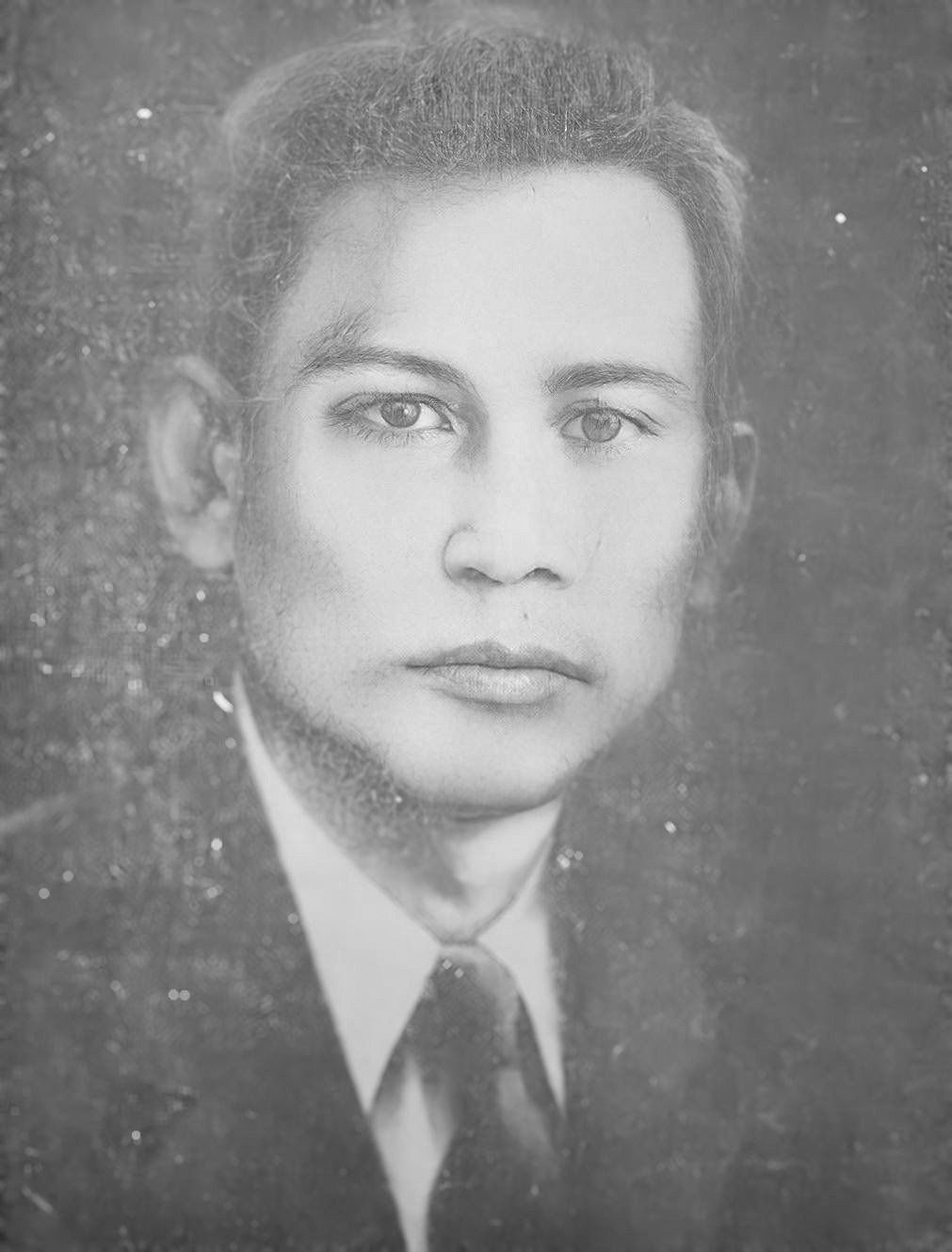
Revolutionary journalist Dang Chau Tue returning to Cam Pha to participate in the proletarianization program in 1928. Photo: Archival material from the book "Traditions of the Coal Region - Revolutionary Memoirs".
Comrade Dang Chau Tue was born in 1907 in Nam hamlet, Binh An village, Khe Kieu commune, Thu Tri district (now Song An commune, Vu Thu district, Thai Binh province), into a family with good economic conditions. From a young age, he received a good education at the French-Vietnamese primary school in Thai Binh, then went to Nam Dinh to study at Thanh Chung school - a place that attracted many outstanding students, including Nguyen Duc Canh, Dang Xuan Khu (later General Secretary Truong Chinh), Nguyen Van Hoan...
In 1926, during the movement to organize a memorial service for the patriot Phan Chu Trinh in Nam Dinh, Dang Chau Tue actively participated and played a prominent role in initiating the movement. A year later, he became a member of the Vietnam Revolutionary Youth League - the predecessor organization of the Communist Party of Vietnam.
During the years 1928-1930, in response to the "proletarianization" policy, Dang Chau Tue went to Cam Pha, mingling with the workers to engage in revolutionary activities and taking charge of producing the Than Newspaper – a lithographically printed newspaper secretly distributed among miners. When the first Communist Party of Vietnam branch in the mining region was established in Mao Khe (Dong Trieu) in February 1930, Comrade Dang Chau Tue was elected as the branch secretary. The Than Newspaper was revived and published again with the participation of Comrade Vu Thi Mai – a female revolutionary party member from Hai Phong. This was the second time the newspaper returned to the miners, continuing its mission of propagating and enlightening them with revolutionary ideals.
In early 1931, Dang Chau Tue was arrested by the French and imprisoned in Hoa Lo Prison, then exiled to Con Dao Island. At the end of 1936, he was released under amnesty law and continued his activities within the Democratic Front movement. In the following years, he held many important positions in the Party's propaganda agencies in Nam Dinh and Thai Binh, and was one of the cadres selected to join the French Socialist Party (SFIO) to garner support from progressive French-Vietnamese democratic forces.
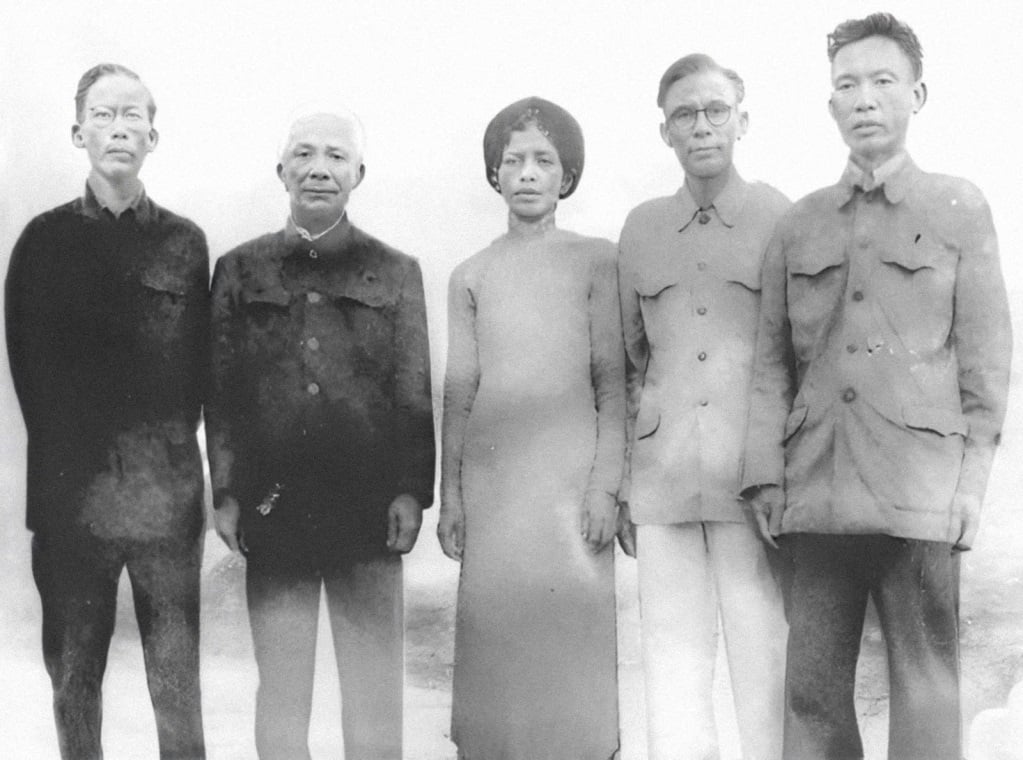
Comrade Dang Chau Tue (far left) and Comrade Vu Thi Mai (middle) were directly involved in the Than newspaper and were members of the first Party branch in Mao Khe. Photo: Archival material.
In 1941, he went to Thanh Hoa and was assigned the task of directing the establishment of the Ngoc Trao guerrilla zone - one of the important pre-insurrection bases in the country. With his extraordinary memory, he memorized and wrote down the regulations of the Party, the Front, and mass organizations under conditions of limited documentation, earning the admiration of his comrades.
After the August Revolution of 1945, he was appointed Chairman of the Provisional Administrative Committee of Nam Dinh province, elected as a National Assembly delegate from Nam Dinh province in the first term, served as a special envoy of the Government, and then held the position of Chairman of the Resistance Administrative Committee of Ninh Binh province. From 1954, he was the Chief Judge of the Appellate Court of the Supreme People's Court until his retirement.
The revolutionary life of Dang Chau Tue is a typical example of a generation of patriotic intellectuals who were early enlightened by proletarian ideals, dedicated to the workers' movement, and made many enduring contributions in the field of propaganda and revolutionary encouragement through their writings. On December 11, 2009, the 11th term of the Quang Ninh Provincial People's Council decided to name a street in Ha Long City after Dang Chau Tue (a 6km section of National Highway 18A, starting at Quang Hanh intersection and ending at the boundary between Cam Pha City and Ha Long City) as a profound tribute to the first revolutionary journalist of the mining region.
The flame of the Coal Mining Journalism movement that he and his comrades ignited in those dusty coal mines is still being continued, preserved, and promoted by generations of journalists in Quang Ninh today – as a persistent stream of ideals, beliefs, and responsibility towards their homeland and country.
The mission of "igniting the flame"
Three appearances, three periods of struggle, the Coal Newspaper has created a tremendous spiritual legacy for revolutionary journalism in Quang Ninh. The flame from that first resistance newspaper has smoldered in the flow of history, preserved and continued by generations of journalists in the mining region.
Today, as journalism enters the era of digitalization, data, and multi-platforms, the flame from the Coal Mining Newspaper – the first local Party newspaper – remains a smoldering fire in the hearts of journalists in Quang Ninh. Each page, each news report, not only reflects the political, economic, and cultural life of the province, but also inspires and nurtures patriotism, a spirit of innovation, and a desire for progress.
That tradition originated from figures like Dang Chau Tue, Nguyen Van Cu, Vu Thi Mai, Huynh Cong Thai..., who were unafraid of danger and did not hesitate to sacrifice their youth for the revolutionary cause and journalism. That tradition is present in every news report, every feature story, and in every contemporary writer who continues to write the revolutionary journalistic tradition with a sense of responsibility, dedication, and profound love for their homeland and people.
The development of journalism in Quang Ninh today cannot be separated from its origins in the early Coal Mining Newspaper. More than just a newspaper, the Coal Mining Newspaper embodied the ideals, intellect, and heart of revolutionary journalists. The responsibility of journalists today is to keep that flame burning brightly.
Hoang Nhi
Source: https://baoquangninh.vn/lua-bao-than-sang-mai-3358920.html
![[Photo] Prime Minister Pham Minh Chinh presides over a meeting on private sector economic development.](/_next/image?url=https%3A%2F%2Fvphoto.vietnam.vn%2Fthumb%2F1200x675%2Fvietnam%2Fresource%2FIMAGE%2F2025%2F12%2F20%2F1766237501876_thiet-ke-chua-co-ten-40-png.webp&w=3840&q=75)

























































Comment (0)