

|
Malaysian players kneel after conceding a goal. |
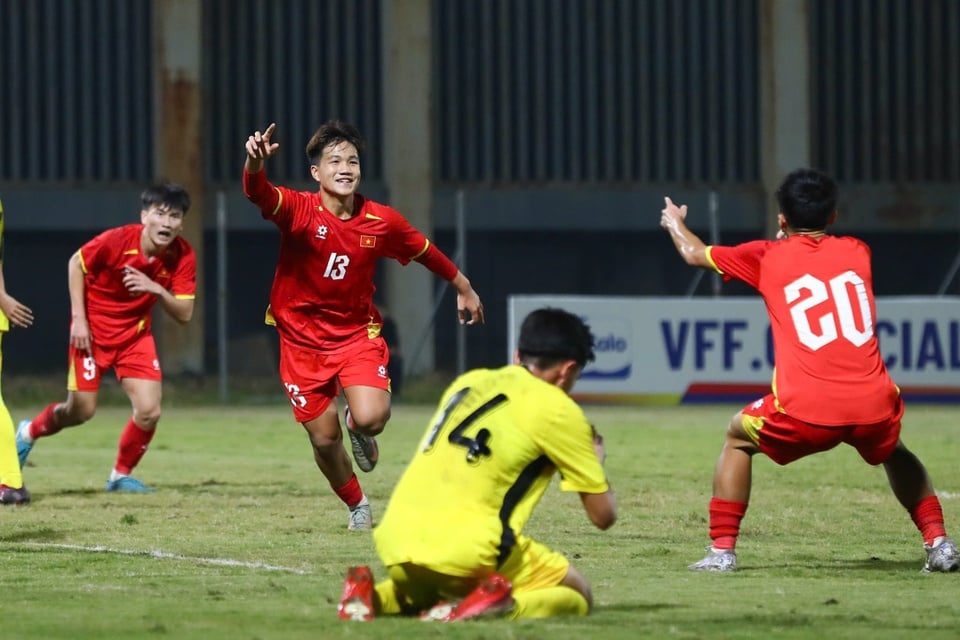
While the Malaysian national team has just caused a stir in Asian public opinion due to the illegal naturalization scandal, the failure of the U17 Malaysia team has become a strong warning about the path to sustainable football development.
From winning Vietnam 4-0 to losing U17 Vietnam 0-4
Just half a year ago, Malaysia beat Vietnam 4-0 in the 2027 Asian Cup qualifiers with a squad that included seven naturalized players. The bitter consequences came not long after FIFA exposed the Malaysian Football Federation for fraudulent records.
With the threat of a ban hanging over the national team, the U17 team's defeat to Vietnam by the same scoreline was a bitter contrast: the national team's hollow victory was based on a lack of transparency, while the U17 team's defeat was a product of the naked truth about internal capacity.
U17 Vietnam entered the match needing only a draw to take the lead, but still played with a more proactive, disciplined and sharper game. U17 Vietnam could have won by more, but they "held back" the score 4-0 as if to respond to the real gap between the two football backgrounds when playing on equal terms. When the match took place on a completely "pure" playing field, without naturalized players, Malaysia's strength was immediately exposed.
What makes Malaysian football ponder is that at the youth level, where the teams are considered to be the most honest reflection of their training background, the gap between them and their ASEAN opponents has become worrying. Without the support of naturalized foreign players, Malaysia relies entirely on its internal strength and has been left in the dust by Vietnam in terms of speed, technique and tactical precision.
ASEAN is not inferior when playing with internal strength
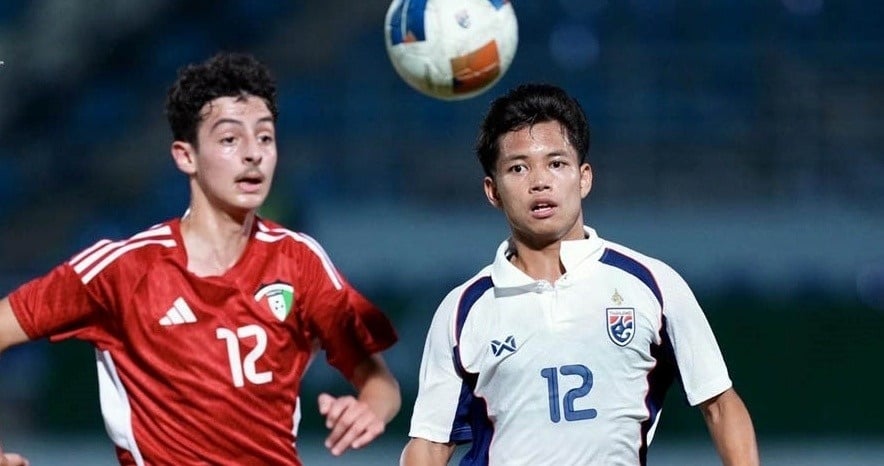
Looking at the entire qualifying round, the achievements of Thailand and Myanmar further demonstrate that ASEAN youth football can stand shoulder to shoulder with the strong Asian football teams when given the opportunity to develop substantially. Thailand came from the brink of elimination to create an impressive comeback to win first place in Group F when defeating the West Asian team - Kuwait with a score of 3-0.
|
Thailand played well against their West Asian opponents. |
Myanmar returned to the finals after 19 years with disciplined, cohesive and courageous play, despite having to face a strong West Asian team, Syria. No team relied on naturalization, no miracles from outside, only perseverance in training and the ability to nurture a new generation.
In that picture, Malaysia stands out in the opposite direction. They are considered one of the leading football nations in the region in using naturalized players to improve the team, but this model is showing fragility and even counterproductive. Results at the youth level show that without external support, Malaysia will find it difficult to compete with Vietnam, Thailand or Myanmar, countries that are investing heavily in training and nurturing the next generation.
Of course, naturalization can bring immediate results. However, if the youth training structure is not consolidated, the bridge from U17 to U19, U21, U23 and finally the national team will become patchy, prone to collapse in the face of any incident.
The lesson is not only for Malaysia but also a general message for ASEAN football: if you want to go far, especially towards long-term goals like the World Cup, you cannot build bridges with temporary pillars of naturalized players. Instead, you have to build solid bridges.
The biggest challenge for ASEAN football teams is how to develop the potential of young players in the U17 group into talents in the U23 group and reach the top of the national team. There have been many young players who played excellently in the U17 group but then declined when they reached the U23 group and disappeared later. Solving the problem of turning potential into new talents is what ASEAN football needs, not naturalization and chasing after achievements.
Source: https://znews.vn/malaysia-co-the-rut-ra-bai-hoc-gi-khi-thua-dam-u17-viet-nam-post1607372.html


![[Photo] Prime Minister Pham Minh Chinh receives President of Cuba's Latin American News Agency](/_next/image?url=https%3A%2F%2Fvphoto.vietnam.vn%2Fthumb%2F1200x675%2Fvietnam%2Fresource%2FIMAGE%2F2025%2F12%2F01%2F1764569497815_dsc-2890-jpg.webp&w=3840&q=75)




























































Comment (0)