

On Windows 11 and Windows 10, there's a way for users to update one or all applications very quickly, using just a single command line in Command Prompt (CMD).
While you can update individual applications, this process is time-consuming and involves many steps. Windows Package Manager is a command-line tool that replaces application installation and management. It's designed to save time and minimize hassle by automating the process of finding, downloading, installing, updating, and configuring most applications, including Microsoft Store apps, traditional (win32) programs, and web applications downloaded using Windows Package Manager.
To update the application using CMD, follow these steps:
- Open the Start menu, search for CMD (or PowerShell), right-click on the top result, and select the Run as administrator option.
- In the Command Prompt window, type the command ` winget upgrade` and press Enter. You will see a list of all Windows applications that have new updates available.
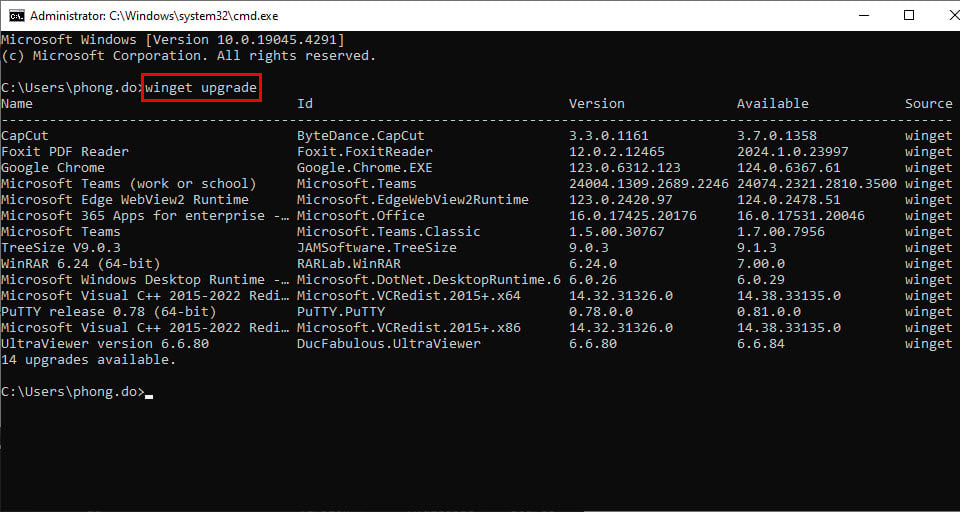
Enter the command `winget upgrade` in the CMD window.
- Next, enter the command `winget upgrade -h --all` and press Enter. This command will update all applications to the latest version.
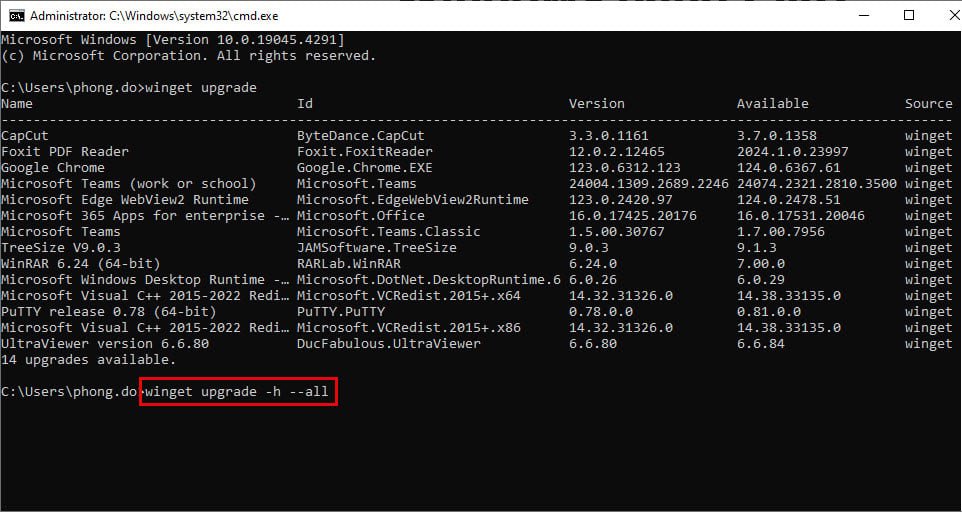
Add the suffix -h --all to update all applications on Windows.
After completing the steps above, the winget tool will download and install updates for all applications installed on your Windows system.
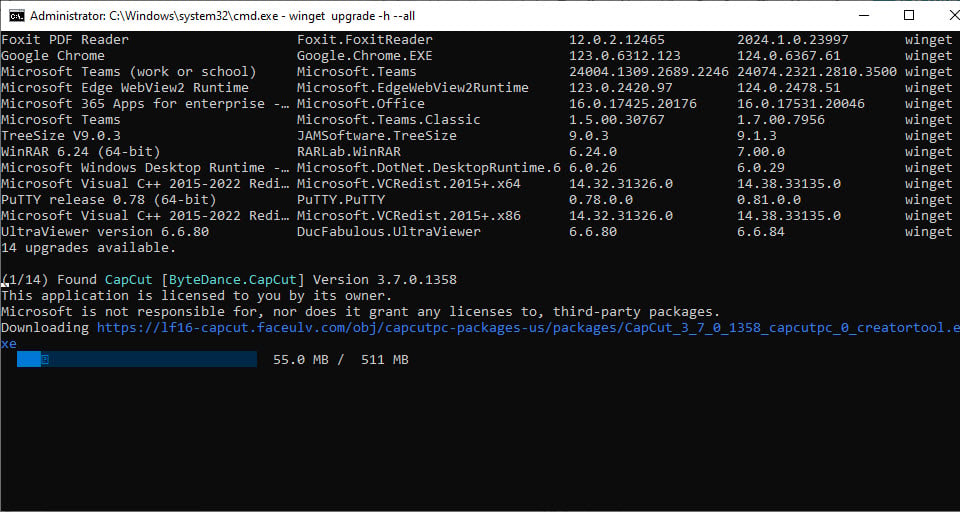
The automatic app update process is shown in detail.
Using the method above, you can only update applications installed using Windows Package Manager. Applications installed from other sources will not be updated through this process. Furthermore, if you later update the application using a different technology, you will lose the ability to update it through Windows Package Manager.
If you want to update a specific application individually, instead of using -h -all , you use the suffix -h --id APP-ID (where APP-ID is the application ID displayed in the ID column). For example: `winget upgrade -h --id ByteDance.Capcut` .
Source link





































































































Comment (0)