

Starting a business in your hometown
Having been a familiar face in the Lao market for many years, Mr. Nghia had experience in trading and understanding the market. About 10 years ago, he decided to return to his homeland to start a business. Instead of his old profession, he wanted to find a new model with less competition and higher economic value. "I realized that raising bamboo rats and civets is not a common model here, but it suits my capabilities and circumstances very well," Mr. Nghia confided.
To avoid relying on luck, he researched the techniques online and then visited reputable farms both within and outside the province to observe and learn from their experiences. With thorough preparation, he decided to invest over 500 million VND in building barns and purchasing breeding stock to implement this new model.
|
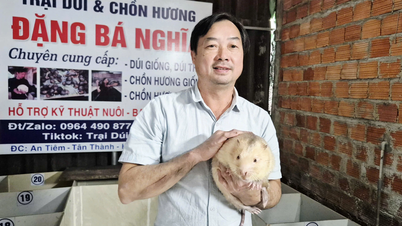
Mr. Nghia's model of raising bamboo rats and civets has been highly praised by the local authorities - Photo: KS |

The secret to Mr. Nghia's success in raising bamboo rats and civets lies in his refusal to take risks regarding origin. According to him, for raising specialty animals, the quality of the breed is paramount. Therefore, for bamboo rats, he buys from reliable breeding facilities within the province and imports more from Thailand to diversify the gene pool. For civets, he sources them from reputable farms in the northern provinces. "My experience is that the breeding stock must have a clear origin and complete certification documents so that the animals are healthy, reproduce well, and are less prone to disease," Mr. Nghia shared.
With a stable herd of 120-200 bamboo rats and a rapidly expanding civet population of dozens, Mr. Nghia has established a well-structured breeding system. He believes that bamboo rats and civets are easy to care for and rarely get sick. However, to achieve high efficiency, breeders must diligently learn proper care and breeding techniques.
Mr. Nghia has made the most of the readily available local food sources, significantly reducing the burden of costs. The food for these two specialty animals is extremely simple: the bamboo rats eat roots, bamboo shoots, bamboo stalks, sugarcane, and familiar tubers and fruits such as sweet potatoes, cassava, corn, and green vegetables; the civets mainly eat ripe fruit, especially ripe bananas—a plentiful local resource—helping the animals thrive.
"Clean barns and readily available feed are the most important factors. You have to learn from the experiences of established farms and proactively research techniques to succeed," Nghia concluded.
New model, high economic value.
Mr. Nghia's farm focuses on selling breeding stock due to its high economic value and quick return on investment. He explains that bamboo rats breed 2-3 times a year. Baby bamboo rats only need to weigh about 600 grams to 1 kilogram (equivalent to 3 months old) to be sold as breeding stock, fetching around 3.5 million VND per pair. The technique of raising them in pairs and separating pregnant female bamboo rats into individual cages ensures a high survival rate.
After being weaned from their mothers, civets are raised for two months until they reach 1-1.2 kg, at which point they can be sold as breeding stock for 8-10 million VND per animal. Civets can begin breeding at 7-8 months old. “The market for breeding civets and bamboo rats is very good, with guaranteed demand. The demand for breeding stock to develop farming models in neighboring provinces is very high, creating a stable market with no worries about oversupply. Sometimes, we can't meet the demand,” Mr. Nghia affirmed.
|
Mr. Nghia is ready to share his production experience from his new model - Photo: KS |

With clear economic benefits, Mr. Nghia's model of raising specialty animals, after deducting expenses, brings his family an average of about 200 million VND per year from selling breeding stock, not including the sale of commercial bamboo rats and civets. This is a realistic figure that has significantly improved his family's living standards and opened up opportunities for wealth creation right in his homeland.
What is commendable is that Mr. Nghia doesn't keep his business experience to himself but is always willing to share his livestock farming techniques with the people and those who buy his breeding stock. His model has become a place where people come to learn, thereby helping to spread new and effective economic practices throughout the community.
Raising bamboo rats and civets not only provides income for the family but is also highly appreciated by the local government for its contribution to diversifying the commune's agricultural economy. Tran Phuoc Cuong, Head of the Economic Department of the Lao Bao Commune People's Committee, commented: “Mr. Dang Ba Nghia's model is a new one, initially bringing quite high economic value to the commune. In the future, the commune will continue to coordinate and support organizations and units to create the best conditions, from capital to technology, to help economic models like Mr. Nghia's develop sustainably.”
Ko Kan Suong
Source: https://baoquangtri.vn/kinh-te/202512/hieu-qua-tu-nuoi-dui-va-chon-huong-o-vung-bien-e7e1bfc/


![[Photo] Two flights successfully landed and took off at Long Thanh Airport.](/_next/image?url=https%3A%2F%2Fvphoto.vietnam.vn%2Fthumb%2F1200x675%2Fvietnam%2Fresource%2FIMAGE%2F2025%2F12%2F15%2F1765808718882_ndo_br_img-8897-resize-5807-jpg.webp&w=3840&q=75)


































































Comment (0)