

A masterpiece of vibrant colors
Born in Dia Linh village, once famous in Hue for its many traditional crafts such as painting amulets and casting the Kitchen God statue for Tet (Lunar New Year), Mr. Khuong Van Lanh chose to pursue mother-of-pearl inlay, a craft that is selective in its apprentices. This profession demands exceptional dexterity, aesthetic sense, a keen sense of composition, and perseverance. "My teacher was also from Dia Linh village, and he taught me when I had just finished secondary school. He told me that mother-of-pearl inlay is both difficult to learn and laborious, but once it takes shape, the artwork can last for years. Whether criticized or praised, the craftsman's reputation will remain for future generations to judge. Therefore, inlay artisans must prioritize aesthetics and be meticulous in every cut and sawing...", Mr. Lanh began his story.
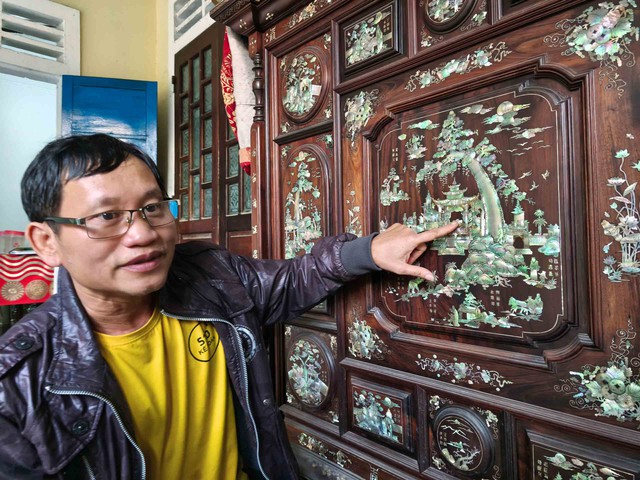
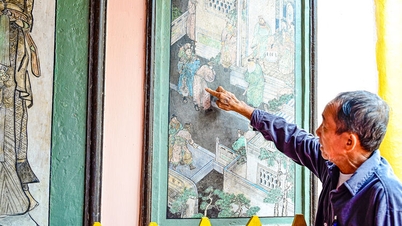
Artisan Khuong Van Lanh introduces a mother-of-pearl inlay painting with the theme of "Twenty-Four Filial Piety Stories" on an altar.
PHOTO: HOANG SON
He explained that mother-of-pearl inlay is not simply about "gluing things together for beauty." A beautiful inlay must be meticulously organized, with a clear beginning and end, a focal point, symmetry, and balance of yin and yang. To create a complete work of art, the artisan must accurately determine the composition from the outset. Pointing to a recently completed altar cabinet, Mr. Lanh explained that the inlaid images on the cabinet "depict" the Twenty-Four Examples of Filial Piety (24 examples of filial piety from classical Chinese literature). Each example of filial piety is a separate story and scene, but when assembled on a large wooden panel, they don't appear disjointed but rather interconnected, forming a complete narrative with a beginning and an end, layers of meaning in the form, and hidden meanings within. From afar or at an angle, it's a sparkling picture, but the more closely you examine it, the more you see the craftsmanship and intention of the artisan.
Introducing a small scene within the larger painting, Mr. Lanh said: "For example, the image of 'lying on the ice waiting for carp' depicts an ancient story about people lying on the ice. The warmth from their bodies melted the ice so they could catch fish to cook for their parents... Once you understand the story, you'll see the depth of the painting, not just the glittering visuals. In this cabinet, I've arranged 24 different scenes into various paintings in different positions."
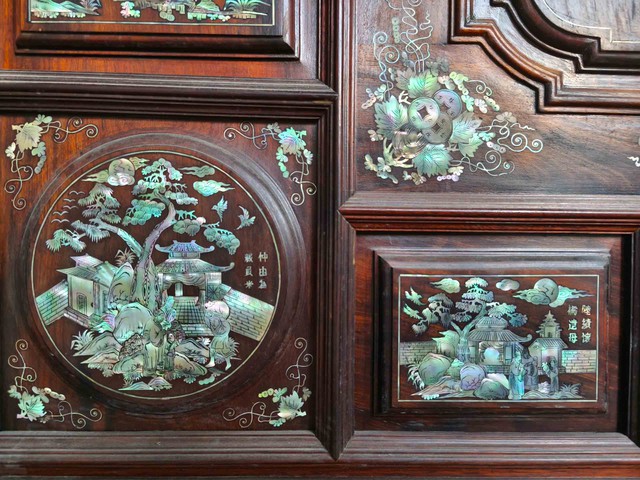
The craft of mother-of-pearl inlay requires skillful craftsmanship.
PHOTO: HOANG SON
Lanh's works often revolve around familiar themes such as the Twenty-Four Filial Piety Stories, the scholar-farmer-craftsman-merchant relationships, flowers and landscapes, and many other classical theatrical stories. Despite their diversity, they all share a common emphasis on meticulous detail and exquisite skill.
Patience in preserving the craft
From the mother-of-pearl inlay artwork on the altar created by artisan Khương Văn Lanh, viewers can easily see that he uses a technique of inlaying small pieces rather than solid blocks. Tree trunks, roofs, leaf veins, bird wings, human figures… are all made from many tiny pieces of mother-of-pearl, cut along the grain, creating a color-shifting effect when the light changes. This is a very high-level technique, as even a slight misstep can break a piece and ruin the composition. The curves, which are the most difficult part of inlay work, are handled smoothly and seamlessly. This shows that the craftsman works entirely by hand, controlling the saw blade to the point of almost "following his thoughts."
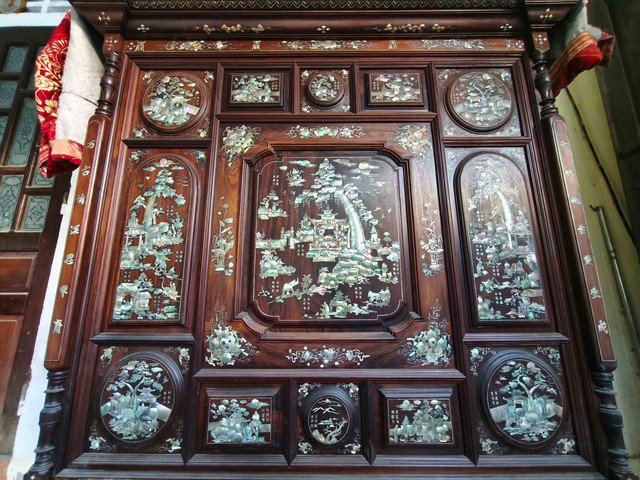
The mother-of-pearl inlay paintings on the altar cabinet are extremely exquisite.
PHOTO: HOANG SON
"To create a beautiful mother-of-pearl inlay, the craftsman must have a thorough understanding of the properties of mother-of-pearl. They must know where to use bright pieces, where to moderate them to avoid glare, where to use strong veins for emphasis, and where to use softer pieces to maintain the background. Mother-of-pearl must be used sparingly and in the right places," he said, adding, "Patience is essential in this craft. With the level of detail on this altar, I used hundreds, even thousands, of saw cuts on each inlaid section. Many jokingly say that only those who consider the craft a form of spiritual practice, working to uphold the honor of the profession rather than chasing time, can persevere to the end."
Recounting the craft process reveals just how important perseverance is. Mr. Lanh explained that after receiving the wooden items, the inlay craftsman will disassemble them, process the surface, sand, smooth, and wait for the wood to stabilize… This preparation alone takes several days. From the drawing, Mr. Lanh cuts paper according to the shape and pastes it onto the wood to mark the outline. He uses a chisel to make a 1 mm indentation into the wood surface, then cuts thin mother-of-pearl to match and attach it. "The most difficult part is the veins, curves, and tiny details, as fine as a hair, all of which are sawed entirely by hand. This material is very brittle. If it breaks, it has to be redone. Some details have to be cut from many extremely small pieces and then assembled, rather than made from a single piece. The key is that cutting technique," Mr. Lanh said.
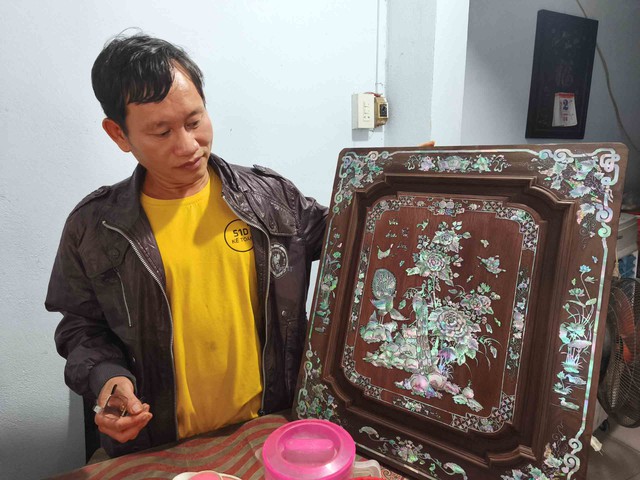
The painting depicts nature with unique and exquisite details, all created by Mr. Lanh through mosaic work.
PHOTO: HOANG SON
With calligraphy, the difficulty is even higher, as it requires capturing the strokes, the flicks, and the thickness of the brushstrokes. The craftsman uses a saw and a steel knife to cut each line, even though many Chinese calligraphy characters are as small as a fingernail. "Seeing the strokes is what it means to be a true craftsman," Mr. Lanh shared. "Although many details are very small, I don't use a magnifying glass as many people think, but instead use a spotlight placed under the mirror or under the inlaid piece. The light reflects up, helping to see every small detail clearly," he said.
Having traveled extensively throughout Southern Vietnam, making all kinds of products from beds, cabinets, horizontal plaques, couplets to inlaid paintings before returning to his hometown to help his wife run a general store, artisan Khuong Van Lanh frankly admits that the mother-of-pearl inlay craft is not enough to support his family. A large cabinet, the mother-of-pearl alone costs about 15 million dong, plus labor costs around 30 million dong, while it takes three months to complete. The small hamlet in the old Dia Linh village, once the cradle of the inlay craft, now only has him clinging to it. Knowing that the craft is gradually dying out, Mr. Lanh still diligently sits at his old wooden table, trying to hold on. "It's a pity for this craft. After all, even though it's a handicraft, if done properly, it's still an art," Mr. Lanh said. (to be continued)
Source: https://thanhnien.vn/nhung-tuyet-tac-xa-cu-18526020822145076.htm

























































































Comment (0)