

A recent study by Accenture shows that businesses applying advanced AI technologies such as large-scale language modeling and AI generation have the potential to increase revenue by up to 10%, 2.6 times higher than businesses that do not use these technologies.
In the age of artificial intelligence and large-scale language models (LLMs), data science and AI are increasingly integrated into workflows. However, deploying and applying AI models to business operations also faces numerous challenges.
According to Mr. Nguyen Van Tuan, CEO of Hyratek, a company supporting AI systems and infrastructure for the project to reconstruct images of fallen soldiers, the demand for equipment used for AI training and development worldwide is higher than the market supply. Buyers even have to place orders with suppliers six months in advance to receive the equipment.

The world is "thirsty" for hardware infrastructure to support artificial intelligence. Meanwhile, AI systems are often trained centrally, at very high costs. This is a major barrier to the application of AI in business operations.
Many businesses in Vietnam are using cloud services to deploy AI models. However, this approach is costly when operating at a large scale and lacks flexibility in workflows.
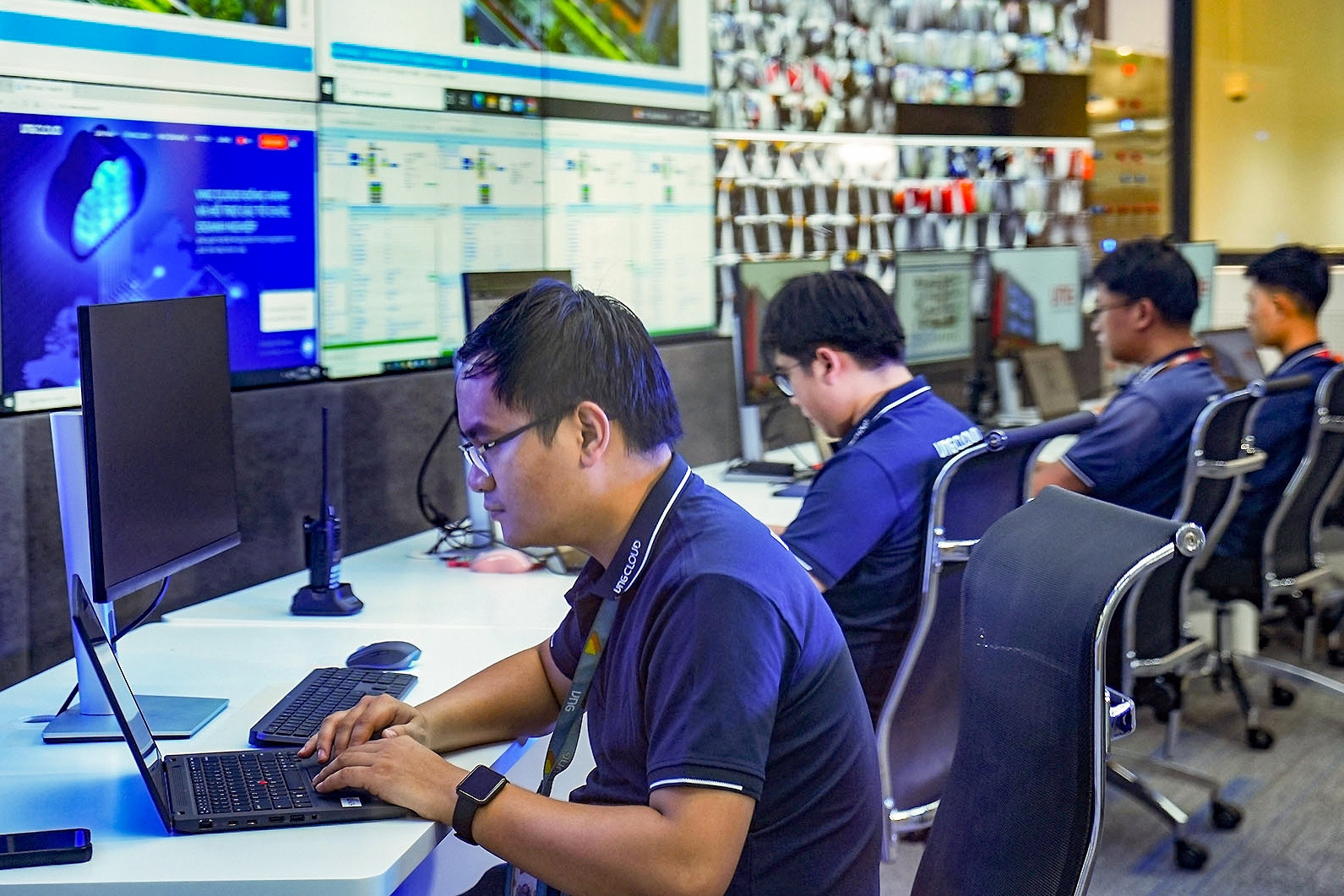
In a recent event, Mr. Nguyen Van Giap, General Director of Lenovo Vietnam, stated that in order to apply AI more effectively to operations and production processes, businesses are increasingly opting for AI-integrated workstations.
Many organizations are shifting to hosting and developing large-scale language models (LLMs) and small-scale language models (SLMs) privately, due to concerns about security and data training costs.
This not only optimizes workflows but also helps business owners make timely decisions and fosters innovation in many areas.
Thanks to their high-performance CPUs and GPUs, these workstations are designed to drive AI model development, refinement, and training at a smaller scale and lower cost than in the cloud.
Using on-premise data is not only safer but also allows data scientists to train AI models with faster, closed-loop testing, thereby reducing the time to obtain final results.

The diversity of large language models is also being increasingly recognized globally. Speaking to VietNamNet, Robert Hallock, Vice President and General Manager of AI and Engineering Marketing at Intel, said that to promote digital transformation, countries can develop their own large language models, with Vietnam having the Vietnamese language model.
According to Intel's Vice President, during the process of working with several multilingual AI models, Vietnam and China were assessed as two countries that are doing a good job of localizing major language models by incorporating local language elements.
Robert Hallock believes that AI can not only be applied to boost business in enterprises, but also effectively in the public sector. In particular, the legal framework of governments provides an excellent environment for artificial intelligence.
A legal document can be hundreds of pages long, making it difficult for anyone to grasp all the information and regulations within it. This is where a large-scale language model with a virtual assistant that asks questions about specific content comes in handy.
A survey by Finastra shows that Vietnam currently leads the markets in interest in AI generative technology. According to the survey results, 91% of Vietnamese people expressed a positive response to the benefits that AI generative technology can bring.
Source: https://vietnamnet.vn/no-ro-xu-huong-tu-phat-trien-cac-mo-hinh-ngon-ngu-lon-ai-2325714.html

![[Live] 2025 Community Action Awards Gala](/_next/image?url=https%3A%2F%2Fvphoto.vietnam.vn%2Fthumb%2F1200x675%2Fvietnam%2Fresource%2FIMAGE%2F2025%2F12%2F16%2F1765899631650_ndo_tr_z7334013144784-9f9fe10a6d63584c85aff40f2957c250-jpg.webp&w=3840&q=75)

![[Photo] Prime Minister Pham Minh Chinh receives the Governor of Tochigi Province (Japan)](/_next/image?url=https%3A%2F%2Fvphoto.vietnam.vn%2Fthumb%2F1200x675%2Fvietnam%2Fresource%2FIMAGE%2F2025%2F12%2F16%2F1765892133176_dsc-8082-6425-jpg.webp&w=3840&q=75)
![[Image] Leaked images ahead of the 2025 Community Action Awards gala.](/_next/image?url=https%3A%2F%2Fvphoto.vietnam.vn%2Fthumb%2F1200x675%2Fvietnam%2Fresource%2FIMAGE%2F2025%2F12%2F16%2F1765882828720_ndo_br_thiet-ke-chua-co-ten-45-png.webp&w=3840&q=75)
![[Photo] Prime Minister Pham Minh Chinh receives Lao Minister of Education and Sports Thongsalith Mangnormek](/_next/image?url=https%3A%2F%2Fvphoto.vietnam.vn%2Fthumb%2F1200x675%2Fvietnam%2Fresource%2FIMAGE%2F2025%2F12%2F16%2F1765876834721_dsc-7519-jpg.webp&w=3840&q=75)


























































![[Photo] Prime Minister Pham Minh Chinh attends the Vietnam Economic Forum 2025](https://vphoto.vietnam.vn/thumb/402x226/vietnam/resource/IMAGE/2025/12/16/1765893035503_ndo_br_dsc-8043-jpg.webp)































Comment (0)