

Neem is one of the crops that yields high economic returns on the sandy coastal areas of Quang Tri province, providing a stable source of income for farmers.
Planting the ném tree helps to loosen sandy soil and increase soil fertility. The ném tree can tolerate heat, drought, and waterlogging quite well, and the planting technique is simple and easy to do.
This plant is less susceptible to pests and diseases, grows well, and is therefore easy to cultivate on a large scale. It requires little time for care but yields high income, especially when grown organically, which further increases the income.
The sandy soil area in Trieu Lang commune is relatively large, making it less suitable for growing crops. Yields are low and highly dependent on weather conditions, allowing for only a winter-spring crop. The summer-autumn crop is mostly left fallow, leading to shifting sands and soil degradation.
The challenge of selecting suitable crops for sandy soil requires significant economic and technical investment. Recognizing this, during the 2023-2024 Winter-Spring season, with the support of the FMCR project team, the People's Committee of Trieu Lang commune, in collaboration with the Quang Tri Agricultural Extension Center, implemented a model for planting and caring for the "nem" plant (a type of medicinal herb) using organic methods.
The organic rice cultivation model is being implemented in Trieu Lang commune, Trieu Phong district, covering an area of 2 hectares.
Initially, this model of growing root vegetables for spice production has yielded certain results, creating a shift in crop structure and paving the way for building the Trieu Lang spice brand in the future.
Despite being grown on nutrient-poor sandy soil, with adequate and balanced fertilization, increased amounts of well-rotted manure, microbial organic fertilizer, and organic mineral fertilizer, and proper care according to technical procedures, the plants developed well and yielded high tuber production.
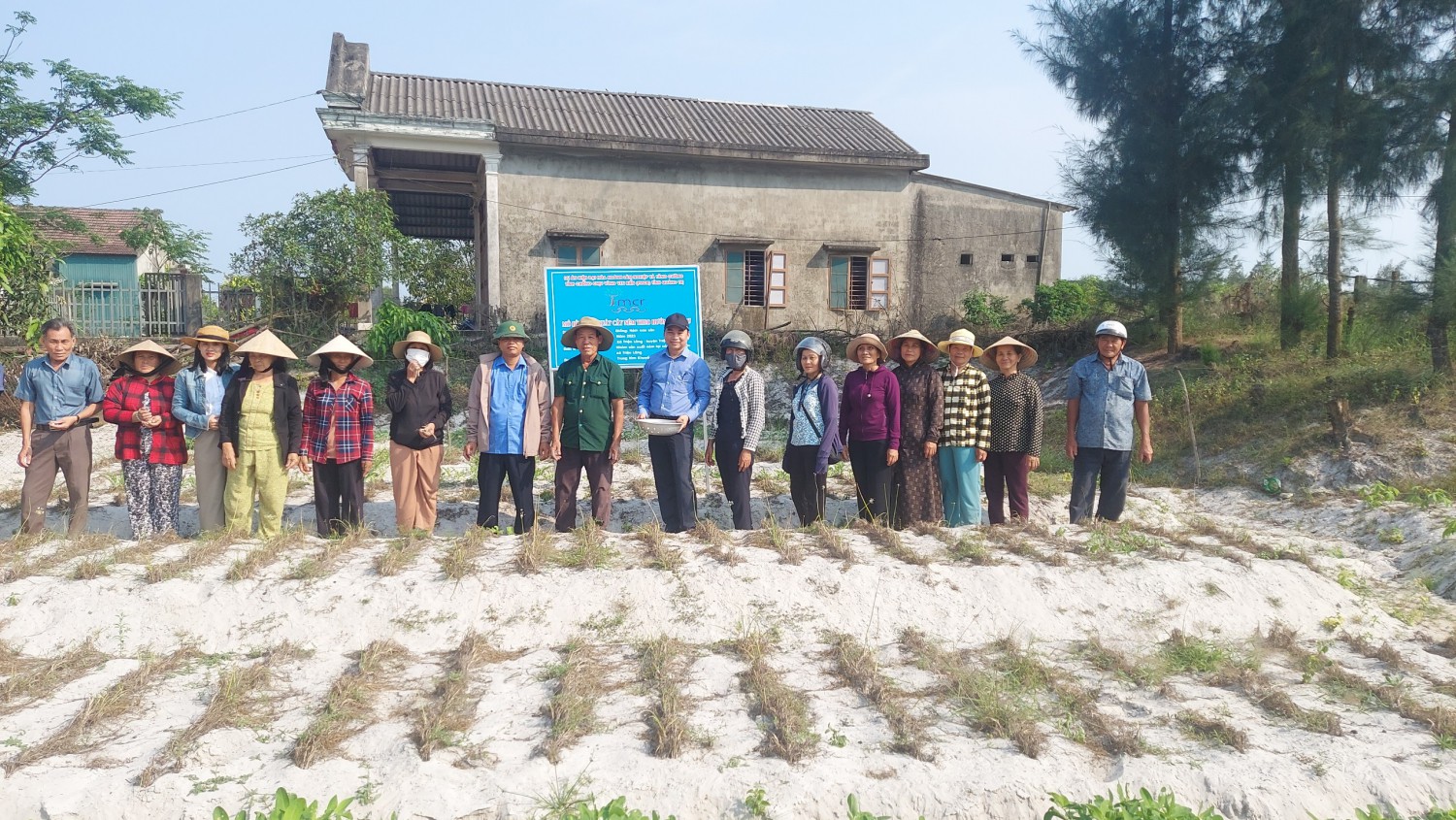
The model of growing ném (a type of plant) using organic methods is being implemented in Trieu Lang commune, Trieu Phong district, Quang Tri province.
In previous years, farmers cultivated ném (a type of plant) using traditional methods and a lot of chemical fertilizers. As a result, the ném plants initially grew lush and green, but were susceptible to pests and diseases, withered quickly, and yielded low productivity.
Today, the model of growing cinnamon trees organically on sandy soil during the 2023-2024 Winter-Spring season has created a breakthrough in crop structure transformation, yielding high efficiency.
Through this model of growing arrowroot for its spice-producing tubers, farmers have grasped the techniques of planting, caring for, and controlling pests and diseases in arrowroot plants effectively. This provides a basis for replicating the model and moving towards planning a concentrated arrowroot commercial farming area for the locality in the coming years.
The successful organic production model for the "nem" tree has increased production value per unit, enabled people to adopt new technical advancements, and created additional livelihoods for the people, contributing to more effective care, protection, and management of coastal forests in Trieu Lang commune, Trieu Phong district (Quang Tri province). The results of this model have helped people confidently exploit the potential and strengths of sandy soil areas, creating a breakthrough in transforming crop structures, adapting to climate change, and bringing high and sustainable efficiency to production. This helps people understand the technical process for applying it to intensive cultivation of neem trees on sandy soil, including composting manure, increasing the use of decomposed organic fertilizers, microbial fertilizers, and organic-mineral fertilizers while limiting chemical fertilizers, making sandy soil increasingly fertile and increasing the economic efficiency of crop production. Compared to other crops, the sesame plant is suitable for sandy coastal areas, is less susceptible to pests and diseases, is easy to cultivate and care for intensively, does not require excessive labor, is suitable for women or older workers, has a moderate investment but yields high profits (3-4 times higher than growing peanuts, potatoes, or cassava), has a wide market, and can be harvested once without much labor like beans or sesame. The model of growing organic rice on sandy soil in Trieu Lang commune has raised awareness in organic agricultural production, gradually creating clean, environmentally friendly products, minimizing pollution, and protecting the living environment and agricultural ecosystem.This model also helps to limit the use of chemical fertilizers, replacing them with organic and microbial fertilizers, resulting in sturdy, healthy plants that are relatively free from pests and diseases, producing fragrant and flavorful nem (a type of Vietnamese sausage), and yielding promising results with high potential for replication. Therefore, we request that relevant departments continue to pay attention to this model.
Mr. Dang Quang Hai, Chairman of the People's Committee of Trieu Lang commune, Trieu Phong district (Quang Tri province), said: In the coming time, the local government will continue to implement policies to encourage people to reclaim and restore sandy areas for planting nem (a type of medicinal plant).Planning cultivation areas, forming concentrated specialized areas for growing pomelo, and producing on a group-household scale will contribute to exploiting the potential and strengths of the coastal sandy areas, moving towards building a raw material production area and establishing the clean pomelo brand of Trieu Lang to enhance product value and expand the consumer market.
Source: https://danviet.vn/noi-nay-o-quang-tri-nong-nhu-nung-cat-trang-xoa-trong-cay-nem-kieu-gi-ma-nong-dan-lai-cao-20240711152136378.htm

![[Photo] Prime Minister Pham Minh Chinh receives the Governor of Tochigi Province (Japan)](/_next/image?url=https%3A%2F%2Fvphoto.vietnam.vn%2Fthumb%2F1200x675%2Fvietnam%2Fresource%2FIMAGE%2F2025%2F12%2F16%2F1765892133176_dsc-8082-6425-jpg.webp&w=3840&q=75)
![[Live] 2025 Community Action Awards Gala](/_next/image?url=https%3A%2F%2Fvphoto.vietnam.vn%2Fthumb%2F1200x675%2Fvietnam%2Fresource%2FIMAGE%2F2025%2F12%2F16%2F1765899631650_ndo_tr_z7334013144784-9f9fe10a6d63584c85aff40f2957c250-jpg.webp&w=3840&q=75)
![[Photo] Prime Minister Pham Minh Chinh receives Lao Minister of Education and Sports Thongsalith Mangnormek](/_next/image?url=https%3A%2F%2Fvphoto.vietnam.vn%2Fthumb%2F1200x675%2Fvietnam%2Fresource%2FIMAGE%2F2025%2F12%2F16%2F1765876834721_dsc-7519-jpg.webp&w=3840&q=75)
![[Image] Leaked images ahead of the 2025 Community Action Awards gala.](/_next/image?url=https%3A%2F%2Fvphoto.vietnam.vn%2Fthumb%2F1200x675%2Fvietnam%2Fresource%2FIMAGE%2F2025%2F12%2F16%2F1765882828720_ndo_br_thiet-ke-chua-co-ten-45-png.webp&w=3840&q=75)









































![[Photo] Prime Minister Pham Minh Chinh attends the Vietnam Economic Forum 2025](https://vphoto.vietnam.vn/thumb/402x226/vietnam/resource/IMAGE/2025/12/16/1765893035503_ndo_br_dsc-8043-jpg.webp)




















Comment (0)