

Mr. Tran Van Sinh, Head of the Culture and Information Department of Ninh Son District, said: Currently, the Raglai people have two traditional festivals: the New Rice Offering Ceremony and the New Rice Harvest Celebration. The New Rice Harvest Celebration has been recognized as a National Intangible Cultural Heritage; the festival takes place every 5, 7, or 10 years, depending on the economic conditions of each family and clan. The New Rice Offering Ceremony takes place annually, usually around the end of November or beginning of December, within each clan, after the rice has been harvested and brought home. It signifies gratitude to the gods, mountains, forests, ancestors, and prayers for favorable weather, a bountiful harvest, and family prosperity. According to Mr. Sinh, the New Rice Offering Ceremony is a project to preserve and promote the valuable traditional culture of ethnic minorities in conjunction with tourism development. Ninh Son district recently organized the reconstruction of the New Rice Offering Ceremony at the Ca Mau clan in Ta Noi village, Ma Noi commune (Ninh Son). Through this, not only are the valuable traditional cultural values of the Raglai people preserved and promoted, but also the cultural values are disseminated to local people to develop tourism and improve their livelihoods.
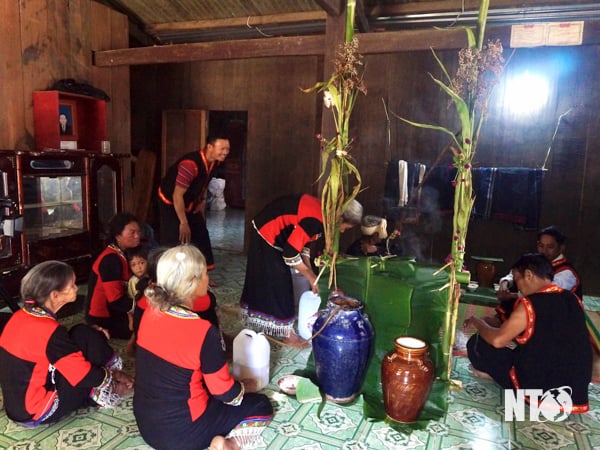
The Ca Mau clan in Ta Noi village, Ma Noi commune (Ninh Son district) held a ceremony to worship the new rice crop.
This year, the New Rice Offering Ceremony took place at the home of Mrs. Ca Mau Thi Son, the family chosen by the clan leader to host the annual ceremony. At Mrs. Son's house, from the entrance to the kitchen, there was a constant hustle and bustle as descendants of the Ca Mau clan from various places gathered to prepare the offerings. From early morning, Mrs. Son and her family roasted rice and pounded it into puffed rice. The women meticulously and carefully performed the initial tasks of the New Rice Offering Ceremony, from roasting and pounding to sifting, with skillful hands. After sifting the first batch of rice, Mrs. Son shared: "The New Rice Offering Ceremony lasts a day and a half. To prepare for the ceremony, the women prepare the offerings, while the men cut bamboo to decorate the area where the offerings are placed and tidy up the house to welcome the ancestors to celebrate the new rice harvest. Besides puffed rice, the Raglai New Rice Offering Ceremony must include rice wine, chicken, rice, paddy, corn, sorghum, and betel nuts." Regarding the chicken offering, it must be a live, white chicken, offered first on the first day, then slaughtered and offered again. The reason for offering a white chicken is to symbolize everything being good and bright. These are offerings from descendants to inform their ancestors of the fruits of their labor over the past year and to ask for their blessings for a bountiful harvest, a more prosperous new year, and good health for the family.
A very special and indispensable element in the Raglai people's New Rice Offering Ceremony is the fire made from homemade candles (beeswax). Besides the offerings, there must be fire on the offering tray. If the sound of the bamboo flute and the Ma La is considered an invitation for villagers to join the family in celebrating the new rice harvest, then the fire is considered a "sacred object" inviting ancestors to celebrate the new rice harvest. When the offerings are prepared, everyone gathers at the appointed time. Women bring the offerings to the center of the house to arrange them for the ceremony. The Ma La is played to begin the ritual, and the shaman starts the ceremony. On the first day, after the completion of the rituals, around noon, rice wine is opened, neighbors and family gather around the table to share stories about life. The conversations blend with the lively sounds of the Ma La, and everyone participates in the festivities that continue until nightfall (depending on the health of each family member, they may rest earlier). Mr. Ca Mau Vien, the clan leader of the Ca Mau clan in Ta Noi village, said: Similar to the first day, on the second day, the ceremony continues until noon, inviting the sky god, the mountain god, and the spirits of ancestors to gather with their descendants to witness the celebration of the new rice harvest; then, they pray to bid farewell to the spirits of their ancestors, sending them to their resting place (carrying the offerings halfway before returning). After this ritual, two shamans will simultaneously pray for the health and prosperity of the clan members.
Mr. Ca Mau Ha, Vice Chairman of the People's Council of Ma Noi commune, said: "The New Rice Offering Ceremony is a long-standing traditional custom of the Raglai people. Besides expressing gratitude to the gods, ancestors, and forefathers, the New Rice Offering Ceremony also strengthens the spirit of unity within the community. This is an opportunity for relatives from different places to gather, meet, visit, show concern and help each other, and work together for development. Currently, there are 27 clans in Ma Noi commune. Previously, all clans shared common festivals; however, now only 5 clans still preserve the New Rice Offering Ceremony and hold it annually. The local authorities are currently promoting the preservation of the Raglai people's cultural identity through propaganda."
Having the opportunity to experience and immerse ourselves in the unique culture of the Raglai people, we witnessed many rituals being reenacted, from spiritual life to dances, and the sound of the Ma La drums echoing like a continuing stream of traditional culture. We hope that the beautiful traditional cultural values of ethnic minorities will continue to be nurtured and spread further.
Kim Thuy
Source

![[Photo] General Secretary and President To Lam receives Amazon's Senior Vice President David Zapolsky](https://vphoto.vietnam.vn/thumb/1200x675/vietnam/resource/IMAGE/2026/05/22/1779466547770_a1-bnd-3513-6601-jpg.webp)



















































Comment (0)