

But in 2021, encouraged by her family, Ms. Thuy decided to return to snake farming. With the capital she had, she started building a 150m2 enclosure, divided into compartments, each compartment into two sections, then covered with clean sand; the doors were made of thick wooden planks (1-1.5cm) with sturdy latches; and she purchased necessary equipment such as fans, freezers, and misting fans. In addition, Ms. Thuy borrowed money from relatives and friends and received guidance from the Cong Ly Commune Youth Union to access preferential loans from the Social Policy Bank to support the expansion of her production scale.
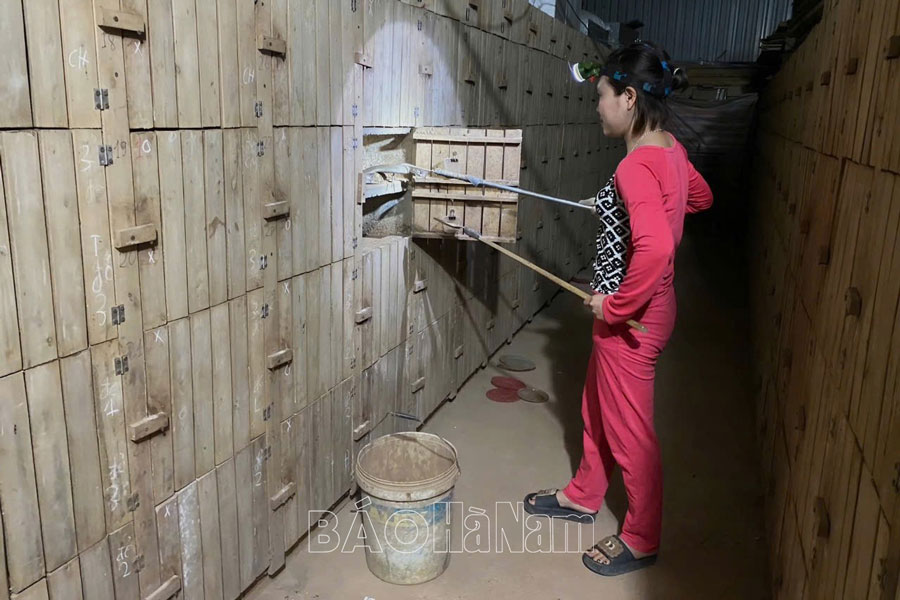
According to Ms. Thuy, the rat snake is a terrestrial species with many different names, such as: rat snake, striped rat snake, long-tailed rat snake; its body has many striped patterns. This snake is docile, and its food is usually diverse, abundant, and easy to find, such as frogs, toads, or low-quality chickens and ducks that are discarded by hatcheries… It is also an easy animal to raise and breed, providing high economic efficiency. Typically, around the third lunar month, when the weather is warm and sunny, is the suitable time for the snakes to feed. At this time, on average, Ms. Thuy feeds the snakes once every 3-5 days; each meal will consume 30-50 kg of food for all the snakes. To save costs, she feeds half of the snakes first. After about an hour, if the snakes haven't finished eating, she will turn the tray and continue feeding the remaining snakes. After 2-3 hours of the snakes eating, Ms. Thuy will clean their cages. With good care, during the hot season, the snakes will shed their skin in about 25-30 days. At that time, they consume a large amount of food, so their body weight increases rapidly. From the ninth lunar month onwards, the snakes will stop eating and begin hibernating, so she will adjust their diet accordingly.
Besides being easy to raise and less prone to disease, snakes can easily contract illnesses, especially diarrhea, if proper diet and regular cleaning of their enclosures are not maintained, making treatment very difficult. In 2023, due to a lack of experience in enclosure hygiene, Ms. Thuy lost nearly 30 adult snakes. Later, learning from experienced breeders, after feeding the snakes and after each breeding cycle, she regularly cleaned and disinfected the entire enclosure to prevent risks to the snakes.
King cobras typically lay two clutches of eggs per year, in May and July of the lunar calendar. The first clutch contains 10-15 eggs, while subsequent clutches yield 15-20 eggs. On average, Ms. Thuy harvests approximately 3,000-3,500 snake eggs per clutch to supply the market. The price of snake eggs ranges from 30,000 to 90,000 VND per egg. From an initial 163 breeding snakes, Ms. Thuy's farm now has 600 snakes of various types. After deducting expenses, she earns 200-250 million VND per year. Combined with scientific breeding methods, a proper nutritional regime, and effective breeding techniques, Ms. Thuy's snake farming model has achieved high productivity and minimized risks.
With perseverance, diligence, hard work, and a determined desire to become wealthy, Ms. Hoang Thi Hong Thuy has succeeded in finding a suitable and highly effective economic development path. Ms. Do Thi Tuoi, Secretary of the Cong Ly Commune Youth Union, stated: "Ms. Hoang Thi Hong Thuy is a prime example of someone who is not afraid of hardship or difficulties, and who strives to develop the local economy. She is worthy of emulation by Youth Union members and young people. In the coming time, the Cong Ly Commune Youth Union will continue to support Ms. Thuy and other Youth Union members and young people throughout the commune in promoting economic development."
Bui Linh
Source: https://baohanam.com.vn/kinh-te/phat-trien-kinh-te-tu-nuoi-ran-ho-trau-155842.html


























![[Photo] Speaker of the National Assembly meets with the Vietnamese community in Türkiye](https://vphoto.vietnam.vn/thumb/1200x675/vietnam/resource/IMAGE/2026/04/18/1776483346102_1-8136-jpg.webp)






























































Comment (0)