

Deputy Prime Minister Tran Hong Ha stated that localities identified as key rice-producing regions still face difficulties in socio-economic development. Agricultural economics remains dependent on weather, climate, and market conditions, and has not yet yielded the same quick returns and benefits as other sectors.
Therefore, the Land Law and the Decree on rice land must have mechanisms and policies to enable localities that are key rice-producing regions to fulfill their political objectives while simultaneously developing socio-economic aspects. Farmers should receive focused support, be given opportunities to apply science and technology, improve productivity, move towards large-scale production, and ensure stable income and living standards.
The Deputy Prime Minister emphasized the spirit of "closely adhering to the law and practice to institutionalize and implement policies on rice land in the Land Law, ensuring synchronized and unified implementation nationwide."
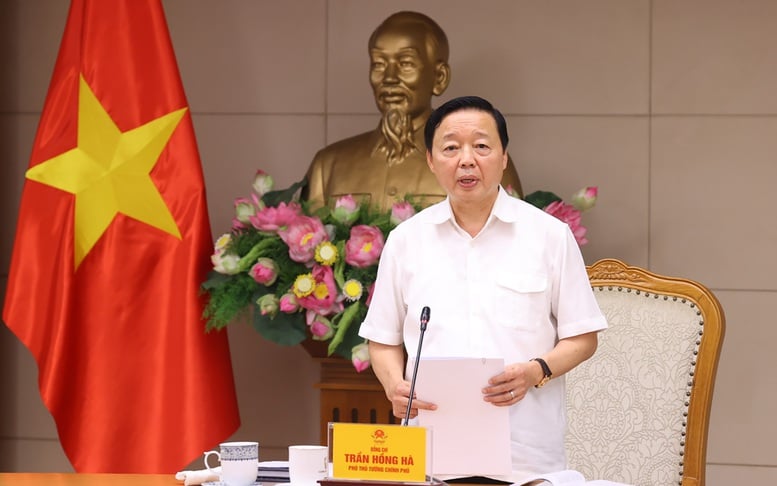
Deputy Prime Minister Tran Hong Ha stated that support policies should help organizations, businesses, and rice farmers cope with all risks - Photo: VGP/MK
Add clear and scientific criteria.
The draft decree consists of 4 chapters and 18 articles regulating the management and use of rice-growing land; and policies to support the protection and development of rice-growing land.
Following the June 18th meeting chaired by Deputy Prime Minister Tran Hong Ha with ministries, agencies, 63 provinces and centrally-administered cities, a number of experts, scientists, and associations, the Ministry of Agriculture and Rural Development has incorporated and supplemented regulations on criteria for identifying high-yield, high-quality rice-growing areas that need protection and whose conversion should be restricted.
Based on the allocated rice land quotas for localities, opinions suggest that the Ministry of Agriculture and Rural Development should establish specific, quantitative criteria such as scale, soil conditions, infrastructure, etc., in each region to determine the scope of rice land areas that need protection and conversion restrictions; and rice land areas that can be converted but still maintain the conditions for rice cultivation again.
Chairman of the People's Committee of Dong Thap province, Pham Thien Nghia, requested the Ministry of Agriculture and Rural Development to clarify what constitutes high productivity and quality; what defines low risk of salinization and acidification; and to consider land used for constructing facilities serving agricultural production and land converted to perennial crops as agricultural land, not rice paddy land.
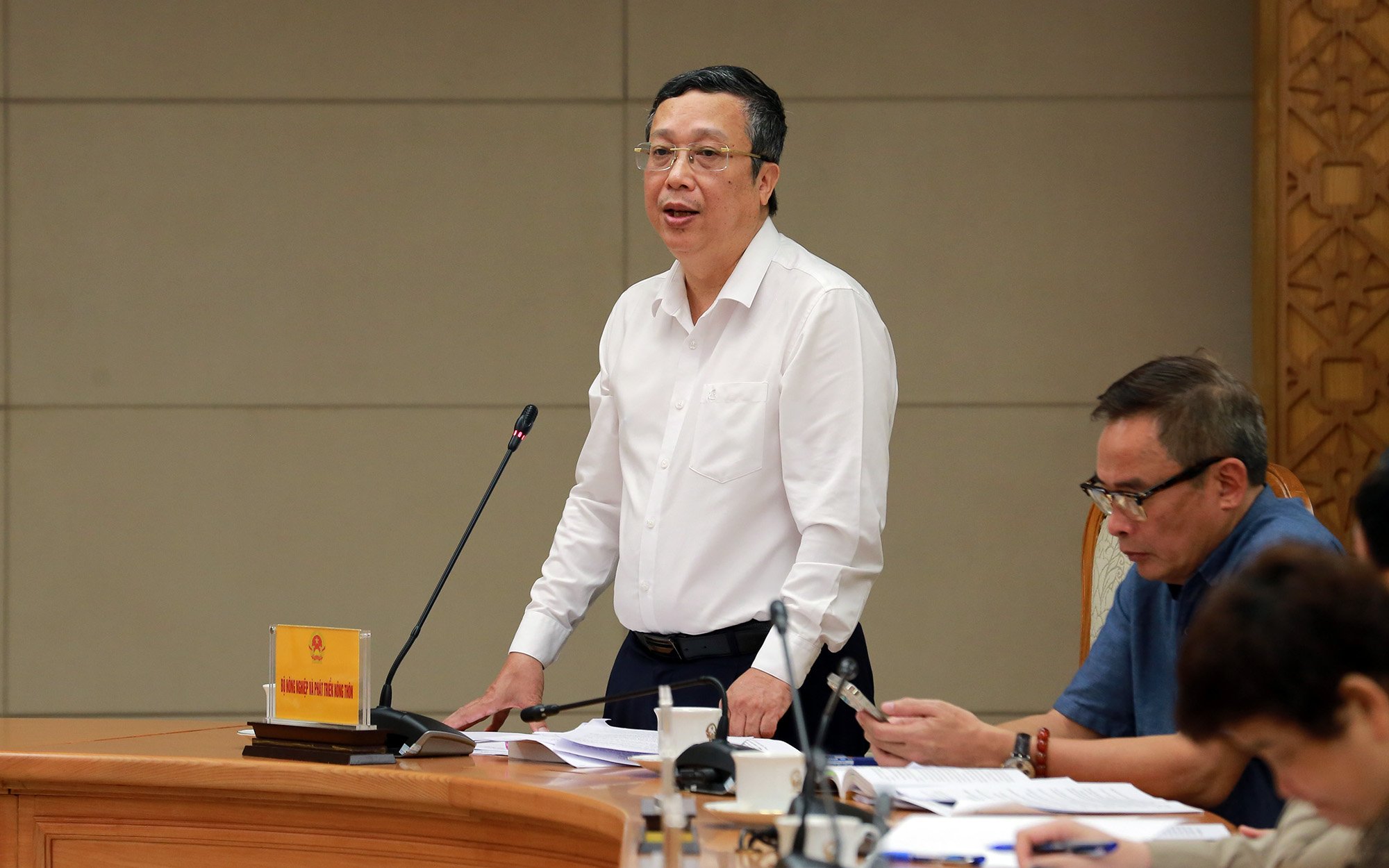
Deputy Minister of Agriculture and Rural Development Hoang Trung delivered a speech at the conference.
The Deputy Prime Minister requested the Ministry of Agriculture and Rural Development to revise and supplement quantitative scientific criteria to serve as a basis for localities to identify high-yield, high-quality rice-growing areas within the total rice-growing land and specialized rice-cultivating land allocated by the Ministry of Natural Resources and Environment.
Furthermore, the Ministry of Agriculture and Rural Development, in coordination with the Ministry of Natural Resources and Environment, identifies major rice-growing regions such as the Mekong Delta, the Red River Delta, and the Central Coastal region. They then delineate areas of high-yield, high-quality rice land, tailored to the specific characteristics of each region. Based on this, they develop regulations and policies for management that are appropriate to the local context.
The Deputy Prime Minister also requested the Ministry of Agriculture and Rural Development to clarify the procedures, processes, and scientific basis for converting the crop and livestock structure on rice land to perennial crops, aquaculture, etc.
Priority is given to large-scale production areas.
Regarding policies for protecting and developing rice land, especially high-yield, high-quality rice-growing areas, leaders of the People's Committees of Long An and Vinh Long provinces stated that localities always need support in irrigation infrastructure, transportation, science and technology, post-harvest preservation, agricultural supplies, etc., with a focus on specific areas instead of a blanket approach; clearly identifying investment capital sources and investment support; and determining the percentage of land converted from rice cultivation to aquaculture combined with rice cultivation.
Based on local realities, leaders of Nghe An, Thanh Hoa, and Thai Binh provinces, along with representatives from the Central Committee of the Vietnam Fatherland Front, suggested that if regulations are not clear and strict, the management of construction projects directly serving agricultural production should be avoided to prevent exploitation for business services or residential purposes. They also proposed researching options for shared use, to prevent "every plot of land having a construction project"...
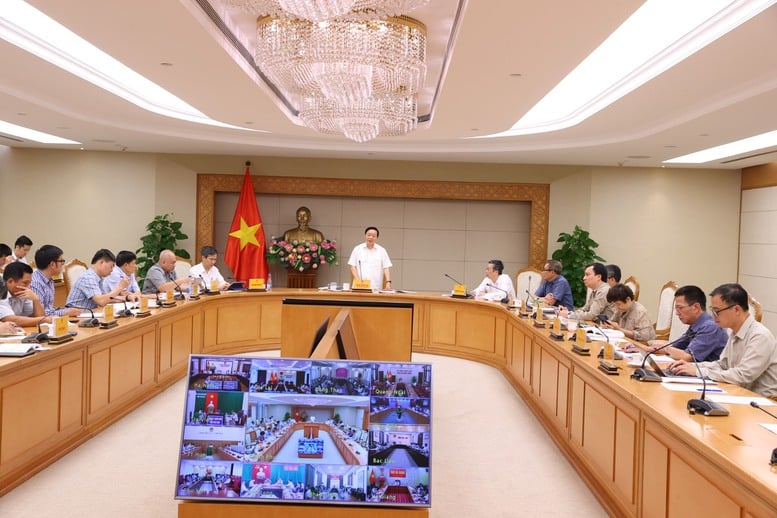
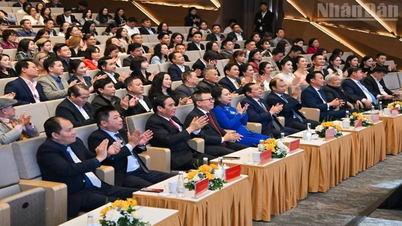
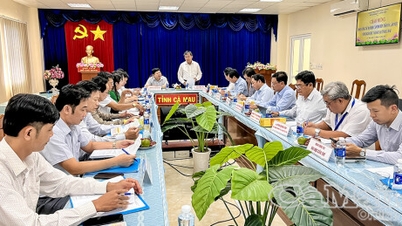
Overview of the Conference.
Mr. Nguyen Quang Hung, Vice Chairman of the People's Committee of Thai Binh province, believes it is necessary to clearly identify the "address" for receiving support funds for strictly protected rice-growing areas with restricted conversion – whether it is for local authorities or for organizations, businesses, and individuals growing rice; and to provide guidance on protecting and improving coastal rice-growing areas at risk of salinization and acidification.
Deputy Minister of Planning and Investment Do Thanh Trung and Deputy Minister of Finance Vo Thanh Hung suggested that it is necessary to clearly define rice-growing areas, specialized rice-growing areas, and high-yield, high-quality rice-growing areas in order to have corresponding policies and avoid duplication and overlap.
Deputy Prime Minister Tran Hong Ha requested the Ministry of Agriculture and Rural Development to compile a policy framework to support the development of rice-growing areas in general, rice-specialized areas, and areas growing high-yield, high-quality rice, with policy layers and mechanisms including: public investment, recurrent expenditure, social mobilization, etc.
According to the Deputy Prime Minister, in addition to existing policies that have proven effective in practice, the Decree needs to include new regulations and mechanisms to help organizations, businesses, and rice farmers cope with climate change risks, support fertilizers, agricultural supplies, and agricultural equipment; and access markets, etc. The goal is to ensure stable income and improve the living standards of rice farmers in all situations.
Policies supporting infrastructure, science and technology, trade, services, and the construction of facilities serving multi-purpose agricultural production should prioritize large-scale production areas for businesses, cooperatives, and models of linkages between households.
Deputy Prime Minister Tran Hong Ha requested the Ministry of Agriculture and Rural Development to review the scope of the Decree to ensure it aligns with the requirements of the Land Law; and to ensure consistency and uniformity of terminology and concepts with related legal documents.
"The decree institutionalizes support policies, issues criteria, and delegates authority to localities for implementation, ensuring feasibility, consistency, and provisions for supervision, inspection, and auditing," the Deputy Prime Minister said.
Source: https://danviet.vn/pho-thu-tuong-tran-hong-ha-de-nghi-bo-nnptnt-khoanh-vung-khu-vuc-dat-lua-co-nang-suat-chat-luong-cao-20240701192356963.htm

![[Photo] Prime Minister Pham Minh Chinh receives Lao Minister of Education and Sports Thongsalith Mangnormek](/_next/image?url=https%3A%2F%2Fvphoto.vietnam.vn%2Fthumb%2F1200x675%2Fvietnam%2Fresource%2FIMAGE%2F2025%2F12%2F16%2F1765876834721_dsc-7519-jpg.webp&w=3840&q=75)

![[Image] Leaked images ahead of the 2025 Community Action Awards gala.](/_next/image?url=https%3A%2F%2Fvphoto.vietnam.vn%2Fthumb%2F1200x675%2Fvietnam%2Fresource%2FIMAGE%2F2025%2F12%2F16%2F1765882828720_ndo_br_thiet-ke-chua-co-ten-45-png.webp&w=3840&q=75)
![[Live] 2025 Community Action Awards Gala](/_next/image?url=https%3A%2F%2Fvphoto.vietnam.vn%2Fthumb%2F1200x675%2Fvietnam%2Fresource%2FIMAGE%2F2025%2F12%2F16%2F1765899631650_ndo_tr_z7334013144784-9f9fe10a6d63584c85aff40f2957c250-jpg.webp&w=3840&q=75)
![[Photo] Prime Minister Pham Minh Chinh receives the Governor of Tochigi Province (Japan)](/_next/image?url=https%3A%2F%2Fvphoto.vietnam.vn%2Fthumb%2F1200x675%2Fvietnam%2Fresource%2FIMAGE%2F2025%2F12%2F16%2F1765892133176_dsc-8082-6425-jpg.webp&w=3840&q=75)























































Comment (0)