

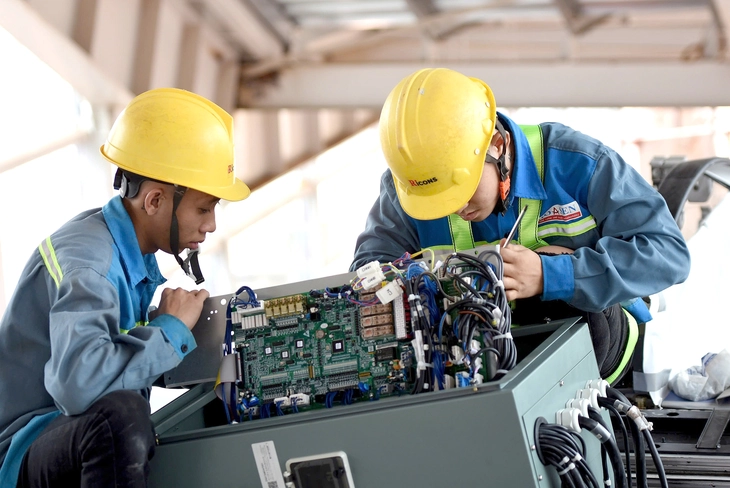
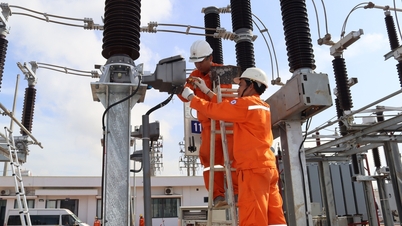
Workers install escalator systems inside the passenger terminal - Photo: A LOC
Long Thanh is not simply an airport, but a strategic link in the chain connecting the socio -economic development of the entire southern region.
By applying the emergency mechanism, a series of projects were accelerated.
From Long Thanh towards the sea, it will directly connect the Ho Tram - Vung Tau - Can Gio tourism clusters, linking with the transshipment port, logistics and free trade zone at Cai Mep - Thi Vai - Can Gio.
From Long Thanh Airport, passengers can travel throughout the Southeast region, the Central Highlands, and the Mekong Delta... This is also a point of entry for international businesspeople and investors before they travel to Ho Chi Minh City to work, network, and seek business opportunities at the International Finance Centre (IFC) in Thu Thiem.
To connect with these key areas, road transport remains the immediate cornerstone. The period from 2020 to 2025 marks a strong acceleration of the expressway network in the Southeast region and the entire country. To date, most of the expressways connecting to Long Thanh Airport have been and are being invested in, from the North-South arterial expressway to radial routes and ring roads.
Simultaneously, Ho Chi Minh City and Dong Nai province have been closely coordinating and implementing many comprehensive solutions to continue other key transportation projects. In particular, thanks to the application of new regulations such as the urgent mechanism, project procedures have been implemented very quickly, potentially shortening the implementation time by about a year.
Typical examples include the Phu My 2 Bridge, Cat Lai Bridge, and Long Hung 2 Bridge (Dong Nai 2), which have been assigned to investors for research and are expected to begin construction in early 2026. In addition, Ho Chi Minh City is also studying the Long Thanh - Ho Tram expressway to create a direct connection from the airport to the coastal tourism and resort cluster.
To travel faster, you need railways and metros.
However, an international airport connected only by road is insufficient. Based on this reality, Ho Chi Minh City and Dong Nai province have recently been promoting the implementation of connecting railway and metro projects. Utilizing the special mechanisms of Resolution 188 and the new regulations of the 2025 Railway Law, Ho Chi Minh City is studying an urban railway line directly connecting Tan Son Nhat Airport and Long Thanh Airport, based on the synchronous connection of Metro Line 2 and the Thu Thiem - Long Thanh railway.
Specifically, Ho Chi Minh City aims to start construction on Metro Line 2 (Tham Luong - Ben Thanh section) on January 15, 2026. The section from Ben Thanh to Long Thanh Airport, approximately 47km long, is currently being studied by Truong Hai Group (Thaco).
In addition, Dong Nai province is also implementing Metro Line 1 (Ben Thanh - Suoi Tien), extending to Dong Nai to connect with Long Thanh Airport. The project has a length of 41.4km with a preliminary total investment of 60,261 billion VND, to be invested in the period 2025 - 2029. On December 10th, the Dong Nai Provincial People's Council passed a resolution assigning the Provincial People's Committee as the implementing agency for the project, providing a basis for proceeding with the next steps.
Notably, another promising connection route is gradually taking shape, opening up a new Long Thanh - Can Gio - Ben Thanh arc, through a series of projects including the Ben Thanh - Can Gio railway line (expected to break ground on December 19th), the Can Gio bridge (expected to break ground in January 2026), and the Vung Tau - Can Gio sea crossing option currently under study.
To expedite the development of a railway line to serve the industrial and logistics services of the region, and to exploit the advantages of its industrial and port systems, Ho Chi Minh City has also assigned Becamex Corporation to research and invest in a combined freight and passenger railway line from Bau Bang to Cai Mep, striving to start construction in 2027 and complete it before 2035.
Source: https://tuoitre.vn/san-bay-long-thanh-trong-diem-ket-noi-toan-khu-vuc-20251214231022696.htm
![[Photo] Prime Minister Pham Minh Chinh receives Lao Minister of Education and Sports Thongsalith Mangnormek](/_next/image?url=https%3A%2F%2Fvphoto.vietnam.vn%2Fthumb%2F1200x675%2Fvietnam%2Fresource%2FIMAGE%2F2025%2F12%2F16%2F1765876834721_dsc-7519-jpg.webp&w=3840&q=75)

![[Image] Leaked images ahead of the 2025 Community Action Awards gala.](/_next/image?url=https%3A%2F%2Fvphoto.vietnam.vn%2Fthumb%2F1200x675%2Fvietnam%2Fresource%2FIMAGE%2F2025%2F12%2F16%2F1765882828720_ndo_br_thiet-ke-chua-co-ten-45-png.webp&w=3840&q=75)
![[Photo] Prime Minister Pham Minh Chinh receives the Governor of Tochigi Province (Japan)](/_next/image?url=https%3A%2F%2Fvphoto.vietnam.vn%2Fthumb%2F1200x675%2Fvietnam%2Fresource%2FIMAGE%2F2025%2F12%2F16%2F1765892133176_dsc-8082-6425-jpg.webp&w=3840&q=75)

![[Live] 2025 Community Action Awards Gala](/_next/image?url=https%3A%2F%2Fvphoto.vietnam.vn%2Fthumb%2F1200x675%2Fvietnam%2Fresource%2FIMAGE%2F2025%2F12%2F16%2F1765899631650_ndo_tr_z7334013144784-9f9fe10a6d63584c85aff40f2957c250-jpg.webp&w=3840&q=75)






























![[Photo] Prime Minister Pham Minh Chinh attends the Vietnam Economic Forum 2025](https://vphoto.vietnam.vn/thumb/402x226/vietnam/resource/IMAGE/2025/12/16/1765893035503_ndo_br_dsc-8043-jpg.webp)















Comment (0)