



Officers and soldiers visit the exhibition area at the historical site of the Southern Regional Party Committee and the Southern Regional Administrative and Resistance Committee.
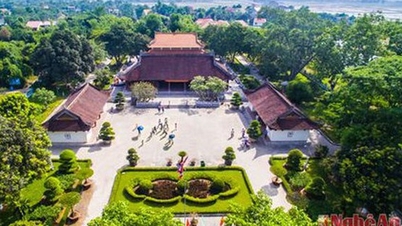
The Southern Regional Party Committee and the Southern Resistance Administrative Committee's base was where comrades such as Le Duan, Ton Duc Thang, Ung Van Khiem, Pham Hung, Pham Van Bach, Pham Ngoc Thuan, Nguyen Binh, Huynh Tan Phat, and Tran Van Tra carried out revolutionary activities. It was also the site of significant historical events of the Southern revolution in the early years of the resistance against French colonialism. Now, visiting the historical site, amidst the gentle fragrance of lotus and frangipani flowers, under the green trees are simple, reconstructed houses and exhibition areas that serve as "witnesses" reminding us of the heroic past of our ancestors.
The commander of the Nhon Hoa Lap Commune Military Command, Tan Thanh District - Ha Hai Ngoc, said: "As a son of the heroic Tan Thanh homeland, I constantly uphold traditions, hone my skills, and advise on building a strong commune armed force, contributing to the successful completion of local military and national defense tasks, meeting the requirements of the new situation."

This place also marks the birth of Southern Vietnamese cinema on October 16, 1947, under the name of the National Guard Photography Group of Zone 8. The first members, such as Khuong Me, Mai Loc, Le Hung, etc., were brought to the war zone from Saigon by the revolutionary movement. Despite the scarcity of equipment, machinery, and film, they studied foreign books, newspapers, and documents to assemble film cameras, projectors, and develop film. They also closely followed the battlefield to film valuable documentary footage, the first being the film "The Battle of Moc Hoa" (August 1948).
On December 28, 1948, at the Military Club of Zone 8 on the banks of the Duong Van Duong canal, the people of Dong Thap Muoi watched a complete documentary film about the Battle of Moc Hoa to celebrate the Conference of the Southern Resistance and Administrative Committee. It can be said that the revolutionary Vietnamese film industry was born in the Dong Thap Muoi base with the film "The Battle of Moc Hoa".
This place also produced valuable paintings by famous artists, such as the painting "The Battle of Tam Vu" by artist Nguyen Hiem, which won first prize at the National Fine Arts Exhibition in 1956, the Ministry of National Defense award in 1984, and the State Award for Literature and Arts in 1996.

The painting "Battle of Tam Vu" by artist Nguyen Hiem is on display at the exhibition area.
Artist Diep Minh Chau, while serving in the Southern war zone, accompanied National Guard units to many places such as Go Cong, My Tho, Ben Tre, Sa Dec, and the Dong Thap Muoi region. Therefore, his works from this period vividly reflect the atmosphere of the resistance in the Southern region.
From natural landscapes, labor, production, and volunteer work to the spirited and determined guerrillas of the South, he infused these vivid images into his works: Landscape of Dong Thap Muoi, A Popular Class in a Hut on the Forest's Edge, Through the Leafy Forest, Guerrillas Through the Village, Soldiers Parting the Reeds,...
Among the sketches he drew right on the battlefield still shrouded in gunpowder smoke, the most notable is the painting of Soldier Le Hong Son sacrificing his life during a charge, which he painted with the soldier's own blood. Particularly noteworthy is the painting of President Ho Chi Minh and three children from the North, Central, and South of Vietnam, which he painted with his own blood during the jubilant celebration of the August Revolution of 1945 and National Day on September 2nd, as they listened to President Ho Chi Minh read the Declaration of Independence.
Lieutenant Nguyen Duc Tu of the People's Army Film Crew shared: "Returning to the Southern Regional Party Committee and the Southern Administrative and Resistance Committee's base in the South, visiting the cradle of Southern cinema, our generation is extremely proud and moved. And here, we will have valuable footage to contribute to the success of the documentary film that our unit is currently producing."
For those born and raised in peacetime, visiting the "red address" of the Southern Regional Party Committee and the Southern Regional Administrative and Resistance Committee's base allows them to better understand the important historical events that took place there, the Party cadres and famous intellectuals who lived and worked there to lead the resistance movement with resounding victories, and to learn about the place where the first Southern Radio Station was established and where the first documentary film of Vietnamese revolutionary cinema was produced.
Coming here, each person is equipped with additional historical knowledge, awakening a sense of pride and profound gratitude, thereby fostering a spirit of responsibility in the cause of building and firmly defending the socialist Vietnamese Fatherland.
Van Anh
Source: https://baolongan.vn/thang-tu-ve-tham-dia-chi-do-a193190.html
























































Comment (0)