

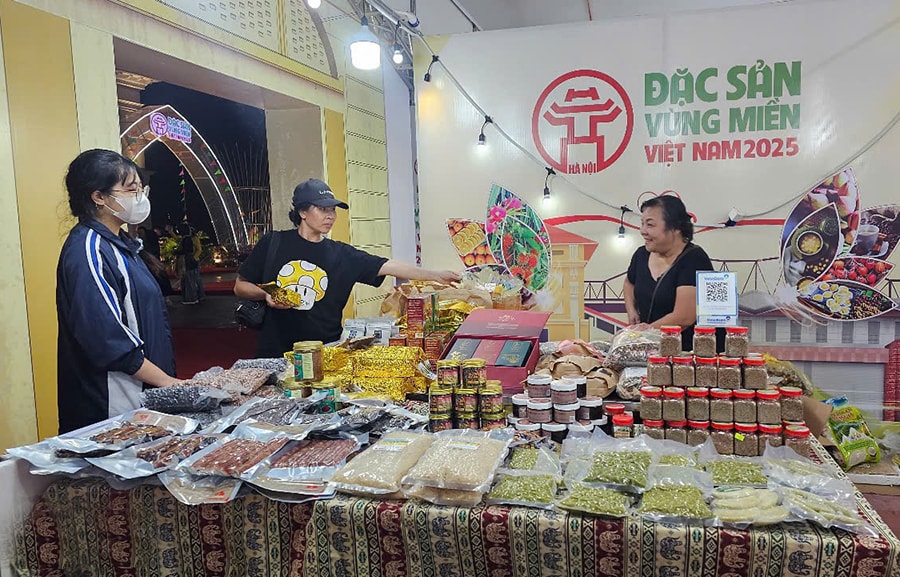
"Highlights" of OCOP products
Hanoi is becoming the leading center nationwide in the development, promotion, and trade facilitation of OCOP products. According to Nguyen The Hiep, Deputy Director of the Hanoi Department of Industry and Trade, the city currently has more than 3,600 recognized OCOP products, leading the country in both quantity and quality, including 65 five-star OCOP products, accounting for over 50% of the total five-star products nationwide.
Not only has Hanoi become a shining example and a leader nationwide in the development of the OCOP program, but in recent times, the city has also focused on implementing a series of trade promotion and consumption activities for OCOP products, such as: Weeks for consulting, introducing and promoting the consumption of OCOP products, traditional craft villages, and safe agricultural and food products…
Each week, the fair attracts hundreds of businesses and cooperatives from Hanoi and other localities such as Ha Tinh , Khanh Hoa, Lao Cai, Thanh Hoa, Quang Ninh, Ninh Binh, Son La, Phu Tho, etc. Most participating units successfully connect with many customers and find outlets for their products. A prime example is the annual Vietnam Regional Specialty Products Fair organized by the Hanoi Department of Industry and Trade, recently held at Royal City Square (Hanoi). With over 200 booths showcasing thousands of specialty products from all over the country, the fair presented the people of Hanoi with a colorful and exquisite "picture of Vietnamese flavors."
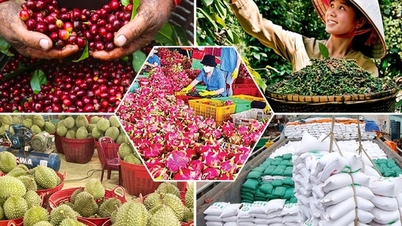
The products featured at the Vietnam Regional Specialty Fair 2025 are incredibly diverse, representing the culinary and agricultural identities of various regions. From the Northwest with its tea cakes made from ancient Shan Tuyet tea trees, Seng Cu rice, Muong Khuong chili peppers, and smoked buffalo meat, to the Central Highlands with its sun-dried coffee, wind-dried persimmons, macadamia nuts, and sun-dried beef. Central Vietnam stands out with Ly Son garlic, Ninh Thuan grapes, agarwood, and Thanh Hoa fish sauce. The Mekong Delta boasts Ca Mau crab, Hoa Loc mangoes, Tra Su An Giang palm fruit, and coconut flower nectar.
According to Nguyen Anh Duong, Deputy Director of the Hanoi Department of Industry and Trade: “This year's fair features many innovations in organization, application of information technology, digital transformation, and communication. Through these innovations, the Department hopes not only to promote regional specialty products to consumers but also to open opportunities to introduce products into domestic distribution systems and boost exports to international markets.”
A new feature at this year's fair is the collaboration with major international e-commerce platforms such as Alibaba and Amazon in the process of adapting to digital trade methods, thereby supporting high-quality Vietnamese products to have export opportunities and become known to a wider international audience.
As a facility specializing in the production of incense sticks, agarwood chips, and handicrafts made from agarwood, and distributing to 16 provinces and cities nationwide, Mr. Ho Van Phuc, owner of Ho Phuc Agarwood, shared that his facility participated in the fair with the desire to promote natural agarwood products, free from chemicals, to visitors nationwide, especially the people of Hanoi.
According to Ms. Vu Thi Hai, representative of Hailcophar International Pharmaceutical Joint Stock Company, the company participated in the fair to seek new markets. Through the fair, Hailcophar focused on advising and introducing to Hanoi residents and tourists nationwide how to distinguish between low-quality and genuine cordyceps; and providing information on usage and health benefits for consumers.
Opportunities for networking and market expansion.
In the context of difficulties in marketing agricultural products and local specialties, trade promotion and marketing of OCOP products have been identified by Hanoi as a breakthrough area. To date, Hanoi has established 115 points for introducing and selling OCOP products throughout the city, creating favorable conditions for residents and tourists to easily access high-quality goods.
In parallel, the city regularly organizes fairs, seminars, and business networking events to help OCOP (One Commune One Product) businesses introduce their products, expand their markets, and connect with distribution businesses. These activities are not only concentrated within the city but also extend to suburban areas, linking with craft village and rural tourism destinations.
According to Nguyen Anh Duong, Deputy Director of the Hanoi Department of Industry and Trade, a highlight is that Hanoi has taken trade promotion to an international level. Many city delegations have participated in promotion programs in Germany, Italy, Australia, Sweden, the United States, and other countries, introducing Vietnamese OCOP products to foreign consumers and importers. Through these efforts, many Hanoi products, from herbal teas, honey, and traditional confectionery to ceramics and rattan products, have been recognized and sold in major markets.
These promotional activities help expand distribution channels, increase brand value, and enhance the competitiveness of OCOP products. At the same time, they make a significant contribution to promoting Hanoi's image as a creative center and a prime example of Vietnam's new rural economy.
It can be said that proactive measures to promote trade and consumption of local specialties have been creating a strong shift in awareness among the majority of consumers in Hanoi, leading them to prioritize the selection and use of goods produced by domestic enterprises, thus creating a sustainable market for agricultural products and specialties from various localities.
Source: https://hanoimoi.vn/thanh-pho-ha-noi-day-manh-xuc-tien-thuong-mai-nang-tam-thuong-hieu-san-pham-ocop-724342.html
![[Photo] The heat at the fireworks display site on the opening night of the Da Nang International Fireworks Festival 2026](https://vphoto.vietnam.vn/thumb/1200x675/vietnam/resource/IMAGE/2026/05/27/1779889741485_ndo_br_z7872039145157-fecaba5112f39e8352544099d7ef4738-5140-jpg.webp)


![[Photo] The courage of new recruits of Brigade 144 on the training ground.](https://vphoto.vietnam.vn/thumb/1200x675/vietnam/resource/IMAGE/2026/05/27/1779881651341_anh-man-hinh-2026-05-27-luc-18-32-52.png)


















































![[Photo] The courage of new recruits of Brigade 144 on the training ground.](https://vphoto.vietnam.vn/thumb/402x226/vietnam/resource/IMAGE/2026/05/27/1779881651341_anh-man-hinh-2026-05-27-luc-18-32-52.png)





















Comment (0)