


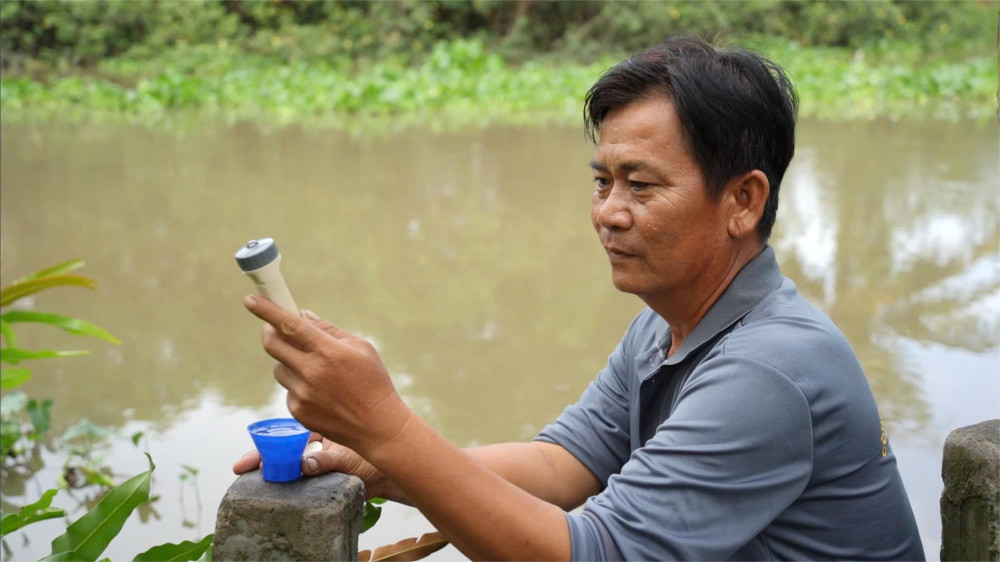
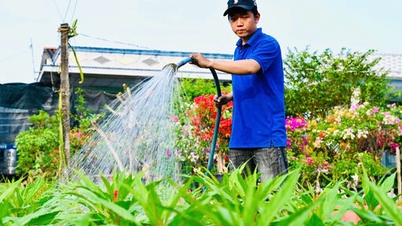
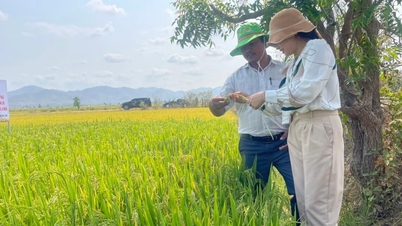
Farmers measure the salinity of the water before irrigating their orchards.
People proactively adapt
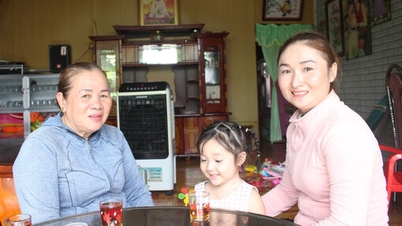
During the dry season, people in the lower districts face a shortage of water for daily use . To cope, households proactively invest in equipment for storing and filtering rainwater; at the same time, they use water sparingly to ensure stable living conditions. Ms. Pham Thi Hien Luong (Nhut Ninh commune, Tan Tru district) said: "Previously, during the dry season, when there was a water shortage, we had to carry water from the pond in buckets for use, but now we prepare water tanks and use water sparingly, so things are fine."
Drought and salinity not only affect daily life but also create difficulties in agricultural production. To proactively manage production, farmers are applying various solutions, closely monitoring weather conditions, and equipping themselves with salinity meters to manage water resources and minimize crop losses.
Mr. Le Van Thao (Tan Thanh commune, Thu Thua district), owner of a 15-hectare jackfruit orchard, suffered heavy losses due to drought and salinity. To cope, he proactively dredged ponds and lakes early to store water, thus ensuring sufficient water for irrigating his orchard. “Learning from previous years, I regularly monitor weather information and continuously update myself on the drought and salinity situation from the District Department of Agriculture and Environment to proactively respond. At the same time, I also equipped myself with salinity meters to ensure the quality of the water used for irrigation,” Mr. Thao shared.
In the Dong Thap Muoi region, floods, high tides, and erratic heavy rainfall in recent years have caused widespread inundation. However, thanks to government investment and the proactive efforts of the people in building sturdy dikes and strictly adhering to seasonal schedules, the situation has been brought under control. Not only have the people effectively responded to natural disasters, but they have also flexibly transformed the flood season into a livelihood opportunity, maximizing the resources from nature to live in harmony with the floods.
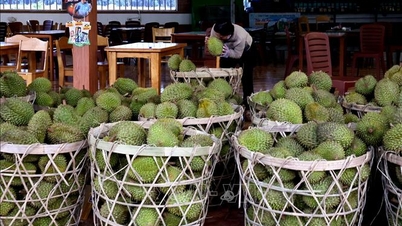
Mr. Tran Van Be Sau (Tan Hiep commune, Thanh Hoa district) shared: “In the Dong Thap Muoi region, the water level rises very high during each flood season. Therefore, before sowing rice, we usually monitor the planting schedule to ensure harvesting before the flood season arrives. Now, with durian cultivation, which has high economic value, I am forced to invest in sturdy dikes and arrange for pumps to operate 24/7, especially during the rainy season.”
Working together to prevent and mitigate natural disasters.
In response to the adverse impacts of natural disasters, the province has identified disaster prevention and control as both an urgent and long-term task. Accordingly, relevant agencies have implemented a series of comprehensive solutions, combining structural and non-structural measures, contributing to a more effective response from the community.
According to Deputy Director of the Department of Agriculture and Environment, Do Huu Phuong: “The province is implementing a comprehensive set of solutions such as building temporary dams, dikes to prevent saltwater intrusion, constructing saltwater intrusion prevention and freshwater storage gates, and electric pumping stations to ensure water supply for production and daily life; at the same time, investing in riverbank erosion control, dredging canals and ditches, repairing dikes in the Dong Thap Muoi area, and replacing automatic gates with forced gates to proactively regulate water.”
Regarding non-structural solutions, the province is strengthening public awareness campaigns, organizing training and drills on disaster prevention and control, installing landslide warning signs, and reinforcing rapid response forces at the commune level. In particular, the province has begun applying digital transformation in the direction and management of disaster prevention and control to improve management efficiency.”
The community is not only the first to be affected when natural disasters occur, but also the first force to participate in responding to and mitigating their consequences. When each citizen is clearly aware of the risks, each locality has a ready plan, and the spirit of solidarity is fostered, the ability to prevent and mitigate natural disasters will become increasingly sustainable. These efforts are contributing to building the province into a cohesive, resilient community that effectively adapts to natural disasters.
| Besides drought, salinity intrusion, and flooding, other forms of natural disasters such as riverbank erosion and storms are also increasing, causing severe damage to the people. Over the past five years, the province has recorded approximately 55 areas affected by erosion, with a total length exceeding 18,800 meters. Damage caused by storms alone is estimated at tens of billions of dong each year, seriously impacting people's property and homes. |
Thursday
Source: https://baolongan.vn/thich-ung-giam-thieu-thien-tai-a196371.html



![[Photo] General Secretary To Lam attends the opening session of the Peace Council on Gaza.](https://vphoto.vietnam.vn/thumb/1200x675/vietnam/resource/IMAGE/2026/02/19/1771516865192_tbttolam5-jpg.webp)







































































Comment (0)