

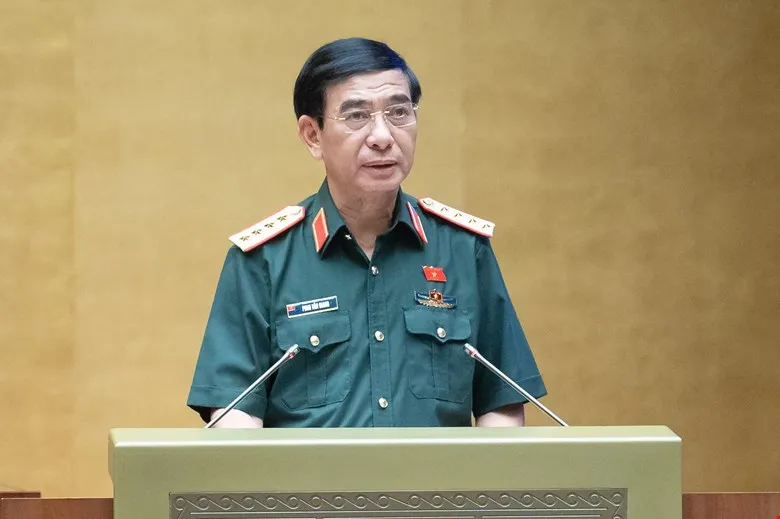
On the afternoon of May 27, the National Assembly heard Minister of National Defense Phan Van Giang present the draft Law on Emergency Situations.
Minister Phan Van Giang stated that the purpose of drafting this law is to establish a legal basis and enhance proactive response and effective remediation in emergency situations, contributing to the protection of the State and the people, as well as the legitimate rights and interests of organizations and individuals.
The draft law comprises 6 chapters and 42 articles, focusing on two major policies: measures to be applied during a state of emergency, the authority to organize, direct, manage, and decide on the application of special measures by certain entities during a state of emergency; and measures to support businesses; and relief and assistance for people responding during and after a state of emergency.
According to the draft regulations, the Standing Committee of the National Assembly (SCNA) decides to declare a state of emergency nationwide or in specific localities upon the proposal of the Prime Minister .
Based on a resolution of the Standing Committee of the National Assembly, the President declares a state of emergency nationwide or in specific localities. If the Standing Committee of the National Assembly cannot convene immediately, the President declares a state of emergency at the request of the Prime Minister.
- Excerpt from the draft Law on States of Emergency -
Resolutions of the Standing Committee of the National Assembly or orders of the President on a state of emergency must be immediately announced through mass media and publicly posted at the headquarters of the People's Committee of the commune, ward, or town where the state of emergency is declared so that the people are aware and can comply.
When disasters have been prevented, mitigated, or overcome; epidemics have been contained or suppressed; and national defense, national security, social order, and safety have stabilized, the Prime Minister proposes that the Standing Committee of the National Assembly issue a Resolution, and the President issue an Order to lift the state of emergency.
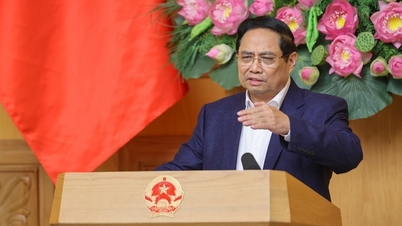
Empowered to decide on measures to be taken during an emergency, the Prime Minister may implement measures not currently stipulated by law and report to the competent authorities of the Party and the National Assembly as soon as possible.
Expressing his views during the review, the Chairman of the National Defense, Security and Foreign Affairs Committee, Le Tan Toi, agreed on the necessity of enacting the law and suggested further research to regulate the applicable measures in accordance with the classification of emergency situations, ensuring consistency, rigor, and feasibility.
Regarding the delegation of authority and the application of emergency measures, the reviewing body agreed to grant the Prime Minister the power, when necessary, to apply measures not yet stipulated by current law and to report to the competent authorities of the Party and the National Assembly in the near future to ensure flexibility in responding to and handling complex situations.
The reviewing agency also agreed with the provision granting authority to the Chairman of the Provincial People's Committee to apply measures not stipulated in current law or different from those stipulated in current law, but noted that a review is needed to ensure consistency and uniformity with the Law on Organization of Local Government.
Source: https://www.sggp.org.vn/thu-tuong-co-the-ap-dung-cac-bien-phap-ma-phap-luat-hien-hanh-chua-quy-dinh-post797021.html
![[Photo] Prime Minister Pham Minh Chinh receives Lao Minister of Education and Sports Thongsalith Mangnormek](/_next/image?url=https%3A%2F%2Fvphoto.vietnam.vn%2Fthumb%2F1200x675%2Fvietnam%2Fresource%2FIMAGE%2F2025%2F12%2F16%2F1765876834721_dsc-7519-jpg.webp&w=3840&q=75)
![[Image] The tenacious fighting spirit of Vietnamese women's football](/_next/image?url=https%3A%2F%2Fvphoto.vietnam.vn%2Fthumb%2F1200x675%2Fvietnam%2Fresource%2FIMAGE%2F2025%2F12%2F17%2F1765990260956_ndo_br_4224760955870434771-copy-jpg.webp&w=3840&q=75)
![[Image] Leaked images ahead of the 2025 Community Action Awards gala.](/_next/image?url=https%3A%2F%2Fvphoto.vietnam.vn%2Fthumb%2F1200x675%2Fvietnam%2Fresource%2FIMAGE%2F2025%2F12%2F16%2F1765882828720_ndo_br_thiet-ke-chua-co-ten-45-png.webp&w=3840&q=75)
![[Photo] Prime Minister Pham Minh Chinh receives the Governor of Tochigi Province (Japan)](/_next/image?url=https%3A%2F%2Fvphoto.vietnam.vn%2Fthumb%2F1200x675%2Fvietnam%2Fresource%2FIMAGE%2F2025%2F12%2F16%2F1765892133176_dsc-8082-6425-jpg.webp&w=3840&q=75)

![[Live] 2025 Community Action Awards Gala](/_next/image?url=https%3A%2F%2Fvphoto.vietnam.vn%2Fthumb%2F1200x675%2Fvietnam%2Fresource%2FIMAGE%2F2025%2F12%2F16%2F1765899631650_ndo_tr_z7334013144784-9f9fe10a6d63584c85aff40f2957c250-jpg.webp&w=3840&q=75)




































![[Live] Closing Ceremony and Award Presentation for the "Impressive Vietnam Tourism" Video/Clip Creation Contest 2025](https://vphoto.vietnam.vn/thumb/402x226/vietnam/resource/IMAGE/2025/12/17/1765974650260_z7273498850699-00d2fd6b0972cb39494cfa2559bf85ac-1765959338756946072104-627-0-1338-1138-crop-1765959347256801551121.jpeg)












Comment (0)