

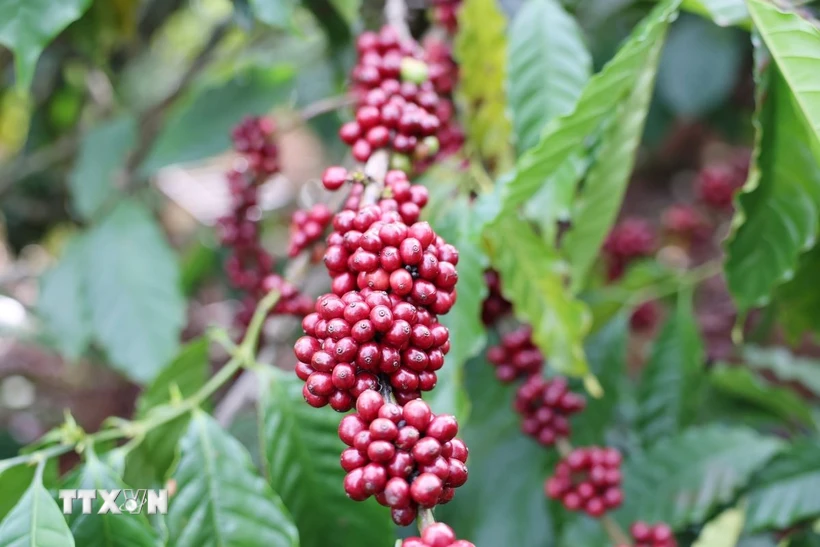
Coffee prices in Dak Lak province are expected to be high for the 2024-2025 crop year. (Photo: Hoai Thu/VNA)
The Ministry of Culture, Sports and Tourism has officially recognized "Knowledge of coffee cultivation and processing in Dak Lak" as a National Intangible Cultural Heritage (according to Decision No. 548/QD-BVHTTDL dated March 5, 2025).
According to Lai Duc Dai, Deputy Director of the Department of Culture, Sports and Tourism of Dak Lak province, Dak Lak province in particular and the Central Highlands region in general possess a valuable source of knowledge: "Knowledge of coffee cultivation and processing."
The recognition of Dak Lak province's "Knowledge of Coffee Cultivation and Processing" as a national intangible cultural heritage not only honors the values of coffee but also acknowledges the contributions of farmers and processors who have dedicated themselves to the Vietnamese coffee industry in general and Dak Lak province in particular.
The recognition of this heritage also contributes to creating added value for coffee beans, helping farmers have a more prosperous life and promoting the development of the coffee industry. Dak Lak province is not only a destination to experience culture, but also a place to enjoy and experience coffee cultivation and processing activities.
The recognition of "the knowledge of coffee cultivation and processing" as a national intangible cultural heritage is a source of honor and pride for the people of Dak Lak province, and even more so as the 9th Buon Ma Thuot Coffee Festival approaches.
"The knowledge of coffee cultivation and processing in Dak Lak," also known as the Dak Lak coffee farming craft, is a form of folk knowledge and traditional craft. This knowledge is recognized in almost all districts of the province, with a concentration mainly in Buon Ma Thuot city, the districts of Cu M'gar, Krong Pak, Ea H'leo, Cu Kuin, and Buon Ho town.
The cultural subjects of coffee cultivation and processing knowledge are individuals and families who possess this knowledge, passed down through generations within their families and communities. This includes mostly local ethnic groups such as the Ede and M'Nong, as well as immigrants from other places who have settled and cultivated coffee since the 1950s.
The cultural space of the heritage site includes: coffee growing areas, coffee processing areas, and areas for practicing rituals and beliefs related to coffee. Coffee plantations (coffee fields) are spaces for practice, showcasing the community's knowledge of coffee cultivation and processing. Coffee gardens can be considered assets passed down through generations within families.
Currently, Dak Lak is "the coffee capital of Vietnam" because it has the largest area and production in the country. Coffee is a key agricultural product in the province's economic structure, accounting for a large proportion of the province's total social product and annual export turnover, directly affecting the income of the vast majority of the people.
With current coffee cultivation area reaching 212,106 hectares and production exceeding 535,672 tons per year, coffee cultivation is not only significant in terms of socio-economics but also holds immense cultural and tourism importance. The development of the coffee industry, combined with the development of local eco-tourism and cultural tourism, has attracted an increasing number of tourists.
Currently, the province has over 200 coffee processing facilities, mostly small and medium-sized enterprises, primarily using the dry processing method.

![[Image] Leaked images ahead of the 2025 Community Action Awards gala.](/_next/image?url=https%3A%2F%2Fvphoto.vietnam.vn%2Fthumb%2F1200x675%2Fvietnam%2Fresource%2FIMAGE%2F2025%2F12%2F16%2F1765882828720_ndo_br_thiet-ke-chua-co-ten-45-png.webp&w=3840&q=75)
![[Live] 2025 Community Action Awards Gala](/_next/image?url=https%3A%2F%2Fvphoto.vietnam.vn%2Fthumb%2F1200x675%2Fvietnam%2Fresource%2FIMAGE%2F2025%2F12%2F16%2F1765899631650_ndo_tr_z7334013144784-9f9fe10a6d63584c85aff40f2957c250-jpg.webp&w=3840&q=75)

![[Photo] Prime Minister Pham Minh Chinh receives Lao Minister of Education and Sports Thongsalith Mangnormek](/_next/image?url=https%3A%2F%2Fvphoto.vietnam.vn%2Fthumb%2F1200x675%2Fvietnam%2Fresource%2FIMAGE%2F2025%2F12%2F16%2F1765876834721_dsc-7519-jpg.webp&w=3840&q=75)
![[Photo] Prime Minister Pham Minh Chinh receives the Governor of Tochigi Province (Japan)](/_next/image?url=https%3A%2F%2Fvphoto.vietnam.vn%2Fthumb%2F1200x675%2Fvietnam%2Fresource%2FIMAGE%2F2025%2F12%2F16%2F1765892133176_dsc-8082-6425-jpg.webp&w=3840&q=75)































![[Photo] Prime Minister Pham Minh Chinh attends the Vietnam Economic Forum 2025](https://vphoto.vietnam.vn/thumb/402x226/vietnam/resource/IMAGE/2025/12/16/1765893035503_ndo_br_dsc-8043-jpg.webp)

















Comment (0)