

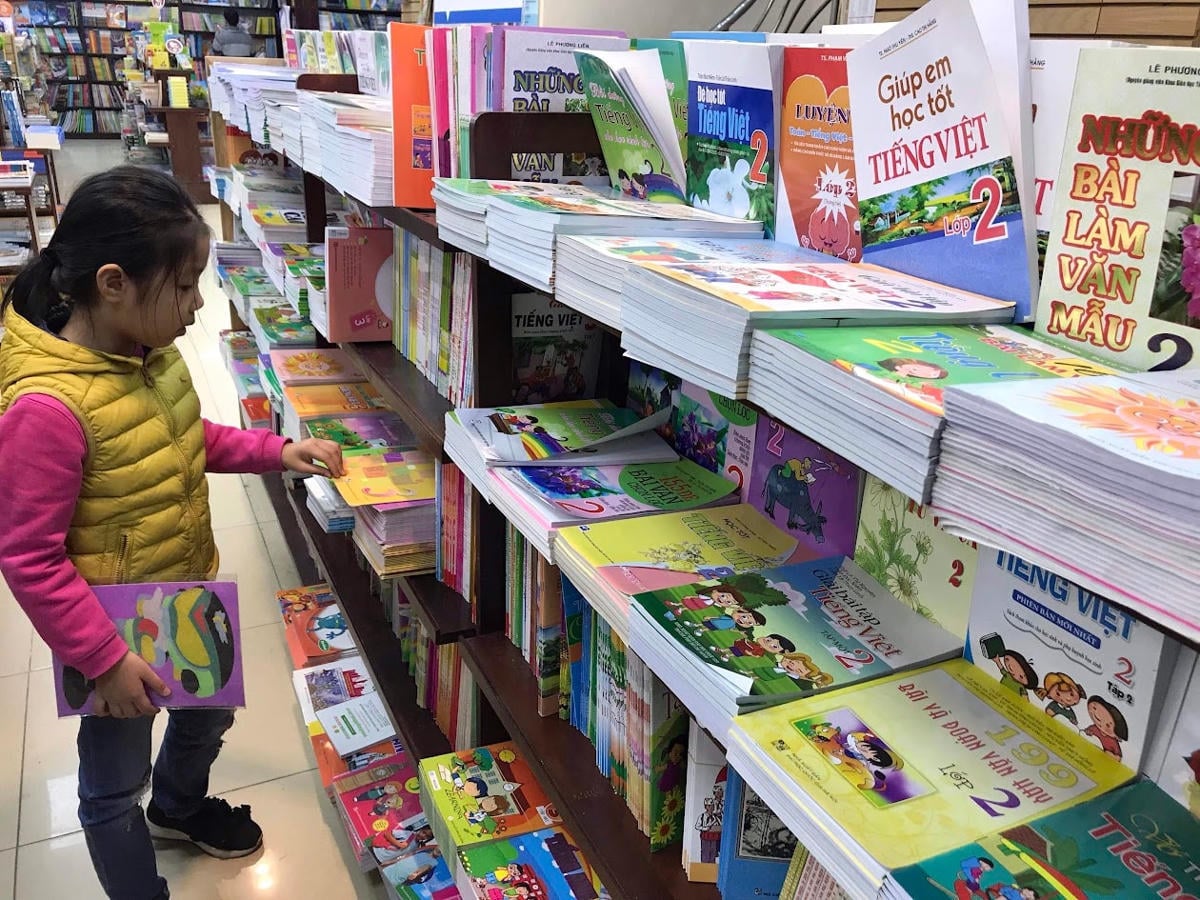
A unified set of textbooks will be implemented starting from the 2026-2027 school year, with the goal of providing textbooks free of charge by 2030.
Regarding textbooks for general education, the Law clearly states: " The Government shall regulate the provision of free textbooks for students." The Minister of Education and Training shall decide on a set of general education textbooks for unified use nationwide.
The National Textbook Review Council is established by the Minister of Education and Training for each subject and educational activity to review textbooks. The Council and its members are responsible for the content and quality of the review.
Compared to the 2019 Education Law, the new law stipulates that textbooks must specify the requirements of the general education program regarding objectives, content, qualities, and competencies of students; and at the same time, guide teaching methods, testing, and quality assessment.
The content and presentation must not be biased based on ethnicity, religion, occupation, gender, age, or social status. Furthermore, textbooks will be published in various formats, including printed books, Braille books, and e-books.
Another notable point of the amended law is that the Minister of Education and Training approves textbooks for use in general education institutions after they have been evaluated and rated as satisfactory by the National Textbook Appraisal Council; it also stipulates the standards and procedures for compiling and revising general education textbooks.
Previously, when using multiple sets of textbooks, the provincial People's Committee decided on the selection of textbooks to be used consistently in general education institutions in the area, in accordance with the regulations of the Ministry of Education and Training.
In fact, even before the National Assembly passed the Law amending and supplementing a number of articles of the Education Law, the issue of unifying a common set of textbooks had already been raised in Resolution No. 71-NQ/TW dated August 22, 2025, of the Politburo on breakthroughs in education and training development, with the specific content: "ensuring the provision of a unified set of textbooks nationwide, striving to provide free textbooks for all students by 2030."
Following this, Government Resolution No. 281/NQ-CP, which promulgates the Action Program to implement Resolution 71 on breakthroughs in education and training development, also requires the Ministry of Education and Training to review and improve the general education curriculum, increase the time allocated to science, technology, information technology, and arts subjects; ensure the provision of a unified set of textbooks nationwide for use from the 2026-2027 school year; and implement a roadmap to provide free textbooks for all students by 2030.

Waiting for the implementation plan to be announced.
Therefore, to ensure timely implementation of the common textbook set from the 2026-2027 school year, the Government has assigned the Ministry of Education and Training to develop a report on the implementation plan for the common textbook set based on the principles of openness, transparency, objectivity, economy, and prevention of waste; while also inheriting the advantages of existing textbook sets, ensuring no disruption to teaching and learning activities, and minimizing the impact on teachers and students.
Responding to concerns nationwide about the "too tight" timeframe, during a National Assembly group discussion on October 22nd, Minister of Education and Training Nguyen Kim Son affirmed that the plan would be implemented in the 2026-2027 school year. “The Ministry is developing an implementation plan, including a specific approach, and will seek the General Secretary's opinion and submit it to the Prime Minister for approval. We will strive to have the plan ready as quickly as November,” the Minister stated.
However, to date, a specific plan for this issue has not been announced. This leaves the public, especially teachers and parents, waiting for official information on the roadmap, solutions, and implementation mechanisms, in the context of the increasingly urgent need to stabilize the curriculum, textbooks, and teaching organization.

Clear criteria are needed for a common set of textbooks.
Associate Professor Bui Thi An, Director of the Institute of Resources, Environment and Community Development, believes that the amended Education Law, which stipulates that the Minister of Education and Training decides on a set of general education textbooks to be used uniformly nationwide without rigidly specifying in the law the method of implementation—whether the State directly compiles them or socializes the process—is appropriate because the specific option is still being researched and its impact assessed. This regulation also allows the Ministry of Education and Training to choose the option that best suits practical realities, whether it directly compiles a new set of textbooks or revises and inherits existing ones, depending on the directives of the competent authority, which is reasonable.
However, regardless of which option is chosen, the shared set of textbooks must ensure that it meets the criteria of being complete, consistent, and diverse in terms of learning materials. This means it must include all subjects, educational activities, and supplementary materials, providing students and teachers with all the necessary tools for teaching and learning. In addition, it must have a reasonable price, reducing the financial burden on parents, students, and the state budget.
"Most importantly, we must meet the objectives of the 2018 General Education Program, which is to develop students' qualities and competencies, innovate teaching methods, and shift from knowledge transmission to holistic development," Ms. An stated.
Sharing this view, Dr. Dang Tu An, Director of the Vietnam General Education Innovation Support Fund, believes that a review of the 2018 general education curriculum needs to be done immediately to ensure that the common textbooks meet clear criteria, undergo rigorous evaluation, and guarantee a continuous flow of knowledge.
Furthermore, Dr. An noted that a unified national textbook set needs to be developed transparently, avoiding repeated "monopoly" practices; it should have open and competitive content evaluation; and it should include a free digital learning resource bank. Therefore, choosing one of the three currently in use sets to create a unified textbook set requires careful consideration, as it would not utilize the remaining sets and it would be difficult to determine which set is of superior quality.
Ms. Nguyen Thi Viet Nga (Deputy Head of the National Assembly Delegation of Hai Phong City) believes that to have a suitable set of textbooks, several issues need to be considered. First, regarding content, it must ensure scientific accuracy, precision, and modernity; it should not be overloaded or repetitive. The structure should be coherent, pedagogically sound, and capable of supporting teachers in innovating their teaching methods. The integration and differentiation should be clear, allowing students from different regions to access the material.
Ms. Nga also emphasized that the accompanying methods and learning materials, including teacher's books, electronic documents, illustrative videos, exercise banks, digital lectures, etc., must be comprehensive and capable of digital transformation in education so that all students and teachers, even in remote areas, can access and use them conveniently.
In addition, stability and feasibility must be ensured during implementation. Textbooks must be designed to be easy for teachers to teach and easy for students to learn. Avoid constant changes that cause disruption in schools.
In particular, Ms. Nga also noted the need to avoid the re-establishment of monopolies. A strict monitoring mechanism is needed, ensuring the independent evaluation council and transparency throughout the entire selection, evaluation, and pricing process of textbooks. Along with this, there should be a clear separation between "state management" and "textbook compilation"; the price of textbooks under the unified ministry should be determined by the State to avoid cost overruns.
Furthermore, according to education experts, the requirements for a common set of textbooks in today's era need to be linked to an open curriculum that encourages teacher creativity. Only then will it avoid creating a "uniformity" in teaching, where teachers only teach according to the textbook and students only study for exams, without developing their independent thinking skills.

Source: https://daidoanket.vn/trien-khai-mot-bo-sach-giao-khoa-thong-nhat-lo-trinh-the-nao.html
![[Photo] Prime Minister Pham Minh Chinh receives the Governor of Tochigi Province (Japan)](/_next/image?url=https%3A%2F%2Fvphoto.vietnam.vn%2Fthumb%2F1200x675%2Fvietnam%2Fresource%2FIMAGE%2F2025%2F12%2F16%2F1765892133176_dsc-8082-6425-jpg.webp&w=3840&q=75)


![[Photo] Prime Minister Pham Minh Chinh receives Lao Minister of Education and Sports Thongsalith Mangnormek](/_next/image?url=https%3A%2F%2Fvphoto.vietnam.vn%2Fthumb%2F1200x675%2Fvietnam%2Fresource%2FIMAGE%2F2025%2F12%2F16%2F1765876834721_dsc-7519-jpg.webp&w=3840&q=75)
![[Image] Leaked images ahead of the 2025 Community Action Awards gala.](/_next/image?url=https%3A%2F%2Fvphoto.vietnam.vn%2Fthumb%2F1200x675%2Fvietnam%2Fresource%2FIMAGE%2F2025%2F12%2F16%2F1765882828720_ndo_br_thiet-ke-chua-co-ten-45-png.webp&w=3840&q=75)
![[Live] 2025 Community Action Awards Gala](/_next/image?url=https%3A%2F%2Fvphoto.vietnam.vn%2Fthumb%2F1200x675%2Fvietnam%2Fresource%2FIMAGE%2F2025%2F12%2F16%2F1765899631650_ndo_tr_z7334013144784-9f9fe10a6d63584c85aff40f2957c250-jpg.webp&w=3840&q=75)






























































Comment (0)