

Located in Gia Thanh Secondary School in Phu Tho , a village with a century-old tradition of making conical hats, teachers have incorporated the conical hat into their math and chemistry lessons, earning recognition from UNESCO.
The Vietnamese conical hat initiative of Gia Thanh Secondary School in Gia Thanh commune, Phu Ninh district, received an award for innovation in teaching methods from the United Nations Educational , Scientific and Cultural Organization (UNESCO), according to information on its website on October 31st.
Gia Thanh Secondary School is one of six schools worldwide to receive a $1,000 grant this year to pilot lessons using UNESCO's living heritage. The competition received 146 entries from 96 schools in 23 countries.
"We were surprised because we didn't think a simple, relatable lesson would win the prize," said Mr. Ngo Ngoc Thuy, the school principal.
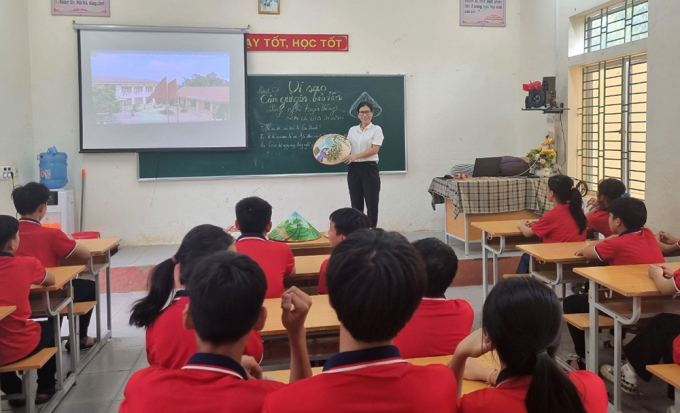
Ms. Tâm uses a conical hat during a Literature lesson at Gia Thanh Secondary School, Phu Tho province. Photo: Tran Thi Minh Tâm
Teacher Thuy said that Gia Thanh has a famous traditional craft village for making conical hats, which has been around for nearly 100 years. Since taking up his position in March, he has always felt responsible for preserving and promoting the hat-making craft, so he and the teachers at the school established a STEM club for making conical hats. To make lessons easier to understand, teachers and students have devised ways to incorporate the traditional conical hat into various subjects.
Ms. Tran Thi Minh Tam, a literature teacher and head of the school's STEM club, observes that the craft of making conical hats is gradually dying out, and not many young people today know about them.
"If we don't incorporate local conical hats into education and awareness campaigns aimed at preserving them, perhaps one day this craft will no longer be passed on," Ms. Tam explained.
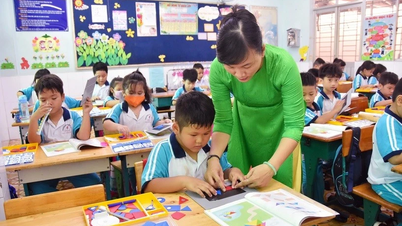
The application of STEM education using conical hats has been implemented at Gia Thanh School since 2022. For example, in Mathematics, students apply formulas to calculate the area, perimeter, diameter, or distance between the brim and rim of the conical hat, and then design the hat mold.
In Chemistry class, students learn about the processes involved in treating leaves, such as soaking, drying, and air-drying, as well as the chemicals used to preserve leaves, prevent mold, and extend their shelf life.
In Art class, students practice drawing landscapes of Phu Tho's countryside to decorate conical hats, thereby fostering in them a love for their homeland and country.
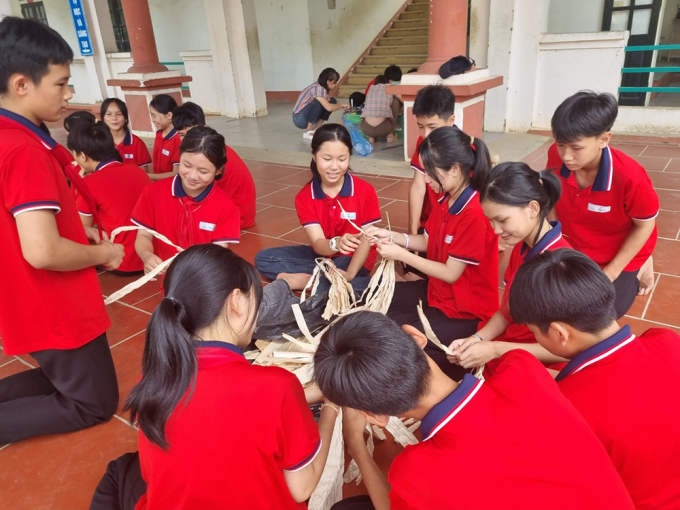
Students apply their knowledge of Chemistry when learning about the process of processing palm leaves. Photo: Tran Thi Minh Tam
In the subjects of local education and Literature and History, Ms. Tâm helps students understand the meaning and origin of conical hats in Vietnamese villages. They also encounter folk songs, poems, and songs that feature images of conical hats.
Ms. Tam said that making conical hats is a daily job for mothers and grandmothers, so the students initially found it normal. However, when the conical hat was incorporated into STEM education activities, the students became very interested.
"The school's STEM club is very effective; quite a few students know how to sew hats and make products at school," she said.
According to Ms. Tam, the UNESCO award is of great significance to teachers, encouraging them to innovate even more in their teaching.
"I am very proud that our initiative has spread. I hope that more agencies and departments will learn about it and provide support to help people in the commune or schools develop the model we are implementing even further," Ms. Tam shared.
Dawn
Source link
![[Live] 2025 Community Action Awards Gala](/_next/image?url=https%3A%2F%2Fvphoto.vietnam.vn%2Fthumb%2F1200x675%2Fvietnam%2Fresource%2FIMAGE%2F2025%2F12%2F16%2F1765899631650_ndo_tr_z7334013144784-9f9fe10a6d63584c85aff40f2957c250-jpg.webp&w=3840&q=75)


![[Photo] Prime Minister Pham Minh Chinh receives the Governor of Tochigi Province (Japan)](/_next/image?url=https%3A%2F%2Fvphoto.vietnam.vn%2Fthumb%2F1200x675%2Fvietnam%2Fresource%2FIMAGE%2F2025%2F12%2F16%2F1765892133176_dsc-8082-6425-jpg.webp&w=3840&q=75)
![[Image] The tenacious fighting spirit of Vietnamese women's football](/_next/image?url=https%3A%2F%2Fvphoto.vietnam.vn%2Fthumb%2F1200x675%2Fvietnam%2Fresource%2FIMAGE%2F2025%2F12%2F17%2F1765990260956_ndo_br_4224760955870434771-copy-jpg.webp&w=3840&q=75)









































































Comment (0)