

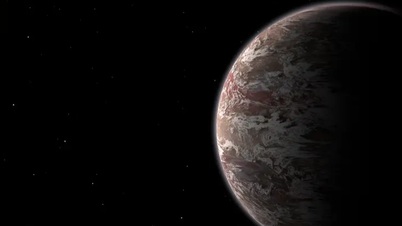
Astronomers have discovered that the planet WASP-69 b possesses a long, comet-like tail, measuring over 563,000 km in length, or 44 times the width of Earth.
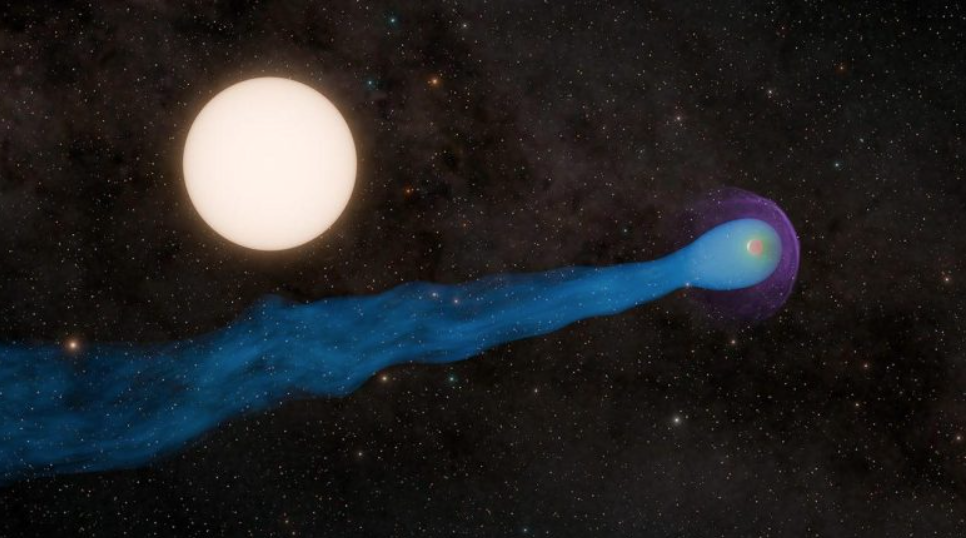
A simulated image of the planet WASP-69 b with its 'tail'.
A team of experts from the University of California, Los Angeles (USA) says that the planet WASP-69 b is a gas giant with a size similar to Jupiter.
The planet is orbiting a star located approximately 160 light-years from Earth. The distance between WASP-69 and its central star is very close, with the planet completing only 3.9 days to orbit the star.
Since the discovery of WASP-69 in 2014, scientists have found that the object they are studying is losing its atmosphere at an alarming rate. Every second, the planet loses up to 200,000 tons of gas, mostly helium and some hydrogen.
At this rate, WASP-69 is likely to lose seven times the mass of the Earth during its lifetime, estimated at around 7 billion years.
Atmospheric leakage, combined with the influence of the central star, has created conditions that allow WASP-69 to "grow a tail" as it travels through space.
Previously, scientists suspected that WASP-69 b might possess a comet-like tail, but this had never been proven until recently.
A report published in the journal Astronomy and Astrophysics presents an analysis by American researchers based on data collected from the WM Keck Observatory on Maunakea volcano (Hawaii).
The results show that the planet does indeed have a tail, measuring over 563,000 km in length, which is 44 times the width of Earth.
WASP-69 b's tail formed when a "stellar wind" phenomenon blew away vaporized atmosphere from the planet, creating a long tail along its path.
Stellar wind, similar to solar wind, is a stream of charged particles emanating from a star. If stellar wind were to disappear, the planet's tail would also cease to exist.
Source: https://thanhnien.vn/xac-nhan-hanh-tinh-voi-cai-duoi-khong-lo-gan-trai-dat-185241215105957713.htm




![[Photo] General Secretary and President To Lam presides over a meeting on preparations for the review of one year of operation of the three-tiered government system.](https://vphoto.vietnam.vn/thumb/1200x675/vietnam/resource/IMAGE/2026/06/02/1780391821195_a1-bnd-4595-9717-jpg.webp)
























































































Comment (0)