

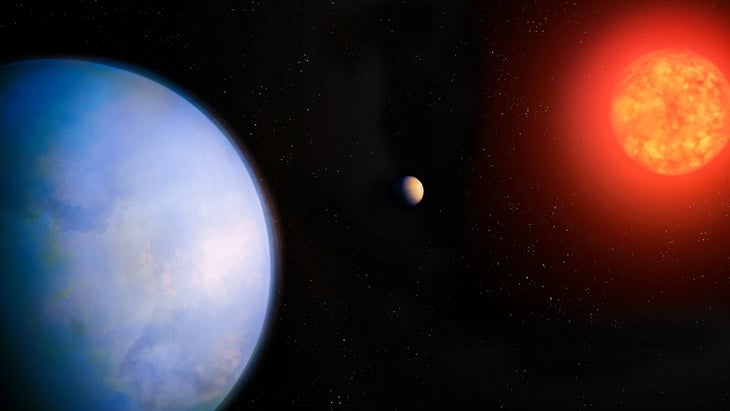
Artist's impression of GJ 251c in the foreground with planet GJ 251 b, in the background, closer to its red dwarf star - Image: University of California
This planet, named GJ 251c, orbits a red dwarf star in the constellation Gemini, only about 18.2 light-years from Earth. With a mass approximately four times that of Earth, GJ 251c is classified as a "super-Earth," meaning rocky planets that are larger and more massive than Earth but smaller than Neptune.
"We cannot yet confirm whether this planet has an atmosphere or life, but it is a promising candidate for future research missions," said Professor Suvrath Mahadevan, Penn State University (USA).
GJ 251c was discovered using radial velocity, a method that tracks the very small oscillations of a star under the gravitational influence of its orbiting planet. After more than 20 years of continuous observation, the research team recorded the characteristic "slight wobble" of GJ 251, revealing the existence of this new planet.
The GJ 251 star system was previously known for another planet, GJ 251b, discovered in 2020. By combining old and new data obtained from telescopes in the US, the team of scientists used the Habitable-Zone Planet Finder (HPF) spectrograph at the McDonald Observatory (Texas) and the NEID spectrograph at Kitt Peak (Arizona) to confirm a second signal, corresponding to the planet GJ 251c, which has an orbital period of 54 days around its host star.
According to scientists, GJ 251c lies just inside the habitable zone, the most important factor for life as we know it, where liquid water can exist. However, determining whether the planet has an atmosphere, or whether it has been stripped of its atmosphere by radiation from its host star, is still an open question.
The host star GJ 251 is a red dwarf, the most common type of star in the Milky Way, but it is also famous for its "hot temper", regularly erupting extremely powerful magnetic storms that can "strip" the atmospheres of surrounding planets.
Famous systems like TRAPPIST-1 or Proxima Centauri b were once expected to harbor life, but observations from the James Webb Space Telescope (JWST) show that most of these planets no longer have significant atmospheres.
However, GJ 251c may be an exception. Because its star is hotter and slightly larger than other red dwarfs, the habitable zone is also further away, helping the planet to somewhat avoid the wrath of its host. If GJ 251c has a strong magnetic field and a thick atmosphere, it could protect itself from stellar winds and maintain stable conditions for life.
The James Webb Space Telescope is currently unable to examine the atmosphere of this planet because of its distance and low brightness. Scientists hope that next-generation telescopes such as the Habitable Worlds Observatory, scheduled to launch in the 2040s, will be able to directly collect light reflected from GJ 251c and determine its atmospheric composition.
"We are at the edge of technological limits. We need larger, more precise telescopes to be able to 'see' this world ," said researcher Corey Beard, University of California Irvine.
The discovery of GJ 251c is a significant step forward in the search for habitable worlds. But whether GJ 251c is truly a 'home away from home' remains to be seen.
The study was published on October 23rd in The Astronomical Journal.
Source: https://tuoitre.vn/bat-ngo-phat-hien-sieu-trai-dat-cach-chung-ta-chua-day-20-nam-anh-sang-20251025113016917.htm
















![[Video] AI application for early detection of common diseases on cassava plants](https://vphoto.vietnam.vn/thumb/402x226/vietnam/resource/IMAGE/2025/12/10/1765328634749_avatar-of-video-1038119-png.webp)














![[Photo] Urgently help people soon have a place to live and stabilize their lives](/_next/image?url=https%3A%2F%2Fvphoto.vietnam.vn%2Fthumb%2F1200x675%2Fvietnam%2Fresource%2FIMAGE%2F2025%2F12%2F09%2F1765248230297_c-jpg.webp&w=3840&q=75)











































































Comment (0)