

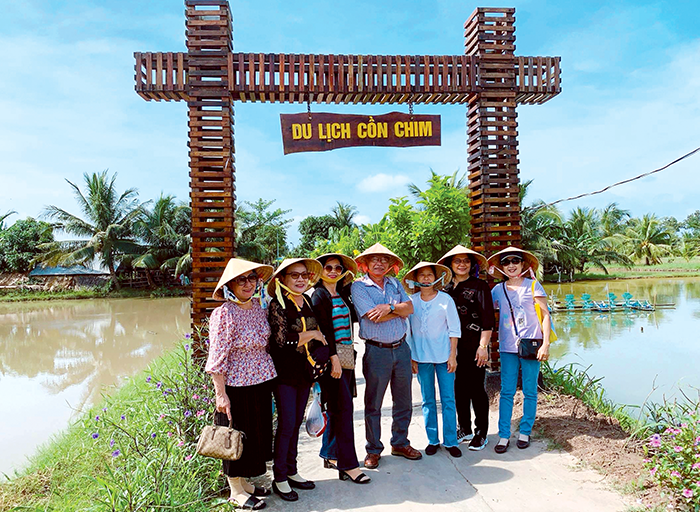
Tourists visiting Chim Island.
Building a scoring model
The Vietnam Tourism Association has proposed the implementation of the project "Building an effective tourism destination management model with the participation of stakeholders towards a green, plastic-free, and low-carbon tourism environment" (the Project), with support from the United Nations Development Programme (UNDP). This is a practical action to promote the green and sustainable development of Vietnamese tourism.
Mr. Vu The Binh, Chairman of the Vietnam Tourism Association, stated that developing green tourism is an inevitable direction. Destination management plays a crucial role, as destinations encompass all necessary tourism services. Focusing on building green tourism destination models will encompass all tourism activities in a green direction. Accordingly, building model destinations through the Project will help to fulfill the necessary criteria.
Specifically, the project aims to build an integrated tourism destination management model with the participation of stakeholders, serving as a foundation for the implementation, monitoring, and evaluation of green tourism development activities. Simultaneously, it seeks to communicate and raise awareness among stakeholders (government agencies, businesses, and local communities) about green transformation in the tourism industry linked to biodiversity conservation and climate change mitigation; and to establish mechanisms for replicating the model, transferring knowledge, providing technical guidance, and sharing lessons learned with localities nationwide.
The project's main activities focus on three key areas: raising awareness of green tourism among the private sector and communities; developing destination management models based on green criteria; and implementing a set of criteria for plastic-free tourism, aiming to reduce carbon emissions.
The project aims to achieve the following goals: at least 80% of participating businesses reducing plastic waste by 30%; at least 120 people trained in green destination management; the issuance of a set of green destination criteria; and the development and operation of a destination management application. According to the plan, the project will be piloted at the Tay Yen Tu spiritual and ecological tourism area ( Bac Ninh province ), serving as a basis for issuing a unified framework of criteria for green tourism destination management nationwide.
When each destination becomes a green tourism space, free of plastic waste and excess carbon, Vietnamese tourism will create a new image of sustainable development, adapting to the environment - where people live in harmony with nature.
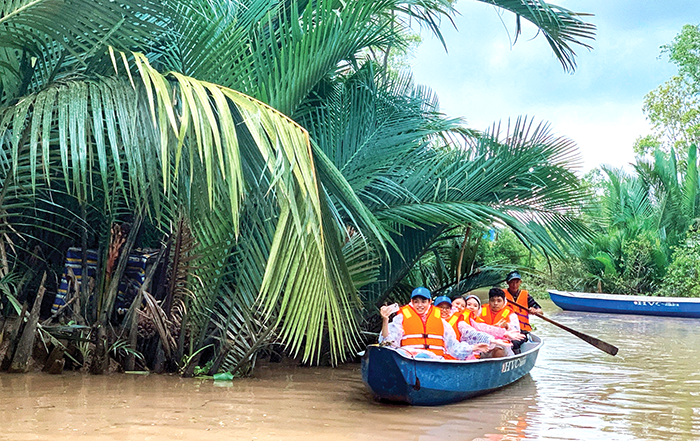
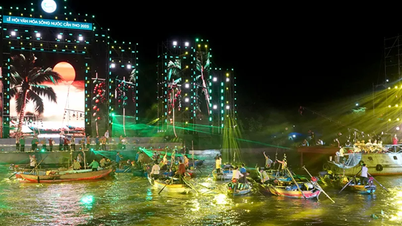
Tourists experience the " Can Tho - Road to Net Zero" program.
Actions for sustainable tourism environment in the Mekong Delta
Ms. Huynh Thi Bich Tuyen, owner of Mekong Silt Ecologe (Can Tho), said: “Climate change is strongly impacting many areas, including the Mekong Delta. We, in particular, are committed to preserving the environment and local resources.” Accordingly, Mekong Silt Ecologe offers solutions and experiences to help tourists raise awareness about environmental protection in tourism activities. Specifically, they use environmentally friendly materials such as reeds, water hyacinth, palm fronds, and coconut shells to make items for guests during their stay. In addition, they offer experiential programs and workshops on making soap from organic waste, or rowing boats and stand-up paddleboards along the canals while cleaning up the river environment.
Ms. Huynh Thi Bich Tuyen stated: “When guests are in a green, environmentally friendly space, they will automatically adapt their actions. For example, a guest who stayed at Mekong Silt Ecologe, after experiencing and understanding the environmental messages, acted by turning off all electrical devices when not needed and sorting waste with us. In fact, small actions, when done consistently, create significant changes.” Tourists visiting Mekong Silt Ecologe are gradually forming a group of visitors who appreciate green spaces and take action for the environment.
In the Mekong Delta, there are many environmentally friendly tourism models, such as nature-based tourism in Con Chim islet (Vinh Long). Here, people practice agriculture in a natural way. Ms. Nguyen Thi Bich Van, Head of the Con Chim Community Tourism Cooperative, said: “Here, people still cultivate rice and garden in a natural, traditional way. Whatever each household has, they use it to create products and services for tourists to experience.” Con Chim is nổi prominent for its “shrimp embracing rice” agricultural model, adapted to an environment frequently affected by saltwater intrusion. This model not only produces clean rice and shrimp but also offers a unique environmental tourism experience, harmoniously combining agriculture, tourism, and the environment in a sustainable manner.
Developing green tourism linked to environmental protection is no longer just a trend; many tourism businesses have now clearly defined long-term strategies for sustainable development. Many destinations and tourism businesses also have criteria or action programs for green tourism. For example, Son Island (Can Tho) has agricultural tourism combined with protecting the aquatic resources of the Hau River; Muoi Ngọt community tourism (Ca Mau) is linked to protecting mangrove forests; farmstays combined with community tourism in Dong Thap; or ecotourism projects like "Net Zero tour Ben Tre" (Vinh Long) and "Can Tho - Road to Net Zero" developed by tourism businesses in collaboration with local communities.
Each model has its own unique features, impacting tourists' environmental awareness and actions in different ways. However, there is still a need for common guidelines and criteria for green and sustainable tourism, building a sustainable tourism brand system to position green destinations. Therefore, the project "Building an effective tourism destination management model with stakeholder participation towards a green, plastic-free, and low-carbon tourism environment" is necessary to form a sustainable green tourism value system.
Text and photos: AI LAM
Source: https://baocantho.com.vn/xay-dung-khong-gian-du-lich-ben-vung-a193583.html



![[Photo] Xuan Son scores a brace, Vietnam wins 3-1 against Malaysia.](https://vphoto.vietnam.vn/thumb/1200x675/vietnam/resource/IMAGE/2026/03/31/1774971675344_ndo_br_52b4d11dd25c53020a4d-copy-jpg.webp)



![[Photo] Hue is breathtakingly beautiful during the season when the paulownia trees bloom.](https://vphoto.vietnam.vn/thumb/402x226/vietnam/resource/IMAGE/2026/04/01/1775007083317_anh-hue-dep-nao-lo_615_1775006800.png)







![[Photo] Da Nang: Exploring the inside of Vietnam's largest "sail" symbol.](https://vphoto.vietnam.vn/thumb/1200x675/vietnam/resource/IMAGE/2026/03/31/1774964764698_ndo_br_anhcau1-jpg.webp)





















































Comment (0)